
Written by: Rasim Belko
The conclusion that the European Council reached back in 2017, and renewed continuously, began to irritate Croatian politics and diplomacy because it seriously threatened their hegemonic interests, striking at one of the key strategies of official Zagreb - the principle of constituent peoples.
In October 2017, point 4 of the European Council conclusions stated: "While acknowledging that the Constitution of Bosnia and Herzegovina lists Bosniaks, Croats and Serbs as constituent peoples (together with Others), the Council reiterates that the principles of equality of all citizens and non-discrimination must be fully ensured. The Council stresses that no legislative or political steps should be taken that would impede the implementation of the Sejdić-Finci ruling and related rulings."
Conscious of the danger to the entire concept of its approach to Bosnia and Herzegovina, the Republic of Croatia, as an EU member state, set out during November and December 2024 to find partners within the Union to ensure that the Council conclusions on Bosnia and Herzegovina only mention constituent peoples, without mentioning citizens.
Information from the Patria Agency indicates that the action was on a broad diplomatic front, from Madrid, via Paris and Berlin, to Rome and Budapest, which currently holds the presidency of the European Council.
However, they were rejected one after another, so they found their only ally, such as it was, in Hungary, which did not directly support the Croatian proposal but allowed them passage through diplomatic channels to attempt to realise the idea.
Until yesterday, Croatian diplomacy was quite confident that it had succeeded, and a triumphant statement was even prepared about how the European Council had recognised only the constituent principle, and not the civic affiliation in Bosnia and Herzegovina. However, after the publication of the conclusions, silence and hush fell over Zagreb, because the conclusions were a cold shower.
Article 65 of the European Council conclusions states: "The Council welcomes the commitment of the political leadership which has delivered concrete results and contributed to the March decision to open accession negotiations, but notes with regret that the reform momentum has stalled since then. The Council calls on all political actors to renew the country's focus on progress on the EU path by taking decisive steps to implement the necessary reforms. Bosnia and Herzegovina should appoint a Chief Negotiator and a national IPA Coordinator under the Instrument for Pre-accession Assistance (IPA) III, as well as develop a national programme for the adoption of the EU acquis. The Council recalls the importance of ensuring the alignment of all adopted laws with the EU acquis and European standards, including the recommendations of the Venice Commission."
Thus, apart from criticism directed at the current rulers in Bosnia and Herzegovina, the European Council demands from Bosnia and Herzegovina a programme for adopting the EU acquis. In other words, to eliminate discrimination from the Constitution and laws and align with the Union's rules. At the same time, Article 65 completely exposed and brought to the wall of truth all the experts and political pawns who, during the election of Marin Vukoje to the Constitutional Court of Bosnia and Herzegovina, convinced us that the opinion of the Venice Commission is not important. It turns out that it is, and as a condition of our integration, so the question is whether the stubborn, immature Trio is aware that by ignoring the opinion of the Venice Commission, they have disabled Bosnia and Herzegovina's European path in the long run.
Article 66 states: "The Council welcomes the fact that the local elections, held in Bosnia and Herzegovina on 6 October 2024 on the basis of the state Election Law, were conducted in a competitive and efficient manner, thereby addressing some of the long-standing ODIHR recommendations. Given the institutional mechanisms set up by the Dayton Peace Agreement, Bosnia and Herzegovina must undertake further constitutional and electoral reforms to ensure equality and non-discrimination of all citizens, in particular through the implementation of the Sejdić-Finci ruling and related rulings of the European Court of Human Rights. The Council reiterates its call for an inclusive process of limited constitutional and electoral reforms through genuine dialogue and in line with European standards in order to eliminate all forms of inequality and discrimination in the electoral process. The Council also recalls that a number of Constitutional Court decisions have still not been fully implemented. No steps should be taken that would impede the implementation of these rulings or further deepen divisions."
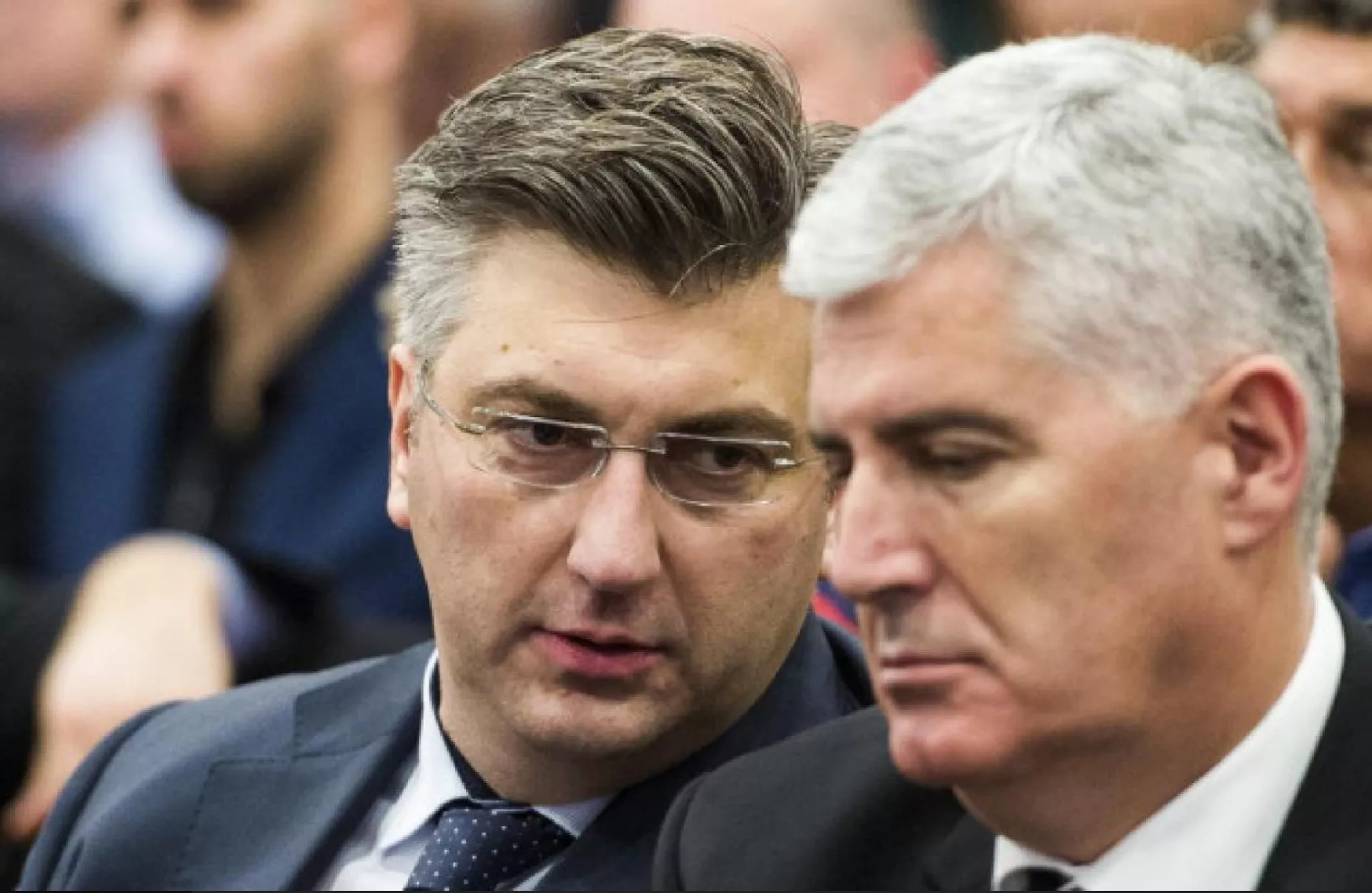
All citizens, then constituent peoples, would roughly be the interpretation due to which yesterday will not remain a fond memory for Plenković, Grlić Radman, Čović, Zovko and others. Because the European Council gave primary attention to the civic, and only then to the constituent principle. But, with an emphasised message that constitutional and electoral reforms should take care and prevent discrimination, and implement the rulings of the European Court of Human Rights.
Interpreting the conclusions, the Council for the Democratisation of Politics also spoke out yesterday, but with the wrong assumption that the European Council, under unimplemented Constitutional Court decisions, alludes to the decision in the Ljubić case, but that is not there. Because High Representative Christian Schmidt, when amending the Election Law, stated that this implemented the decision in the Ljubić case, and the only one that has not been implemented even today is the "Komšić" case, which decided that Others should sit in the leadership of the Federation of Bosnia and Herzegovina.
Nevertheless, sources claim that the closest to the truth is that the European Council meant a broader context and decisions that are not implemented due to the arbitrariness of Milorad Dodik and the authorities in the Republika Srpska.
A serious struggle was waged, according to Patria sources, over the past month, and what is interesting is that the Ministry of Foreign Affairs and Elmedin Konaković did not take part in defending the interests of Bosnia and Herzegovina. And the diplomatic network is primarily tasked with dealing with those interests, but Konaković does not care about these issues.
In the end, the most important thing is that Croatia did not succeed in capturing Bosnia and Herzegovina with medieval values on the path of its destruction. The European Union did, by protecting its own values through focusing on citizens and only then on the constituent peoples. The question that remains after all this is the anxiety of what happens when Bosnia and Herzegovina is left without those people who are ready to fight for its interests from the shadows and through private connections, while we pay 'konakovićs', 'bećirovićs and the like' to defend those interests.
One important battle has been won, but the end of the war is not yet in sight.
Komentari (0)
Prijavite se za komentiranje
PrijavaJos nema komentara. Budite prvi!
Minuta
Sve →Iz drugih kategorija

High Representative Not Elected: Germans, French and British Against Americans, New Attempt at End of June

ČOVIĆ WITHOUT MERCY: How Those Who Brought Ademović to Office Created a Political Hell for Him



Sunny Saturday, quite warm



Tragedy in Albanian resort: Two minors drown












