
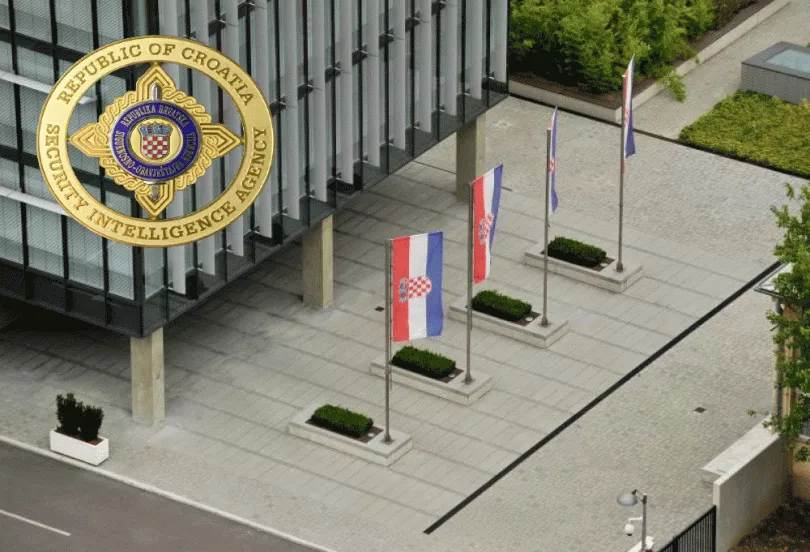
(Patria) - The Security and Intelligence Agency of Croatia (SOA) has published a report in which Bosnia and Herzegovina is mentioned in several places.
"Bosnia and Herzegovina, which shares the longest mutual border with the Republic of Croatia and in which Croats are one of the three constituent peoples, is still burdened by internal political instability. This instability stems from the different positions of the dominant political options of the three peoples regarding the fundamental principles of the Dayton Peace Agreement and the Constitution of BiH, as well as the issue of further centralization of the state. In doing so, the basic principles of the Dayton Peace Agreement can be presented through the formula 1:2:3; a unique BiH, composed of two entities (Republika Srpska and the Federation of BiH) and three equal, constituent peoples (Bosniaks, Serbs and Croats)", the report states, where, intentionally or not, it was inserted that BiH is composed of two entities, which is unconstitutional, because BiH consists of, and is not composed of.
Furthermore, the SOA, which was heavily involved in the events surrounding the amendments to the Election Law, states that 'the fundamental issue of dispute during 2022 was the principle of constitutionality, i.e., the equal status of each of the three peoples in the institutions of BiH, regardless of their number'.
"Croats in BiH, as the smallest people, advocate for the preservation of the principle of constitutionality, as well as a decentralized state structure because it guarantees them political equality with the other two peoples.
Bosniak national parties are dissatisfied with this principle because they believe that Bosniaks, as a people who according to the 2013 census make up 50% of the population in BiH, should be proportionally represented in the representative and executive bodies of BiH. Political parties without a national prefix in BiH (so-called civic parties, whose electorate is predominantly in majority-Bosniak areas) also believe that the principle of constitutionality should be abolished, and representative and executive bodies should be filled regardless of national determinants", the Report states.
They note that, in addition to abolishing or diminishing the principle of constitutionality of the three peoples, Bosniak and so-called civic political parties also advocate for greater centralization in BiH.
"Therefore, the issue of the election law, especially during the election year of 2022, emerged as key for the further implementation of the provisions of the Constitution of BiH and the principles of the Dayton Peace Agreement. Namely, the existing election law in BiH is burdened by rulings of the Constitutional Court of BiH and the European Court of Human Rights (ECHR), which declared certain of its provisions unconstitutional, i.e., discriminatory.
At the same time, Croats are dissatisfied with it because it enables the 'outvoting of Croats', i.e., it gives the possibility for voters from among other peoples to elect political representatives for Croats.
The implementation of court rulings on the election law is one of the EU's demands on BiH for obtaining candidate status for EU entry. Negotiations among the leading political parties of BiH in the pre-election period were not successful, and no changes were made to the election law, i.e., the rulings of the Constitutional Court of BiH in the Ljubić case and the ECHR in the Sejdić-Finci case were not implemented, so the general elections in October 2022 in BiH were conducted under the existing election rules", the SOA states.
The SOA sees the protests in front of the OHR as pressure on Christian Schmidt.
"The High Representative's attempt to impose part of the amendments to the election law in July 2022 caused organized protests in Sarajevo with the participation of certain leading figures from Bosniak and so-called civic political parties. The protests were accompanied by media pressure on the High Representative, and numerous threats of violence against him were recorded on social networks.
The High Representative then postponed the imposition of the proposed amendments until the completion of the general elections in October 2022. After the elections, the High Representative made several decisions aimed at unblocking the process of forming the Government in the Federation of BiH. The diversity of views on the rules of the electoral process creates tensions in the political, public and media space of BiH. Diminishing the constitutionally guaranteed equality of the three peoples in BiH undermines the constitutional order of BiH based on the Dayton Peace Agreement, and could further destabilize BiH and negatively affect inter-ethnic relations, the multi-ethnic character and the democratic legitimacy of the political system of BiH", the SOA states.
The SOA is particularly concerned about the abolition of constitutionality.
"The abolition of the constitutionality of Croats in BiH would prevent the equal influence of Croats on the further social, economic, foreign policy, i.e., Euro-Atlantic direction of BiH's development. In such complex political-social circumstances, the presence of international forces in BiH and the activities of the High Representative continue to serve as a factor of stability and peaceful resolution of disputes", the report states.
At the same time, geopolitical circumstances, the SOA adds, also affect the attitudes of the international community in BiH, so on certain issues regarding the future of BiH, there is no international consensus.
"For example, Russia has not participated in the Steering Board of the Peace Implementation Council since July 2021 because it believes that the current High Representative was not elected in accordance with the prescribed procedure. The situation in BiH also attracts the attention of other non-European and non-Western state actors. Internal political turmoil has prevented the processes of BiH's approximation to Euro-Atlantic integrations. In doing so, Croatian, Bosniak and so-called civic parties generally advocate for BiH's entry into the EU and NATO, while Serbian parties oppose BiH's approximation to NATO and some of them do not hide their connection with Russian political actors", the published SOA report states.
Komentari (0)
Prijavite se za komentiranje
PrijavaJos nema komentara. Budite prvi!
Minuta
Sve →Iz drugih kategorija

High Representative Not Elected: Germans, French and British Sabotaged Americans, New Attempt at End of June

ČOVIĆ WITHOUT MERCY: How Those Who Brought Ademović to Office Created a Political Hell for Him



Sunny Saturday, quite warm



Tragedy in Albanian resort: Two minors drown












