
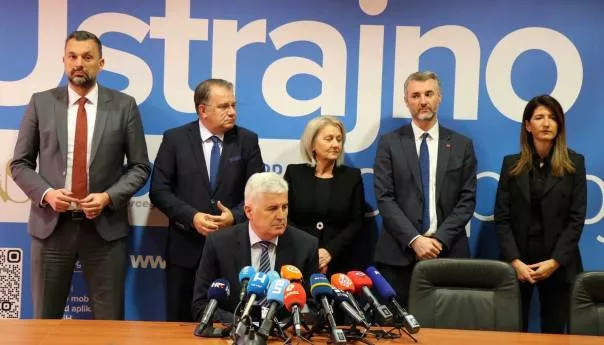
(Patria) - From the group of parties rallying around Elmedin Konaković and Nermin Nikšić, it is announced day after day that the story about forming the new Council of Ministers will be completed by the end of the month.
The names of the ministers in the new composition of the Council of Ministers are also known.
What is evident is that SNSD and HDZ will have complete control over the Council of Ministers of Bosnia and Herzegovina, given that the group of parties gathered around Konaković and Nikšić, which is called one thing today and another tomorrow, for the nationally undecided Edin Forto (who is literally running away from the position of Prime Minister of Sarajevo Canton, leaving it in millions of debt) is ready to hand over the majority in the Council of Ministers to the political enemies of the state.
Thus, official Zagreb and official Belgrade, through their branches in Bosnia and Herzegovina, HDZ and SNSD, will dominate the state government in Bosnia and Herzegovina. Zukan Helez and Elmedin Konaković, as representatives of the demographic majority who are also, however absurd it may sound, the political minority in Bosnia and Herzegovina, will only represent figureheads in the new Council of Ministers.
Helez and Konaković will not be able to stop any decision of the new Council of Ministers with their votes, nor the implementation of the political will of Belgrade and Zagreb. It is naive to believe that the Deputy Chairperson of the Council of Ministers (in this case, Konaković) will remove from the agenda of the Council of Ministers' sessions everything that is harmful to the interests of the state of Bosnia and Herzegovina every time, because in that case he would be declared a person blocking the decision-making process, and Konaković builds his political agenda precisely on opposite political premises; unblocking, relaxation, and the like.
It is clear even to the last political layman that the formation of the Council of Ministers on such grounds represents a radical weakening of state political positions and interests. Even if we were to disregard the fact that Dragan Čović and Milorad Dodik are already presenting invoices for signed party agreements before the ministers have even taken their seats, in the form of demands for state property and the election law; even if we were to disregard that, and assume that bad solutions will not occur, one cannot escape the impression that the Bosniak, and the overall Bosnian political factor in the announced Council of Ministers is completely marginalized.
Furthermore, it can be stated that in a political sense, Bosnia and Herzegovina has been taken fifty years back, to the period before the 1971 census, to the period when we had Serbs, Croats, and Undecided as political categories in Bosnia and Herzegovina. Today, it is clear that Serbs in Bosnia and Herzegovina are represented by Milorad Dodik, Croats by Dragan Čović, and Bosniaks are not represented by anyone, because the third ethnic political unit has been occupied by the nationally undecided Forto, whom, to be truthful, Čović and Dodik attribute to Bosniaks. Perhaps rightly so.
Of course, there remains a small possibility that Elmedin Konaković and Zukan Helez will realize that the people in whose name they are supposedly taking office, in order to be a political minority in their own country, should not be taken back more than fifty years and politically de-subjectivized for the sake of their positions. Of course, there remains a possibility that Helez and Konaković will ask for the cards to be reshuffled differently, but this is indeed a small possibility, given the impression that neither SDP nor NIP have problems with self-Palestinization.
However, self-Palestinization is not the only problem when it comes to the new Council of Ministers of BiH. Perhaps Bosniaks can somehow accept being second-class citizens in their own country. We say perhaps because we do not see any valid political or social resistance to the unprecedented political self-humiliation and self-degradation, but it is difficult for them to agree to an incompetent composition of the new Council of Ministers, to various Nešići, and Čović's strange personnel solutions, etc...
Bosniaks are one thing, and state parliamentarians are another. By the end of the month, it will be known whether there are enough state parliamentarians from the Bosniak or Bosnian political spectrum who are willing to vote for the formation of an incompetent and self-Palestinizing Council of Ministers of BiH.
Komentari (0)
Prijavite se za komentiranje
PrijavaJos nema komentara. Budite prvi!
Minuta
Sve →Iz drugih kategorija

High Representative Not Elected: Germans, French and British Sabotaged Americans, New Attempt at End of June

ČOVIĆ WITHOUT MERCY: How Those Who Brought Ademović to Office Created a Political Hell for Him



Sunny Saturday, quite warm



Tragedy in Albanian resort: Two minors drown












