By Rasim Belko
Imagine that in the time when the terrorist organization ISIS was sowing death in the East and West, someone in Istanbul, Sarajevo, or another country organized a march for "suffering brothers." It is difficult to imagine, because no normal person will march for terrorists.
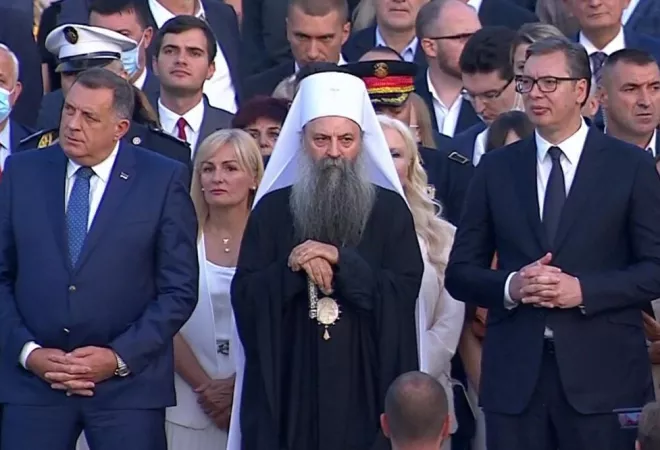
Except for the followers of separatist Milorad Dodik. Last night in Banja Luka, they marched for their "brothers" in Kosovo, i.e., for the terrorists who attacked the police of independent Kosovo. And thus, they clearly refuted all the nonsense of analysts who do not see the connection between the Kosovo and Bosnian problems, although it is quite clear.
Both problems contain identical causes, in Belgrade, Banja Luka, and Moscow. And for each of these causes, the agitation of the situation in Kosovo or Bosnia and Herzegovina is beneficial within strategic plans.
It will turn out to be a good ace up Vučić's sleeve for internal affairs because elections are coming, and in the meantime, he will continue to lament the necessity of the Community of Serb Municipalities as salvation for Serbdom in Kosovo and announce a possible uprising if the CSM is not formed.
The Kosovo showdown also suited Milorad Dodik because he has been targeted as the key destabilizer in the Western Balkans for months. Now he breathes a little easier.
Moscow benefits most from all of this because it diverts attention from the Ukrainian front and, in a way, shows the West its strength and ability to undermine the already fragile peace.
And the West?
Well, the story is a little different in the West. They view Kosovo and Bosnia and Herzegovina as different objects.
The attack committed in the village of Banjska in Kosovo is a problem for the stability of the Western Balkans for many in the West, and according to their stance, Western diplomacy must deal with it.
Even one of the most rigorous measures is proposed: imposing sanctions on Serbia for everything, and NATO is called upon to be ready and decisive to act. The international beehive has been stirred every time someone lights a torch in Kosovo, especially when masked bandits with Serbian insignia and weapons appear in the north of that country, ready for a frontal conflict with Kosovo's security agencies.
A month earlier, in a country about five hundred kilometers away from Kosovo, with identical causes, political rallies organized by Milorad Dodik and his separatist movement SNSD began. Supporters of the separatist leader took to the streets in concert with slogans of "the border exists," accompanied by the police of Republika Srpska, convicted of genocide. They blocked road communications, contrary to the Constitution and the Dayton Peace Agreement.
However, unlike the Kosovo problem, for Western diplomats and politicians, this was not a threat to the stability of the Western Balkans. For three decades, the West has been repeating the same mistakes in Bosnia and Herzegovina, ignoring Serbian nationalism, radicalism, and separatism until it reaches a breaking point. And then, in a rush against time, it finds solutions that leave room for the continuation of chaos.
Dodik now has police and weapons, he has money and power. Those who attacked BiH with Serbia in the nineties did not have this, and especially not the Serbs from the north of Kosovo. After all, Dodik has institutions behind him that absolutely control processes in 48 percent of BiH's territory.
And therefore, it is unclear how the West does not see the patterns of terrorist action by Dodik and his structures. How is it that 30 people cause something that the West acknowledges as a terrorist act, while Dodik's actions, which have maintained tension and fear for two decades, are not terrorism against the population and the state of BiH and destabilizing for the Balkans.
Similarly, attacks on the non-Serb population in the Serb entity are not considered terrorist actions. If the non-Serb population of the Republika Srpska entity continuously warns that they are not safe in their homes, what is that if not institutional terrorism that bypasses the international community, which turns a blind eye to such things in Bosnia and Herzegovina.
The sole purpose of terrorism is to intimidate the population in the interest of certain policies. And there is no doubt that the terrorism of the institutions and the president of Republika Srpska against citizens of non-Serb ethnicity and the state of Bosnia and Herzegovina has the same goal as the terrorism of Serbian mercenaries in Kosovo.
The fact that the methods are different should not deceive anyone, especially not world leaders who decide our destinies.
Therefore, it is worrying that in its official stance on the events in Kosovo, the European Union says: "It was unequivocally a terrorist attack," while on the other hand, EU officials try to present the situation in Bosnia and Herzegovina as progress despite the terrorist actions not of special units, but of the institutions of Republika Srpska and its police.
Thus, the practice continues that terrorism is whatever Western diplomats say it is, regardless of the established definitions of terrorism.
Bosnia and Herzegovina is continuously under political terror, its institutions and order are under continuous blows and attacks. Therefore, what Serbia and Russia carry out occasionally in Kosovo, Dodik and the institutions of Republika Srpska have been doing in BiH for more than two decades!
But perhaps it is a plan, and therefore it is not terrorism!
Komentari (0)
Prijavite se za komentiranje
PrijavaJos nema komentara. Budite prvi!
Minuta
Sve →Iz drugih kategorija

High Representative Not Elected: Germans, French and British Sabotaged Americans, New Attempt at End of June

ČOVIĆ WITHOUT MERCY: How Those Who Brought Ademović to Office Created a Political Hell for Him



Sunny Saturday, quite warm



Tragedy in Albanian resort: Two minors drown












