
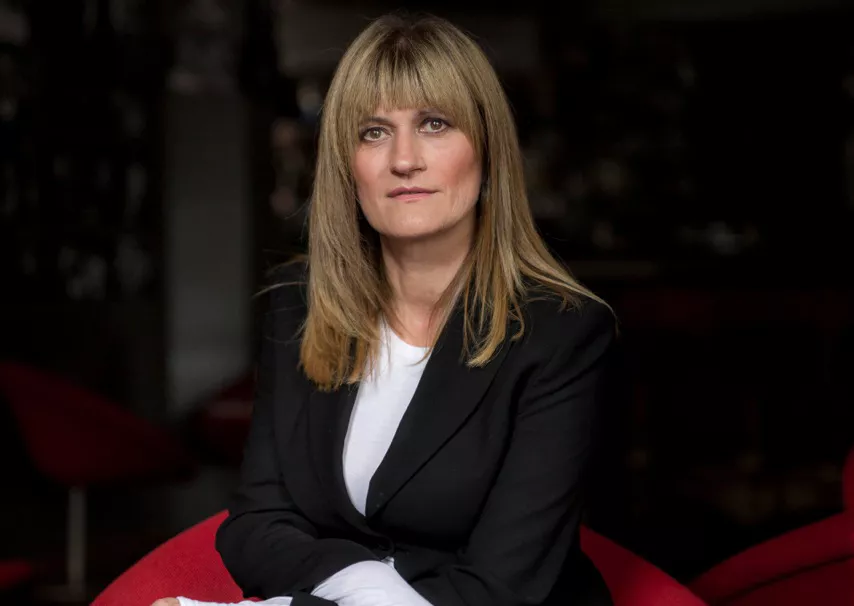
Interviewer: Armin Aljović
Nevenka Tromp is a lecturer at the University of Amsterdam. She is a former associate of Hague prosecutor Geoffrey Nice and the author of a book on the trial of Milošević titled “Death in The Hague: The Unfinished Trial of Slobodan Milošević” (Sarajevo University Press 2019).
In an interview with the Patria News Agency, Tromp discusses the trial proceedings before the Hague Tribunal, the role of politics in these marathon trials, how it is possible for Serbia to go unpunished despite Serbia being the one that caused the wars of the nineties, and shares her views on how much the inertia of Bosniak politics from Sarajevo contributed to the events of the nineties being, as she puts it, wrongly recorded in history.
You stated that the criminal plan for the wars in Croatia, Bosnia and Herzegovina, and Kosovo was conceived in Belgrade under the political leadership of Slobodan Milošević, and that Radovan Karadžić, Ratko Mladić, and others from Republika Srpska were Belgrade’s ‘contractors’. If that is the case, how is it possible that Serbia avoided a verdict from the Hague Tribunal? Is it due to Serbia’s influence on the Hague Tribunal, or are there oversights by the prosecution? Is it even possible to politically influence such a court?
- When I began my research in 2006 on the unfinished trial of Slobodan Milošević, one of the important guidelines to be defined was the judicial processes dealing with mass atrocities. A review of my findings on this topic can be read in the first chapter of the book "Death in The Hague: The Unfinished Trial of Slobodan Milošević" published by Sarajevo University Press. In short, trials for mass atrocities are, by the most neutral definition, always political trials because they deal with political crimes. This means that individuals of a regime whose policies led to mass human rights violations, violence against individuals and groups, armed conflicts, and wars in which international humanitarian law was systematically violated are being tried. Therefore, it is inevitable that when determining criminal intent in individuals accused of mass atrocities, the core criminality of the ideology that shaped the military, political, and criminal plan is touched upon. That is why, for example, in my book, I first distinguish between the Greater Serbian ideology, Milošević as the leader of all Serbs, and the moment his political plan became criminal.
'FINANCING THE WAR IN BIH'
If we now turn to your question about Belgrade's role in the war in Bosnia and Herzegovina and Karadžić and Mladić as ‘contractors’, the beginnings of the creation of the Republika Srpska Krajina in Croatia in 1990, as well as the beginnings of the creation of Republika Srpska in Bosnia and Herzegovina from 1992 onwards, are moments that the Prosecution team identified as key moments when Milošević’s plan to create a post-Yugoslav state became criminal. His slogan “All Serbs in one state” was treated by the Prosecution as a variant of the Serbian state project, calling Milošević’s ideology “de facto Greater Serbia”, because the borders of such a state would be significantly expanded by annexing territories in Croatia and Bosnia and Herzegovina, as Milošević insisted on the principle of ‘self-determination of peoples’, not the principle of ‘self-determination of republics’ as Slovenia, Croatia, and Bosnia and Herzegovina wanted. The principle of ‘self-determination of republics’ was also confirmed by the Robert Badinter International Commission, which Milošević never accepted. The criminality of the Serbian plan, which was planned, organized, and financed by Belgrade, lies in the fact that through its ‘contractors’ in Croatia and Bosnia and Herzegovina, it created the RSK and RS by first pursuing ethnic separation of the Serb and non-Serb populations in territories where there was a Serb population. However, since the ultimate goal was the unification of the RSK and RS with Serbia, territories of the so-called corridors, such as Posavina and Podrinje, were to be conquered. Precisely in areas where the Serbian side had territorial claims, and where the majority population was non-Serb, the most horrific crimes occurred. And let's not forget, the creation of RS through crimes was a plan conceived in Belgrade. In the municipality of Prijedor, mass crimes of a genocidal nature began as early as 1992 and culminated in Podrinje in Srebrenica and Žepa in the summer of 1995. How this territorial conquest was to proceed and how it proceeded was announced by the National Assembly of Republika Srpska on May 12 in a document called Six Strategic Goals, the first of which was precisely the ethnic separation of the Serb and non-Serb populations in territories claimed by the Serbian side, and which are then listed in the remaining five goals.
Milošević and his regime fully financed the war. Belgrade established the 30th and 40th Personnel Centers within the Yugoslav Army (VJ) through which all officers of the Serbian Krajina Army (SVK) and the Army of Republika Srpska (VRS) had a dual role - one in the VJ and the other in the SVK or VRS. All these former JNA, and then VJ officers, received preferential war service credit for the war years starting from August 1990, i.e., from the time of the ‘Balkan Revolution’ in the Knin region. Imagine a situation where General Mladić's war years are counted from the summer of 1991 when, as a JNA officer, he ordered the attack and destruction of Kijevo, a small village in the Knin region with a majority Croatian population. Or for 1995, when he was the chief military commander of the VRS forces that conquered Srebrenica and then killed more than 8,000 Bosniaks. I think it should also be emphasized that from the very beginning of the existence of the RSK and RS, every minister of defense was appointed and paid by the 30th or 40th Personnel Center. Milan Milanović Mrgud testified in great detail about this, showing all the documentation of his appointment and payment method. All VRS officers convicted of genocide in Srebrenica were VJ soldiers. The list of evidence of Belgrade's direct involvement is much longer than can fit into one interview. I will mention only two important things that were not heard enough at the Tribunal. The first concerns evidence showing that Serbia, or the Federal Republic of Yugoslavia (1992-2003), had members of its Ministry of Internal Affairs (MUP) and VJ forces on the ground throughout the wars in Croatia and Bosnia and Herzegovina. I will mention only members of the 63rd Paratrooper Unit of the VJ from Niš and members of the paramilitary unit Škorpioni, which operated in eastern Croatia and in the Trnovo area where that cruel execution of young captured Bosniak civilians in Godinjske bare was filmed. The list of direct presence of VJ and MUP units is quite extensive. The second concerns evidence regarding the de facto power that Milošević had over the political leadership of Republika Srpska. British diplomat Ivor Roberts best described Milošević’s control over Karadžić in his book “Conversations with Milošević” when, during negotiations with Milošević about the release of captured UNPROFOR personnel in June 1995 by the VRS, he received a promise from Milošević that they would be released. Roberts asked Milošević how he could be sure that Karadžić would comply, and Milošević replied that he would send him the message or order through Jovica Stanišić with a clear message that if he did not comply, he would be killed. As we know, the UNPROFOR personnel were released after Stanišić’s visit.
RS survived the war and, with the help of Dayton, persisted as a separate territorial entity in Bosnia and Herzegovina. The political structures of RS do not even try to find a way to coexist with the Federation with the aim of strengthening BiH as a sovereign state, but openly advocate for its secession and unification with Serbia. It is evident that they perceive RS as an intermediate phase of a process whose ultimate goal is the annexation of RS to Serbia. Serbia views RS as its only ‘war booty’ from the wars it waged in the 1990s. The political leadership of Serbia publicly states that the territory of RS is more important to them than Kosovo and that - as far as Belgrade is concerned - any redrawing of its borders would include the annexation of RS to Serbia.
After all this, the official Belgrade still says that the Hague Tribunal is a political court, and that only Serbs were tried there? What is Serbia actually denying? What is the goal of official Belgrade? Because it is evident that people were killed. And they didn't kill themselves?
When Belgrade criticizes the Tribunal as a political court, that criticism suggests that the Tribunal is a political instrument of the powers that created it. According to that interpretation, the trials at the Tribunal are akin to show trials reminiscent of Stalin's era. In my search for answers to questions about the type of judicial processes for mass atrocities, I came across terminology that distinguishes between political, show, politicized, and transformative judicial processes. Regarding the term political courts, especially those established to try individuals for criminal responsibility for mass atrocities, then all such courts and judicial processes dealing with criminal responsibility for mass atrocities are political courts in the most neutral sense. According to this definition, trials of individuals who were part of a criminal plan, whether as politicians who articulated it or as military or police executors of that plan, will always be political trials in some way. Specifically, many of the individuals tried at the Tribunal were representatives of state institutions and in those positions were part of a regime that accepted crimes as a means of achieving geopolitical goals. Show trials are trials whose outcome is known even before the trial begins. These are trials whose goal is not a just verdict but rather they address an audience outside the courtroom, sending a message of threat and fear to all who do not support the regime. Such trials instrumentalize legal form for political purposes, i.e., for eliminating opponents and critics of the ruling regime. The English term for show trials is ‘show trial’, which summarizes the essence of the message such courts are supposed to convey to the public that follows them. In my research, I adopted the term ‘transformative judicial process’ as a working definition. These are trials for political crimes that fall somewhere between the legal and the political, because through their public form, i.e., through trials of individuals for political crimes, they expose past and current political problems to the public, thereby helping society understand what happened and why. For example, the legality and legitimacy of the Tribunal’s establishment from 1993 was challenged by Serbia. From the first defense submissions in the Duško Tadić case, the defense of every Serbian defendant emphasized this issue. Slobodan Milošević claimed that he did not recognize the Tribunal because its establishment was not voted on by the UN General Assembly but was created by the UN Security Council, i.e., a political body represented by the five most powerful world states. The Prosecution responded with a long submission, stating that the legitimacy and legality of the Tribunal were confirmed and accepted by Milošević himself when he signed the Dayton Agreement in December 1995 along with Alija Izetbegović and Franjo Tuđman. In several points of the Dayton Agreement, all three signatories commit to cooperating with the Tribunal. Although I believe that the transformative function of the Tribunal had many positive effects, its legitimacy was undermined most by the victims who, after years of waiting for final verdicts, were exhausted by the waiting and disappointed not only by the verdicts but also by the fact that the Tribunal, for some reason, protected Serbia’s interests through legally unfounded and unjustified consent to protect documents. This affected the final outcome of Hague justice and the Hague truth about the nature of the wars of the 1990s, which will significantly contribute to the arguments of Serbian apologists and deniers of Serbian crimes and Serbia’s role in the genocide in Bosnia and Herzegovina.
'POLITICIZATION OF JUDICIAL PROCEEDINGS'
Finally, attention should also be paid to the politicization of judicial proceedings. The politicization of courts and trials is always harmful and unacceptable, and these politicizations are attempted to be hidden and denied by those who politicize them and by the courts that allow it. Politicization includes various hidden interventions from within or outside the courts, through which certain goals are attempted to be achieved outside of court procedures. In the discussion of this problem, there are those who say that political influences on courts are inevitable and that there is no ‘legal purism’ because every legal system is a reflection of the ideology and political system of every society. However, the problem with political influences on legal processes is that when information about a specific case emerges in public, the Tribunal remains silent about it and denies it, which undermines its credibility. After public disclosure of inadmissible influences on judicial proceedings, such as those presented by judges Frederik Harhoff and Christoph Flugge, Tribunal representatives have never even attempted to explain what it was about, but rather a priori reject any possibility of political influence on the Tribunal’s work. I think this is an unserious defense because if the archives of the EU and the European Commission regarding the negotiations on the cooperation of Serbia and Croatia with the Tribunal are ever opened, we may come to completely different conclusions. However, for now, these archives are closed to the public. I was at a symposium in The Hague a few years ago when someone from the audience asked Mr. Brammertz about political influences. He replied that there were absolutely none, and half an hour later left the symposium saying he was in a hurry to Brussels for a meeting at the EU. Wouldn't it be better to be open and explain when and how certain decisions were made? EU archives are full of material to show what was discussed there and to what extent there were political influences on the Tribunal or through the Tribunal on the countries of former Yugoslavia that expressed a desire to become EU members. After the EU archives, I think it will be most interesting to examine the US archives and see what influences there were and to what extent.
However, one should not forget that it was Serbia that tried from the very beginning, and eventually succeeded, in politicizing the Tribunal in its favor. For example, when Sir Geoffrey Nice went public in April 2007 with the information that hundreds of pages of the most important documents from the state archives of Serbia, or the FRY, were protected under an agreement between Carla del Ponte and the then Minister of Foreign Affairs of Serbia (then the Federation, which was called Serbia and Montenegro from 2003 to 2006) Goran Svilanović from May 2003. Serbia managed to politicize this at the Tribunal through Del Ponte, who accepted it at the time, and from then on, the protection of documents from Belgrade became a permanent practice. Serbia’s motive was to hide from the public all evidence that would implicate the state of Serbia in the crime of genocide, for which it was sued by Bosnia and Herzegovina at the International Court of Justice (ICJ) in The Hague back in 1993. And when in 2007 the ICJ acquitted Serbia of responsibility for genocide, without the ICJ judges having access to the protected VSO documents, it also emerged that under a renewed agreement, this time between Del Ponte and Serbian Minister Rasim Ljajić from 2005, without the involvement of the trial chamber, Del Ponte agreed to it, and Serbia protected documents requested by the Tribunal from the public and other courts at its own discretion. This practice was continued by her successor, Serge Brammertz. As a result of such politicization of the Tribunal, thousands upon thousands of pages that Serbia protected from the public are now inaccessible to all courts. The Tribunal Prosecutor’s Office mentions 3,000 files for crimes committed in Bosnia and Herzegovina handed over to the court in Sarajevo as one of its major achievements, but the question is whether the Sarajevo teams have access to the Tribunal’s evidence through its successor, the Mechanism for International Criminal Tribunals. The success of the Sarajevo indictments will depend on the Mechanism’s willingness to gain access to the protected materials. This is a very sensitive issue because no one knows exactly how much material is protected and under which Tribunal rules. Sarajevo teams have been unsuccessfully seeking evidence of genocide from the court cases of Zdravko Tolimir and Popović and others for some time in order to bring genocide cases. However, much of the necessary evidence is inaccessible. Every trial chamber has the right to protect witnesses and evidence. The question is on what basis did Del Ponte protect documents directly with Belgrade. The answer probably lies in the broad discretionary powers of the Chief Prosecutor’s office itself. It is precisely this power of the Chief Prosecutor that created room for politicization, because it was enough to infiltrate the environment around the Chief Prosecutor to exert direct influence on decisions. Apparently, this is the only thing Serbia thought of exploiting. And it seems to have succeeded.
Serbia understood the power of the Tribunal better than all its post-Yugoslav states and from day one tried with all its might to influence its work. By controlling the documents it was obliged to submit to the Prosecution from its state archives, Serbia thus protected itself before the ICJ from accusations of genocide in Bosnia and Herzegovina. In doing so, it also controlled the historical narrative of its role in the wars. The success Serbia achieved is fascinating and admirable. According to the Tribunal’s verdicts, it appears that the war in Bosnia and Herzegovina was a civil war, as the crimes were reduced to the level of RS and VRS. Serbia, or the connection between individuals from Serbia through a joint criminal enterprise, is not present in any verdict against the accused from RS and VRS. According to the Tribunal, Serbia was not involved in the war in Bosnia and Herzegovina, except for a brief period from April when the war began until May 19, 1992, when the VRS was established. This was established in the Tribunal’s first verdict, where the verdict against Duško Tadić states Serbia’s involvement in the international armed conflict. No verdict criminalizes the Greater Serbian state ideology. Vojislav Šešelj, who openly advocated for it, was acquitted of all charges for the war in Croatia and Bosnia and Herzegovina, and was convicted only for crimes against Croats in Hrtkovci, i.e., in the territory of Serbia. It is precisely because of such verdicts, as far as Serbia is concerned, that the politicization of the Tribunal through controlling the submission and protection of evidence from state archives has paid off.
Could the Bosnian and Herzegovinian side itself have done more in the case of the lawsuits before the Hague Tribunal? What was the role of BiH itself during these marathon trials for war crimes in Bosnia and Herzegovina?
- I think it can now be concluded with certainty that BiH - unlike Serbia - achieved much less than could have been achieved and what the victims rightfully expected. Serbia skillfully played the role of the Tribunal’s biggest critic, while in fact, it was trying to get the best it could for itself all along, and it succeeded. It got away with responsibility for the crimes of genocide in Bosnia and Herzegovina. On the other hand, BiH, on whose territory the Serbian aggression claimed the most lives and left great destruction, welcomed the establishment of the Tribunal and saw great potential in it.
Bosniaks, as well as Kosovars later, were convinced that it was so clear and obvious to everyone who the victims were and who the aggressors were. Few of them even thought that the Tribunal could disappoint them. Because they saw the Tribunal as their salvation and their natural ally. That is why disbelief still prevails among victims in Bosnia and Herzegovina after verdicts that do not assign responsibility for crimes to Belgrade. I often recall a visit to Bakir Sadović, then head of cabinet to President Izetbegović, in the spring of 2011. In a conversation about how these trials of Serbian defendants might end due to the protection of documents, he told me that the Bosniak side placed great hopes in the Tribunal, and therefore could not criticize it. I remember replying that I understood that, but that one could not treat the Tribunal with uncritical adoration as if it were a ‘sacred cow.’ This was only three years after the ICJ verdict, meaning there were still seven years left to identify new documents that would open the way for a revision. Even in 2011, it seemed that the Bosniak side was not ready to take the initiative for a revision or to use the political channel to the UN and raise the issue of Del Ponte’s responsibility for protecting documents from Belgrade. Because how can new documents that ended up at the Tribunal be identified when the Tribunal has been systematically helping Belgrade since 2005 to protect precisely those pieces of evidence from the public that would show the involvement of Serbian state institutions in the crime of genocide in Bosnia and Herzegovina. The answers to these questions could best be provided by the Bosniak members of the Presidency, Haris Silajdžić and Bakir Izetbegović, as representatives of the people who suffered the most in the war, who, by their political function, could have addressed the UN on this issue, which they never did. What is even more indicative is that their representative in The Hague stated in the Bosnian media that it was not true that Carla del Ponte protected documents.
During Alija Izetbegović’s term, i.e., in the first years after the war, BiH was very successful in cooperating with the Tribunal, which then had great legitimacy in BiH society. Vasvija Vidović, who was the first liaison officer with the Tribunal, came to that position based on her professional reputation as a judge and legal advisor. With only a few of her colleagues, she worked tirelessly to uncover traces of crimes and submit evidence from the field and state archives of BiH to the Tribunal. Her cooperation with the first Chief Prosecutors - Richard Goldstone and Louise Arbour - was extremely productive with much mutual respect. With the arrival of Carla del Ponte in the summer of 1999, all that changed. Vasvija Vidović was no longer at The Hague. After Del Ponte’s arrival, a clique formed around her in the Prosecutor’s Office, which acted on its own. I do not know, nor do I have direct knowledge of the role of Vasvija Vidović’s successor as the Bosniak liaison officer in all of this, because in my six years of work on the Milošević case - from 2000 to 2006 - I never saw or even knew who the Bosniak liaison officer was. He never requested a meeting with Geoffrey Nice, who was handling that case. Sir Geoffrey often mentions as an anecdote how the Bosniak liaison officer awarded him a medal of merit when he worked as a prosecutor on the Kordić and Čerkez case, two Bosnian Croats convicted of crimes against Bosniaks in central Bosnia, and how that same liaison officer ignored him while he was working on the Milošević case. Sir Geoffrey often jokes about this and tells everyone that based on the behavior of the Bosniak liaison officer, it seemed that the Bosniak side was more interested in making greater criminals in Bosnia and Herzegovina than Croats, rather than Serbs.
'INJUSTICE TOWARDS GENERAL DELIĆ'
Another issue where BiH missed an opportunity to fight for justice for its citizens at the Tribunal is the verdict for war crimes against the wartime commander of the Army of BiH, General Rasim Delić. During Carla del Ponte’s mandate, the Tribunal indicted several Bosniaks, including General Rasim Delić, the commander-in-chief of the Army of BiH from 1993 to 1995. Del Ponte insisted on indicting representatives of all warring parties in BiH. In 2007, the trial chamber issued a non-final verdict of 3 years minus days spent in prison during the trial against General Delić. In fact, the judges acquitted him on all counts of the indictment except one, that General Delić was guilty because he did not punish the perpetrators of crimes against twelve captured Serb soldiers in the village of Livade and Kamenica camp under his command responsibility. His legal team, consisting of Vasvija Vidović and John Jones at the time, appealed the verdict, convinced that an acquittal would follow. However, on April 16, 2008, General Delić died in his apartment in Sarajevo just a few weeks before the final verdict was to be announced. In such cases, a non-final verdict becomes final, and thus General Delić enters the war history of BiH as a war criminal. The same Tribunal acquitted General Momčilo Perišić, Chief of the General Staff of the VJ from 1993 to 1998, with a final verdict in 2013. The verdict states, among other things, that Perišić was only carrying out orders from the Supreme Defense Council (VSO), and since not all members of the VSO were indicted, it was not possible to prove Perišić’s guilt. Could the Bosniak side, through its liaison office in The Hague, have worked to indict, in addition to Milošević, two other members of the VSO, namely Momir Bulatović and Zoran Lilić, who, as members of the VSO, were the collective commanders of the VJ and the Yugoslav Armed Forces during wartime and peacetime? They were the ones who promoted General Ratko Mladić based on General Perišić’s recommendations during the war in Bosnia and Herzegovina. Del Ponte’s insistence on indictments based on an “ethnic key” contributed to an artificially created ‘equalization of guilt’ because it now appears that all sides in the war are equally guilty. Criminal investigations that follow crimes should follow the trail of crimes and evidence and then write indictments, not first define a quota for each side in the war, in this case, an ethnic group, and then indict several individuals based on a random sample to satisfy statistics.
And finally, the question should be asked whether the Bosniak side could have influenced the Hague indictments regarding the legal qualification of the crime of genocide? Because there are many inconsistencies in the Hague indictments for genocide. For example, very few politicians were generally indicted for genocide. From Serbia, it was only Slobodan Milošević, and from RS, it was Radoslav Brđanin, Radovan Karadžić, Momčilo Krajišnik, and Biljana Plavšić, but she only temporarily. Only Milošević was tried for genocide from Serbia, and after his death, there is no path to Belgrade. He, like Karadžić, was tried for genocide for both 1992 and 1995. However, Karadžić was convicted of genocide only for 1995, i.e., for Srebrenica. Brđanin was tried only for 1992 in the Autonomous Region of Krajina (ARK) but was acquitted of genocide charges in the verdict; Momčilo Krajišnik was tried only for the period from April to December 1992, but even under such a reduced indictment, he was acquitted of genocide charges; Biljana Plavšić outsmarted Del Ponte, i.e., the Prosecution, in plea negotiations and managed to remove genocide from the indictment. Furthermore, as is known, the Prosecution charged about ten VRS officers with the crime of genocide, all of whom were seconded to the VRS according to the decisions of the VSO, for which the 30th Personnel Center of the VJ was used, commanded by Ratko Mladić as a VJ general. None of their indictments or verdicts connect them to the VJ and Belgrade. Thus, genocide ended at the level of Bosnia and Herzegovina, i.e., Republika Srpska. Of the politicians from RS, all except Karadžić were acquitted of genocide charges. The connection of the crime of genocide in Bosnia and Herzegovina and Belgrade went only through the indictment of Slobodan Milošević, but in Karadžić’s verdict in 2016, the judges ruled that the Prosecution did not prove that Milošević was part of the joint criminal enterprise for which Karadžić is charged with crimes in Bosnia and Herzegovina. This was also confirmed in the final verdict in 2019. Would these verdicts have been different if, by chance, Milošević had been tried in a joint proceeding with other members of the VSO and General Perišić, and after his death, they continued to try them. Thus, a sea of incredibly important evidence from Milošević’s trial remained unused.
Who failed from Bosnia and Herzegovina? Could the experts even work without the support of institutions?
My job at the Prosecutor’s Office in the political leadership investigation team required frequent trips to Belgrade, where, among other things, I worked on accessing state archives for the needs of Slobodan Milošević’s trial. During that work, I came across VSO and other important documents. But only after Serbia’s acquittal for genocide at the ICJ did I start following BiH’s reaction to these legal processes more closely and came to very disturbing findings. Serbia’s behavior in cooperating with the Tribunal, especially its attempts to control the submission of evidence to the Tribunal, was conditioned on the one hand by the obligations undertaken by signing the Dayton Agreement and the effort to move closer to EU membership step by step with a positive assessment of cooperation. On the other hand, Serbia needed to protect its interests at the ICJ, where it could have been convicted of genocide in Bosnia and Herzegovina. States have great power in the international system of states. This means that one state has more power than any court in the world. And they will use that power whenever they can because it is their legitimate right. It is difficult to expect a state to passively await a verdict for genocide at this most important and authoritative UN court. Serbia had at least three reasons to fight for an acquittal at the ICJ: first, in case the court ruled that Serbia was guilty, the state would have to pay large sums for material and non-material damages to the victims; second, a verdict for genocide would cement Serbia’s guilt for the aggression in Bosnia and Herzegovina, which would affect historiography about the nature of the war, and this historical burden would follow Serbia indefinitely; third, Serbia’s geopolitical goals in Bosnia and Herzegovina have not been achieved, and regardless of the genocidal crimes committed in the process of creating RS, Serbia has not yet abandoned the idea of unification with RS. This goal would be more difficult - or even unattainable - if Serbia had been convicted of genocide in Bosnia and Herzegovina at the ICJ.
However, what surprised me was that the Bosniak side did not know how, did not want to, and ultimately did not do enough on its part to show and prove through the Tribunal and the ICJ who suffered during the war in Bosnia and Herzegovina and why, but also who was responsible for it. In doing so, the Bosniak political elite politically marginalized itself, left Serbia room to treat the status of RS in Bosnia and Herzegovina as an open political issue that still needs to be definitively resolved; disappointed a large number of victims regarding justice; and allowed Serbia to control the writing of pre-war, wartime, and post-war history of Bosnia and Herzegovina through the verdicts of the Tribunal and the ICJ.
On one occasion in July 2015, Sir Geoffrey and I had a conversation with the then-President Bakir Izetbegović about the need to prepare a revision of the genocide lawsuit at the ICJ in The Hague. We tried to explain to him all the negative consequences if a revision was not filed by 2017. We told him then not to listen to those who tell him that the revision is doomed to failure and those who advise him that there is no new evidence. We drew his attention to the fact that VSO documents ceased to be protected in 2011 in the case of General Perišić, and he and his advisors did not react within six months, as the rules require, to open a revision, explaining to him that many opportunities for filing a revision had been missed from 2007 until that time in 2015. In that conversation, I told him that it was incomprehensible to us that the Bosniak liaison officer from The Hague had never contacted Sir Geoffrey, neither during the Milošević trial, nor after Sir Geoffrey’s public statement about the protection of documents from Belgrade. President Izetbegović replied that, in his assessment, there were no bad intentions, but rather it was INDOLENCE. In my opinion, indolence is a negative trait, like laziness, indifference, lack of interest, so it is even more surprising that the same ‘indolent’ liaison officer is still in The Hague and that in his rare media appearances, he consistently and “non-indolently” praises Del Ponte’s merits for justice in Bosnia and Herzegovina for a full 20 years, as if time had stopped for him in 2000 and he had not followed the media or read verdicts since then.
As is known, the filing of the revision was unsuccessful because President Izetbegović, with his team of advisors and American lawyers, did not work on the revision but on its obstruction. Due to public pressure, he had to pretend that the revision was being prepared while working to ensure that the revision would never be accepted by the ICJ. Although Izetbegović knew since June 2016 that Sakib Softić - the state agent from the time of the lawsuit could not automatically be an agent in the revision procedure, as this officially came from the ICJ itself - Softić still submitted the revision in February 2017. The ICJ reacted and indicated that Sofitć did not have the right to be an agent, but made a very sporting gesture by returning the revision submission and giving them additional time to try to submit the revision again, despite the deadline having passed. This could have been done through the only possible official person, i.e., through the BiH ambassador to the Netherlands. However, this never happened.
Thus, this farce of a revision ended exactly as planned by the circles around President Bakir Izetbegović. How seriously they worked on the revision is probably indicated by the fact that the text of the revision has not been published or made available to the public to this day.
Developed societies have renounced their criminals. Germany renounced the Nazis from World War II and today is the personification of justice in Europe. How to encourage catharsis in the former Yugoslavia?
- Let’s not forget that in the case of Nazi Germany, it was still ‘victor’s justice’ where the Allies dictated the terms of peace, and thus the trials of members of the defeated Nazi forces. None of the Allies were accused of bombing Dresden, Berlin, or the atomic bombing of Hiroshima and Nagasaki. According to some, ‘victor’s justice’ is the most effective model for post-war consolidation of war-torn societies. This applies primarily to Japan and Germany, two countries that started wars of conquest and were subsequently defeated. Both countries became world economic powers after World War II, which sufficiently illustrates the extent of their success. The economic success of these countries was not helped by war crimes trials but rather - at least as far as Germany is concerned - by inclusion in the comprehensive economic and social program known as the Marshall Plan.
The world has changed a lot since 1945. In the world we live in today, it is unrealistic to expect that it is possible to impose a model of victor’s justice on any current conflict that would be globally accepted as legitimate.
So how, from this complex and tangled post-Yugoslav post-conflict reality, can we achieve catharsis after which it would be possible to move forward without the burden of the past and mistrust? Judicial justice and the punishment of crimes are, of course, important as one of the modalities in post-conflict societies. However, I think the big problem in Bosnia and Herzegovina for catharsis is the absence of political justice. Because the process of disintegration of Yugoslavia is not yet over, as Serbia still has territorial claims on parts of Kosovo and parts of Bosnia and Herzegovina, i.e., on Republika Srpska. It is evident here that the Dayton Agreement does not provide sufficient guarantees for the residents of Bosnia and Herzegovina to preserve the territorial integrity of BiH, regardless of the verdicts and punishment of individuals like Mladić and Karadžić. Catharsis has not happened and will not happen through the Tribunal’s verdicts, and I think a turn for the better will be possible only when the political leadership of both the Federation and Republika Srpska begins to work on strengthening BiH as a unified state oriented towards European values and EU membership. Political stability and security will, on their own, create fertile ground for the healing of society: step by step.
This conclusion actually speaks to the limited scope of punitive justice, into which continuous investments have been made for the past 26 years, and on which too much reliance has been placed, thus failing to work on restorative justice, i.e., care for the victims. It is important to emphasize that criminal justice is focused on perpetrators. Criminal proceedings focus on the accused, and victims appear only as witnesses in a strictly orchestrated legal scenario where there is no room for emotions. Through these legal dramas, perpetrators are exposed through social media and documentaries, thus becoming part of global popular culture. Accused individuals like Milošević, Karadžić, and Mladić have always had very loyal followers who have never stopped looking at them as national heroes. This is further fueled by the judicial reality because any trial for mass atrocities will produce two narratives about responsibility for crimes in the courtroom: that of the Prosecution and that of the defense. Thus, this duel of arguments, which already existed in the political, military, and historical narrative even before the trial began, continues in the courtroom and thus shapes the judicial, i.e., legal narrative. The question is which of these narratives will prevail as dominant, regardless of the verdicts. As far as the Tribunal is concerned, it remains to be seen whether and to what extent the verdicts will influence the existing narratives that were created from the time the conflict that led to the war began to escalate.
And finally, every criminal proceeding after the verdict is rendered raises the question of the congruence of the concepts of ‘law’ and ‘justice.’ Law is a normative system based on laws and regulations, while justice is a very individual and often emotional relationship to the results of the trial.
Let’s return to justice through the case of General Rasim Delić, who is a convicted war criminal, under whose command the Army of BiH preserved the territorial integrity of BiH. From 1994, cooperation with the Croatian armed forces began, leading to the military defeat of the Serbian side. How will his military merits as commander of the Army of BiH be treated in history textbooks in BiH? Will his name even be mentioned in official historical interpretations of the wars, or will it be omitted due to the verdict that forever marked him as a war criminal?
Even after 20 years of dealing with this topic, I do not have an answer to what Justice with a capital J is.
Komentari (0)
Prijavite se za komentiranje
PrijavaJos nema komentara. Budite prvi!
Minuta
Sve →Iz drugih kategorija

High Representative Not Elected: Germans, French and British Sabotaged Americans, New Attempt at End of June

ČOVIĆ WITHOUT MERCY: How Those Who Brought Ademović to Office Created a Political Hell for Him



Sunny Saturday, quite warm



Tragedy in Albanian resort: Two minors drown












