
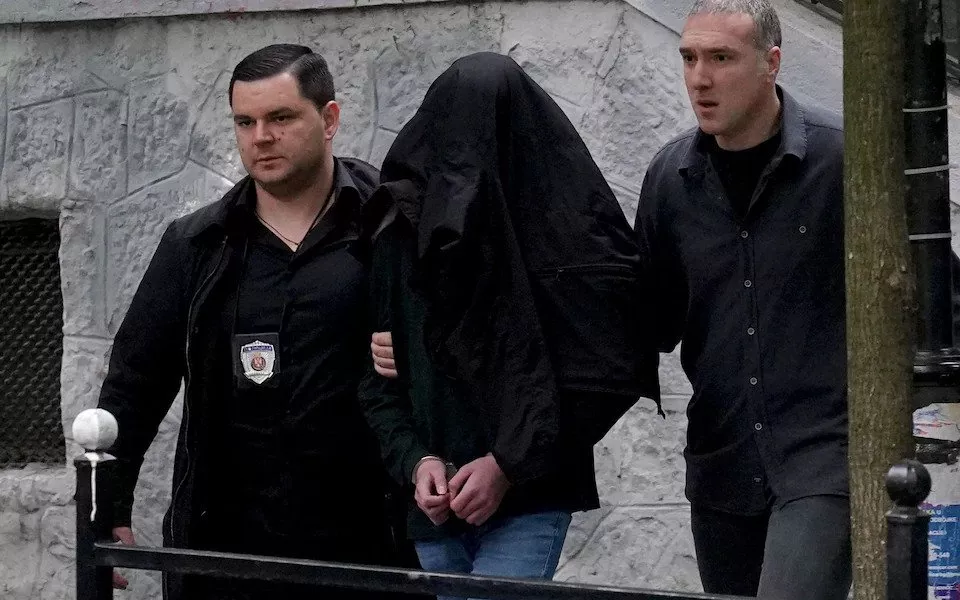
(Patria) - The boy Kosta K., suspected of the bloodshed in the Belgrade elementary school he attended, will not turn 14 until July, meaning he was considered a child without criminal responsibility at the time of the act and cannot be arrested, detained, or held; there will be no trial or sentence for him.
Family circumstances and parental failures
He will most likely be placed, at least temporarily, in a social welfare institution until his family circumstances and any parental failures (abuse, neglect, lack of treatment, etc.) are determined.
Institutions for children under 14 must be open-type institutions, even when dealing with children in conflict with the law, from which children attend regular schools, have regular activities, and efforts are made to resocialize them and return them to society as quickly as possible.
If it is determined that the crime was an anomaly and that the parents possess all necessary parental competencies, he will be immediately returned to the family.
In accordance with legal procedure, if a child who has committed a criminal offense is under 14 years of age, the police will still file a criminal complaint, but the public prosecutor's office will dismiss it and inform the social welfare center about everything.
- The center is then obliged to investigate the child's family and determine the competencies of the child's parents. It needs to be determined whether the act was influenced by the parents abusing the child, neglecting him, not treating him, or something similar.
If they suspect this, the child will, until the situation is definitively determined, most often be placed in a social welfare institution. If it is determined that the parents did not contribute to the commission of the act and that they possess the necessary parental competencies, the child is returned to the family, usually with certain supervision or recommendations - explains Lana Pető Kujundžić, a long-time judge and president of the Association of Judges for Youth.
What next?
If such a thing is determined for a child suspected of committing such a serious offense as Kosta K., the center usually tries to create a plan for reintegrating the child back into society, primarily into regular schooling, so that the stigma does not permanently mark his life.
If it is determined that the parents abused or neglected the child, the center proposes removing the child from the family and placing him in an institution or foster family, and takes measures against the parents, such as filing a criminal complaint for violation of the child's rights, writes Jutarnji.hr.
Analyses show that in systems, such as the Anglo-Saxon one, where children are tried as adults in cases of particularly serious criminal offenses, child perpetrators very often take their own lives.
- A tragedy occurred, eight children were killed. As we are shocked and start thinking about how the boy perpetrator should be punished, we need to think about what we want and what justice is in this case. Is a system in which another child will be killed what we want - asks the judge.
Age limit
In the Republic of Serbia, it is stipulated that a child under 14 cannot be held responsible for criminal offenses because it is considered that up to that age, they cannot understand or control their own behavior, cannot connect causes and consequences, nor distinguish where play ends and reality begins.
- The age of criminal responsibility is an extremely important institute and a serious matter because children are not small adults, they are children. The UN Commission on Juvenile Justice advises each state to set it and advises that it not be before the age of 14.
Most European countries maintain this limit at 14 years. Exceptions are England and Wales, where this limit, I believe, has been raised from 8 to 10 years, then Scotland, where the limit is 12 years, and on the other hand, Finland and Norway, which consider children not criminally responsible until the age of 16 - points out Pető Kujundžić.
Had Kosta K. already turned 14, he would have been considered a minor offender, arrested, and likely held in pre-trial detention. However, regardless of the severity of the criminal offense, he could not have been sentenced to juvenile prison - such a sentence is only possible for children over 16 years of age.
For minors between 14 and 16 years old, only educational measures can be imposed, the most severe of which is placement in an educational institution, a closed facility that represents a kind of intermediate institution between a children's home (colloquially a reform school) and a juvenile prison.
- For perpetrators between 14 and 16 years old, a preparatory procedure is conducted, which is the equivalent of an investigation for adult perpetrators, led by the public prosecutor. During this procedure, circumstances are determined, witnesses are interviewed, medical reports, social welfare center reports, and other documents are collected, and a proposal is submitted to the juvenile judge.
This would be an indictment for adults, but for minors, a sanction is also proposed, hence the term proposal. The most severe sanction for the most serious criminal offenses in that age group is placement in an educational institution.
Unlike adults, the sanction does not have a fixed duration - for example, two years in prison - but is imposed within a legally prescribed interval, and educators decide when it is "enough," i.e., when the child has been resocialized - explains the judge.
Case of a ten-year-old in England
The measure of an educational institution cannot last less than six months or more than three years, and the measure of an educational home - which is an open institution - lasts from six months to two years, and after the maximum period, the measure cannot be extended.
An educator assesses when the child has been resocialized, i.e., when they are ready to return to the environment from which they were removed: this, regardless of the severity of the criminal offense, can be, for example, in eight months, and the child is then "clear.".
Judge Pető Kujundžić believes that such a legal path, chosen by Europe, is the only correct one. She recalls the case of two ten-year-olds who, about 30 years ago in England, killed a two-year-old child they abducted from a shopping center, beat him, and left him on the train tracks to be run over by a train.
The boys, 4th-grade elementary school students, were tried as adults, with lawyers and a jury, in a public trial, with cameras and television coverage. They were eventually sentenced to life imprisonment, but with the possibility of parole. They served their sentences in a classic prison for adult men.
- They were released, I believe, after 25 years. One of them's family no longer wanted to see him. He was placed in a social housing unit, and everyone on the street was informed that a murderer who had killed a two-year-old child was moving in next door. He was soon killed in a drug-related shootout. The other ended up in a psychiatric institution and committed suicide. Let's not wish for such a system, even after such a horror. It only takes more lives - warns the judge.
Komentari (0)
Prijavite se za komentiranje
PrijavaJos nema komentara. Budite prvi!
Minuta
Sve →Iz drugih kategorija

High Representative Not Elected: Germans, French and British Sabotaged Americans, New Attempt at End of June

ČOVIĆ WITHOUT MERCY: How Those Who Brought Ademović to Office Created a Political Hell for Him



Sunny Saturday, quite warm



Tragedy in Albanian resort: Two minors drown












