
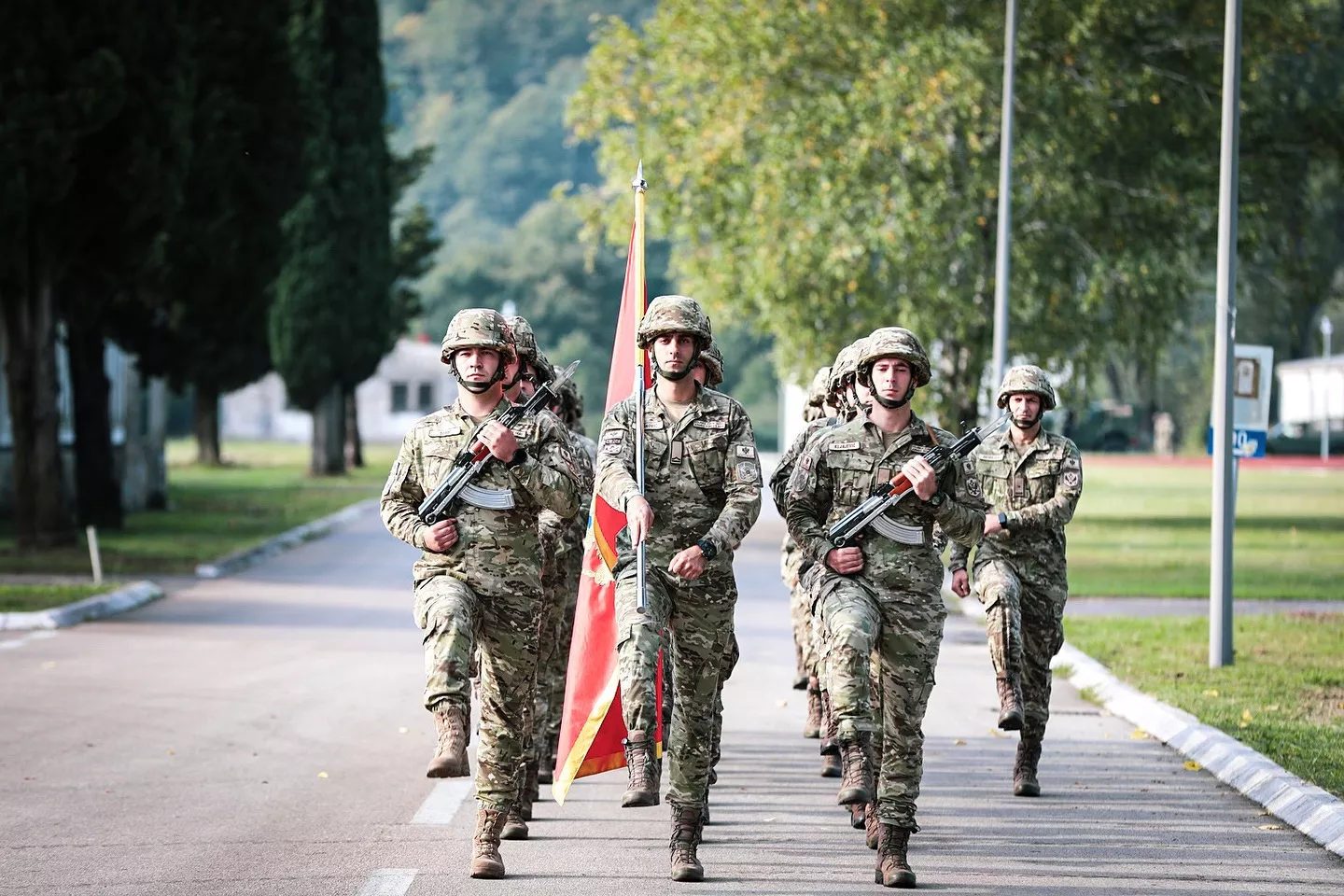
(Patria) - Instead of time spent in the army, young people will be able to continue their education, engage in work or dedicate themselves to other useful activities, said in 2006 the then president of Montenegro Filip Vujanović, announcing the abolition of compulsory military service.
Eighteen years later, Montenegro is considering reintroducing compulsory military service. Minister of Defence Dragan Krapović supports this possibility.
Policy of regional countries
The Ministry of Defence does not rule out the possibility that Montenegro will also consider this issue.
They told Radio Free Europe (RFE) that any decision would have to be based "on a broad consensus and analysis of potential consequences."
The story was brought to the fore by announcements from Croatia and Serbia that they will reintroduce compulsory military service from next year.
For military analyst Aleksandar Radić, Montenegro should "follow" the policy of other regional countries.
- Now you don't really have a choice. Follow the steps that have already been taken... Montenegro is in a wave where something must be done, so it's better to do it on time than to be late - says Radić.
Montenegro abolished compulsory military service in 2006, the same year it restored independence through a referendum. Eleven years later, it became a NATO member.
- The decision on reintroducing compulsory military service lies with the member states, in this case Podgorica.
About a third of NATO members have some form of compulsory military service, and some allies are considering doing the same - said an Alliance official, in response to RFE's inquiry on how NATO views this possibility.
He added that NATO does not prescribe compulsory military service.
- The way military personnel are recruited and retained (in service) is a decision of individual nations. It is important that allies continue to have capable armed forces to protect our territory and population - this official emphasised.
In that regard, as he said, NATO appreciates Montenegro's continuous contribution to common Euro-Atlantic security.
In Croatia, a NATO member since 2009, compulsory two-month military service, which has so far been voluntary, should start from January next year.
Serbia, which is militarily neutral, has also decided to replace voluntary military service with compulsory service. It should be implemented from September and last 75 days.
Radić says the timing of decisions in Croatia and Serbia indicates that these two countries still view each other with suspicion.
- And if one makes a move that leads to military strengthening, then the other does it too - adds Radić.
He also cites the example that, as part of military modernisation, both countries purchased French Rafale fighter jets.
- It is obvious that they are following each other in the decision on military service as well - Radić points out.
Kosovo would do the same
The RFE interlocutor adds that Kosovo has also expressed its intention to introduce compulsory military service.
- There is a strong political commitment to that, which is based on nationalism and the recognition of the Serbian factor as a risk. For them, it will be easy to win public opinion for such an idea - Radić states.
He points out that, like Montenegro, North Macedonia will most likely open the issue of reintroducing military service.
- And probably, step by step, North Macedonia will face the choice to introduce compulsory military service - Radić's words.
He believes that Bosnia and Herzegovina is a special case, due to the relations between the entities of the Federation and the RS.
Radić says that reintroducing military service in BiH would be an additional complex issue, given that "such a mechanism would be seen as potentially creating a basis for inter-ethnic conflict in that complex mosaic of three constituent peoples and the Dayton legacy."
- I think that military service will remain a taboo topic there - Radić concludes.
In Montenegro, after the abolition of compulsory service, the possibility of voluntary service was opened five years ago. It lasts three months and opens the possibility of employment in the Armed Forces of Montenegro, which numbers about 2,400 members.
The transition to compulsory military service is a complex issue, the Ministry of Defence stated for RFE.
"It requires a serious analysis of all aspects, including potential economic costs, the impact on education and employment of young people, as well as the ethical and moral views of citizens," they said.
They add that public consultations are also necessary, which would include representatives of young people, the professional public, non-governmental organisations...
An important link in the decision-making process is the General Staff of the Armed Forces of Montenegro, the key military institution responsible for implementing this policy.
They would, as stated by the Ministry, prepare arguments for making the final decision at the political level.
Incidentally, in Montenegro, the Armed Forces are commanded by the President of the State based on decisions of the Defence and Security Council, which, besides him, includes the Presidents of the Government and the Parliament.
Komentari (0)
Prijavite se za komentiranje
PrijavaJos nema komentara. Budite prvi!
Minuta
Sve →Iz drugih kategorija

High Representative Not Elected: Germans, French and British Sabotaged Americans, New Attempt at End of June

ČOVIĆ WITHOUT MERCY: How Those Who Brought Ademović to Office Created a Political Hell for Him



Sunny Saturday, quite warm



Tragedy in Albanian resort: Two minors drown












