
Written by: Dean Džebić
During the NATO bombing campaign against FR Yugoslavia, i.e. Serbia, a part of the air defense system, along with accompanying radars, magically disappeared from the composition of the Army of Republika Srpska.
Thus, just before the bombing, a significant portion of the air defense assets of the VRS was sent for overhaul to Serbia, in fact, sent as a form of support to the existing air defense infrastructure of the Yugoslav Army, where it remained.
Of course, this, like many other stories about the selfless sharing between the Republic of Serbia and the entity of Republika Srpska, is quickly forgotten and has been forgotten even where it should not be.
Thus, the session of the National Assembly of Republika Srpska from December 10, 2021, was also forgotten, when conclusions were adopted on the transfer of competencies to the BiH level in the field of security and defense.
One of the points is the need to fulfill the strategic interest of the RS to independently regulate the legislative framework for the production of weapons and military equipment, bypassing the existing procedure at the state level.
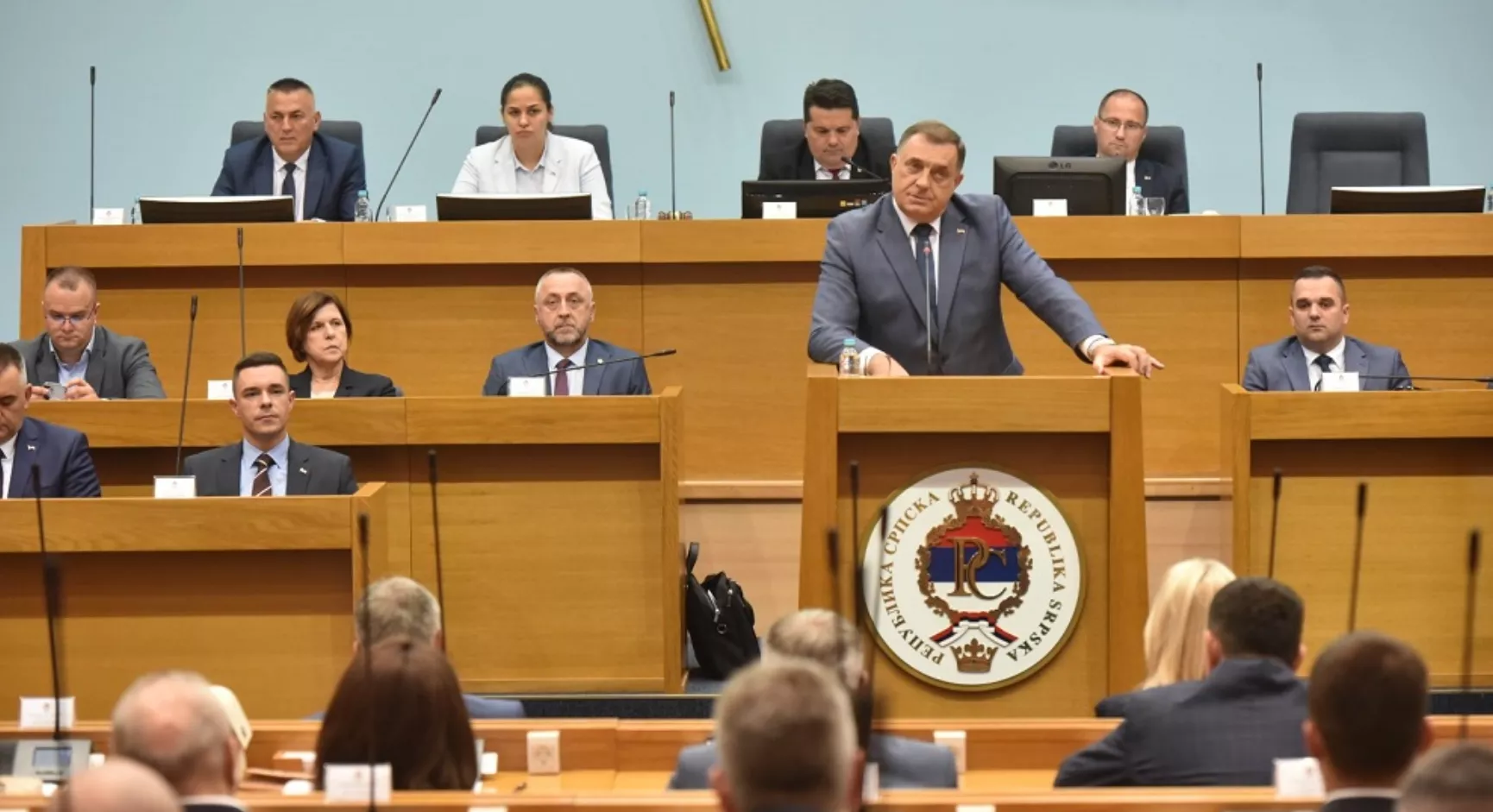
That point should receive its legislative crescendo with the adoption of the Draft Law on the Production of Weapons and Equipment in the RS, adopted at yesterday's session.
Existing procedure and legal regulations
On the other hand, the opposing existing legal regulations, based on the General Framework Agreement for Peace in BiH, i.e. Annex 4, Article 3, stipulate that trade is the exclusive competence of the state of Bosnia and Herzegovina.
Additionally, according to the Law on the Production of Weapons and Military Equipment in BiH (WME), adopted in 2003, the Ministry of Foreign Trade and Economic Relations has a central role in the process and procedure of completing the sale and export of weapons.
"Legal entities that have previously obtained a permit from the Ministry of Foreign Trade and Economic Relations of Bosnia and Herzegovina can engage in the production and overhaul of WME," states Article 3 of the Law on the Production of WME in BiH.
The issue of existing regulations in the field of production of weapons and military equipment in relation to the adopted Draft Law on the Production of WME in the RS is significant for several reasons, which are mostly attempts to shift the arguments by the political leadership of the RS.
Before we delve into a more detailed analysis of the Draft itself, it should be noted that one of the main arguments for adopting this law was the argued existence of an already existing entity law regulating this area.
But there is a significant difference. Namely, the FBiH adopted the Law on the Production and Trade of WME in FBiH in 2007, but not as an entity law opposing the state law from 2003, but rather a law that largely confirms the state level as an unnecessary duplication.
Production and export without state supervision
According to available information on the content of the adopted Draft Law on the Production of WME in the RS, if the Constitutional Court does not challenge and annul it, this is the most concrete attempt to dismantle the Dayton Agreement.
According to previous practice, defense industry companies from BiH could export weapons and equipment exclusively according to the so-called G to G model, i.e. "government to government."
According to the current state law, the process of exporting weapons was carried out through an inter-ministerial approach that included assessments by the ministries of defense, security, and finally foreign trade and economic relations.
The adopted draft from the National Assembly of Republika Srpska stipulates that, instead of the Ministry of Foreign Trade and Economic Relations, the permit for work as well as the export and import of raw materials is granted by the Government of the RS.
The work permit is a particularly significant segment of the Draft due to the announced proliferation of new companies that, due to high interest rates, currently cannot start operations.
It is precisely in the context of interest rates that the flow of capital lies, i.e., the independent determination of prices for services and goods that would not be reported to the Ministry of Foreign Trade and Economic Relations.
Thus, complete de-sovereignization with an additional segment of losing any control if the controlling stake were bought by a natural or legal person, which is also enabled by the new Draft.
Controlling stake an opportunity for Serbia
Ownership of companies engaged in the production of WME has different modalities in the world, and the key difference is mainly in the system of organization, i.e., whether it is a limited liability company or a joint-stock company.
Due to the scope of operations, as well as production capacities for interpreting this segment of the Draft, we will consider the joint-stock companies: "Orao" from Bijeljina, "Kosmos" from Banja Luka, and "TRB" from Bratunac.
Thus, according to the new law, in all three, also the largest companies in the RS entity, a foreign entity will be able to purchase up to 49 percent of shares, while the controlling stake of 51 percent would remain with the Government of the RS or other owners.
However, as we learn, the Draft stipulates that, in the case of a government assessment, the purchase of a controlling stake, i.e., 51 percent of shares, can be approved.
On a practical level, this possibility creates the preconditions for legalizing the purchase of a majority stake, i.e., the controlling stake in companies for which the Republic of Serbia assesses that they have the greatest production and export capacity.
Two important things should be highlighted here. Namely, that the aforementioned "Kosmos", "Orao", and "TRB" are companies of strategic importance for the Serbian defense industry, with a special aspect on "Orao" and "Kosmos".
And on the other hand, in both companies, there is already a certain percentage of Serbian capital.
In general, for the maintenance of older jet engines and radars used in the Air Force and Air Defense of the VS, the aforementioned two companies are the only ones that can meet the challenge.
It is precisely for these reasons that both "Orao" and "Kosmos" have been involved in numerous programs of the Ministry of Defense of the Republic of Serbia for many years with the aim of financial consolidation.
Of course, besides "Orao" and "Kosmos", there is a whole range of smaller companies that would, with their production capacities, significantly expand the production range of the Yugoimport-SDPR consortium, which corporately handles the entire export of weapons from Serbia.
On the other hand, there is great interest from companies in the RS to jointly appear on third markets under the auspices of Yugoimport, given the significant contacts and connections that Yugoimport inherited during the Cold War-era arms trading of Yugoslavia with countries in Africa and Asia.
Exiting the state framework
Thus, according to available information on the Draft of the new law, which is still not publicly available, it is a legislative feat that contradicts several BiH laws, primarily the Constitution of BiH, i.e., Annex 4.
As such, this case must receive its epilogue at the Constitutional Court if it is adopted in the National Assembly of Republika Srpska or does not receive such amendments or changes that would keep it within the existing framework of state law.
Of course, the possibility of Serbian capital entering this strategic area remains, but this phenomenon cannot be prevented by existing legal remedies, given that companies from the RS refuse to jointly appear with companies from the FBiH under a single state corporation that would broker and articulate the procedures for ordering, procuring, and purchasing weapons and military equipment from BiH.
The refusal of companies from the RS to participate and the lucid desire of Serbia to take over companies that, with their remaining capacities, largely determine the operational capabilities of certain branches of its army - are strong blows to the remaining nails in the coffin of Dayton BiH.
On the other hand, the persistent stance of Milorad Dodik on the Constitutional Court actually provides the best answer as to what is the greatest deterrent factor that has been fighting for years against the de-sovereignization of BiH in the strategic spheres of its economy and public administration.
With all the troubles, for everything produced in the RS entity, it still says Made in BiH, but if we sleep through it, perhaps jet engines with the inscription "Made in Serbia" will whistle over BiH.
Komentari (0)
Prijavite se za komentiranje
PrijavaJos nema komentara. Budite prvi!
Minuta
Sve →Iz drugih kategorija

High Representative Not Elected: Germans, French and British Against Americans, New Attempt at End of June

ČOVIĆ WITHOUT MERCY: How Those Who Brought Ademović to Office Created a Political Hell for Him



Sunny Saturday, quite warm



Tragedy in Albanian resort: Two minors drown












