
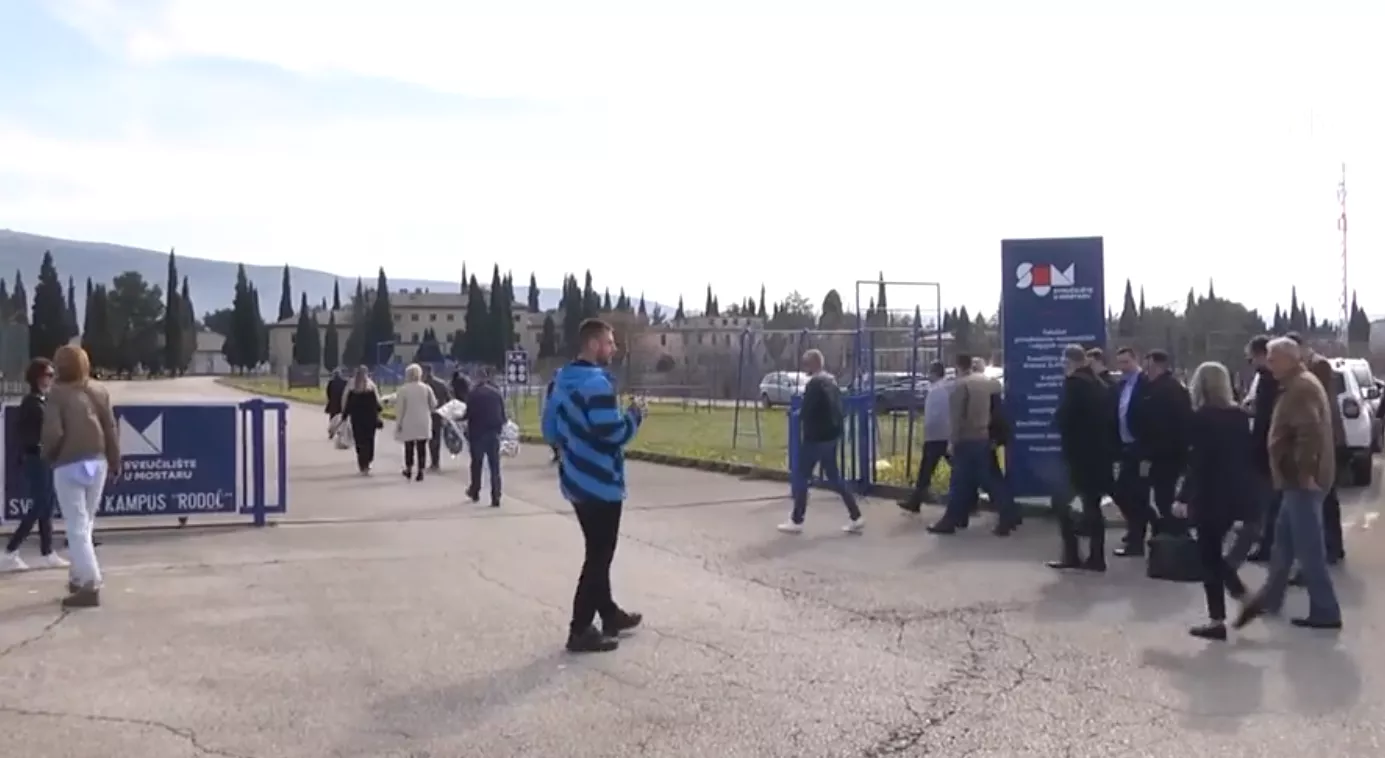
(Patria) - Croatian Nacional reported that the construction of the HVO museum at Heliodrom in Mostar is being financed from Croatia's budget.
"The real truth is that this controversial institution, which is being built precisely on the site where the HVO held a camp for Bosniaks in 1993 and 1994, is financed from the state budget of the Republic of Croatia. Nacional confirmed this information, which will further burden the already severely damaged relations between Croatia and BiH, with the Ministry of Croatian Veterans last week," according to Nacional's text here.
Prompted by the news that the construction of the HVO museum had begun in the Mostar barracks "Stanislav Baja Kraljević", in the Heliodrom area of Mostar, which the Ministry of Defense of BiH announced on February 27, Nacional sent questions to the Ministry of Croatian Veterans, headed by Minister Tomo Medved, on Tuesday, March 21, regarding this project. We were interested in whether the Croatian state budget finances the Association of Holders of War Decorations of the Croatian Defence Council of Herceg-Bosna, which media in BiH reported as the project holder and "donor" for the HVO museum in Mostar. We were also interested in whether the Ministry of Croatian Veterans cooperates with this association, whether it was informed about the construction of the HVO museum, and whether it was involved in the project in any way. We received the Ministry's response on Thursday, March 23:
"The Ministry of Croatian Veterans is implementing a co-financing project for the construction, installation, or arrangement of memorials to victims who suffered in the Homeland War. Based on a public call, initiatives from Homeland War associations and local self-government units are supported, and up to three memorials in Bosnia and Herzegovina can be co-financed through the public call. The Association of Holders of War Decorations of the Croatian Defence Council of Bosnia and Herzegovina applied to the Public Call published in 2022, with the consent of the Association of Volunteer Veterans of the Homeland War of the HVO HB, the HVIDRA of the HVO HB, the Union of County Associations of Families of Fallen and Missing Croatian Defenders in the Homeland War of the HVO HB Mostar, and the Croatian Association of Camp Detainees of the Homeland War of BiH, with a request for co-financing the construction of the HVO museum at the location of the barracks 'Stanislav Baja Kraljević' in the settlement of Rodoč near Mostar. The request for co-financing included, among other things, project documentation financed by the Ministry of Defense of Bosnia and Herzegovina and a Memorandum of Understanding and Cooperation between the Association of Holders of War Decorations of the HVO FBiH and the Ministry of Defense of BiH on cooperation in various areas of interest, including museum activities. The co-financing agreement was signed on December 21, 2022, under the same conditions and financial guarantees that apply to the co-financing of the construction, installation, or arrangement of memorials related to the Homeland War in the Republic of Croatia."
The question remains whether this construction is part of the coalition agreement of the current government in BiH, formed by center-left parties led by SDP BiH with HDZ BiH and Dodik's SNSD.
Therefore, the "donation" that the media in BiH have been writing about in recent weeks, relaying statements from unnamed sources in the neighboring country, is actually taxpayer money from Croatia. Judging by the reactions of Bosniak former camp detainee associations to the news of the construction of the HVO museum at the site of the former camp for Bosniaks, this information will only further worsen relations between Croats and Bosniaks in the Federation of BiH. At the same time, however, another important circumstance should not be overlooked: the construction of the museum at the site of the former camp, which is certainly cynicism of the worst kind, has been agreed upon by both past and present authorities of Bosnia and Herzegovina, including the current Minister of Defense of BiH, Zukan Helez, who is also the vice-president of the Social Democratic Party (SDP) of BiH, the leader of the nominally left-wing, anti-nationalist bloc of parties in the neighboring country.
On Monday, February 27, media in BiH reported a statement from the Ministry of Defense of BiH that the Deputy Minister of Defense of BiH for Policy and Plans, Slaven Galić, visited the barracks "Stanislav Baja Kraljević" with the Deputy Chief of the Joint Staff, Major General Ivica Jerkić. They were received by the commander of the 1st Infantry Guards Regiment of the Armed Forces (AF BiH), Brigadier Martin Pažin.
"The main topic of the working meeting was familiarization with the mission and activities of the regiment, with a special focus on the start of renovation works on the building of the Military Museum of the 1st Infantry Guards Regiment of the AF BiH in the barracks 'Stanislav Baja Kraljević' in Mostar," announced the Ministry of Defense of BiH. Media in BiH specified that "Brigadier Martin Pažin presented the plan for the First Phase of the reconstruction of the building for the internal exhibits of the Military Museum, which consists of replacing and installing external openings, renovating the external plaster, and reconstructing internal partition walls. This phase of works is being realized with donation funds and is being carried out based on the signed memorandum of understanding between the Association of Holders of War Decorations of the HVO FBiH and the Ministry of Defense of BiH."
The media reported that Deputy Minister of Defense Slaven Galić emphasized at the time that the "military museum will be a guarantee that the historical role and significance of the units of the Croatian Defence Council will continue to be spoken about and passed on to future generations."
According to the claims of former camp detainees, the HVO museum will be located in the administrative building of the barracks complex, which housed the command of the Heliodrom camp from 1992 to 1994. This building has a basement, ground floor, and two upper floors. The basement will house technical rooms, a depot, and an exhibition preparation area.
The problem, however, is that the HVO museum, according to the claims of former detainees, will be in the same building that housed the command, as well as solitary confinement cells, of the HVO camp for Bosniaks from 1992 to 1994. This camp got its name – Heliodrom – from the former JNA base. A few days later, the Association of Camp Detainees Stolac reacted. "Building a museum on the site of the former Heliodrom concentration camp, where the Central Prison was located, for the army that organized this crime, is a direct spit in the face of the victims and their families. This represents a rape of the truth, and instead of repentance for the 'joint criminal enterprise,' crimes in concentration camps under the political rule of HDZ BiH are being glorified today," stated the association, adding that "the role of the Ministry of Defense of our country, which will co-finance this civilizational shame, is particularly shameful. The fact is that there was a concentration camp for Bosniaks, and one only needs to ask what the world public would do if someone built a museum to the Nazi Wehrmacht in the Dachau camp near Munich. We strongly oppose this and will not stand idly by while someone humiliates us again," warned the Association of Camp Detainees Stolac. The Association of Camp Detainees Mostar also protested, whose member Emir Hajdarović called the construction of the museum at the site of the former camp "hiding the place of suffering" and "an attempt to rewrite history" for Radio Slobodna Europa. "They are opening a museum in a building that is synonymous with suffering. The goal is for everything to be forgotten after a certain time and for such places to be given a different function," said Hajdarović.
The construction of the HVO museum has a rather long history. After the three warring armies were united into the AF BiH in 2006 under the patronage of the international community, three national regiments were formed, following the traditions of the Army of RBiH, HVO, and the Army of RS. Thus, the 1st Infantry Guards Regiment of the AF BiH was established in Mostar, which, according to media reports from the neighboring country, "inherits the identity, tradition, and cultural-historical heritage of the Croatian Defence Council and the Croatian people." It is stationed at Heliodrom, in the barracks where the HVO held Bosniak men, as well as civilians, the elderly, women, and children detained from 1992 to 1994. It is planned that each of the national regiments will build its own museum. The HVO museum is intended to have a central part, the one at Heliodrom, and four branches, in barracks in Livno, Kiseljak, and Orašje, as well as a memorial to the stopping of JNA tanks near Široki Brijeg. According to information provided to the media by former Deputy Minister of Defense of BiH, Mirko Okolić, the museums of the former Army of BiH and Republika Srpska have not yet been completed, but their locations are known: these are the Dubrava barracks in Tuzla and Kozara in Banja Luka, which have not caused controversy so far.
Heliodrom in Mostar, however, has caused considerable controversy. That is why Nacional sent questions to the Ministry of Defense of BiH regarding this project. We were interested in when the museum would open, who would be the author of the exhibition, who is financing the museum, who provided the donation, and how much it amounts to. We were also interested in why the site of the HVO camp for Bosniaks was chosen as the location for the museum, and whether this institution would cover the war between the HVO and ARBiH from 1992 to 1994, and how. We also asked whether the Minister of Defense of BiH, Zukan Helez, vice-president of SDP BiH, considers it appropriate for the HVO museum to open at the site where the HVO held a camp for Bosniak civilians, and whether the construction of the HVO museum was part of the coalition agreement of the current government in BiH, formed by center-left parties led by SDP BiH with HDZ BiH and Milorad Dodik's SNSD. We did not receive answers by the time this issue of Nacional went to print.
"The fact is that there was a concentration camp for Bosniaks, and one only needs to ask what the world public would do if someone opened a museum to the Nazi Wehrmacht in the Dachau camp near Munich. We strongly oppose this and will not stand idly by while someone humiliates us again," warned the Association of Camp Detainees Stolac.
According to the claims of former camp detainees, the HVO museum will be located in the administrative building of the barracks complex, which housed the command of the Heliodrom camp from 1992 to 1994. This building has a basement, ground floor, and two upper floors. According to media information, the basement will house technical rooms, a depot, and an exhibition preparation area. The ground floor will feature exhibition spaces and restrooms, the first floor will display infantry weapons, and the second floor will be dedicated to a library, reading room, and offices. The museum exhibit will include collections of weapons, technical equipment, uniforms, war flags and emblems, documentary materials, audio and video recordings, with a cultural-historical collection, a publishing collection and a press archive, as well as a photo exhibition and communication equipment, special and recent events, and a memorial room for fallen HVO members. The media also reported the view that the HVO museum will be important because it will "offer valuable historical exhibits through cultural tourism aimed at enriching identity," and that it will "help evoke memories of days of pride and glory."
All of this is unofficial information that no one wants to officially confirm. The Ministry of Defense of BiH ignored Nacional's offer to explain how exactly the HVO museum will present the war path of that army, so there is nothing left but to relay unofficial sources: the Bosnian-Herzegovinian edition of Večernji list published an article on March 17 stating that "at an authentic location, which was also the scene of heavy fighting in 1992, numerous historical exhibits will be presented, while a multimedia presentation of the history of the HVO will present its war path – from the initial phase of Croat defense in the Homeland War to resistance, then military organization, and finally active operations in the liberation and stabilization of BiH." In the museum, "children, and their children, will be able to see their fathers and grandfathers from the HVO, witness war actions, and in multimedia halls see a memorial room dedicated to fallen Croatian defenders, numerous weapons, uniforms, insignia, and flags." Only the "flag of the HVO and Herceg-Bosna," Večernji list reported, will be 86. "Part of the complex is a central memorial in the form of a cross rising from a rosary, and stones connecting Croats from Posavina to the sea who were in the HVO," reported the Bosnian-Herzegovinian edition of Večernji list, without citing its sources.
According to data from the judgment of the Hague Tribunal, Heliodrom was established on September 3, 1992, by decree of the Minister of Defense Bruno Stojić, as the 'central military prison for the area of Herceg-Bosna' near Mostar.
One question, however, cannot be avoided: if "children, and their children, will be able to see their fathers and grandfathers from the HVO," and that "at an authentic location," will "children, and their children" also be able to see their fathers and grandfathers in the camp? Will the HVO museum at Heliodrom also depict that part of the HVO's war history, the war with the Army of BiH in 1993 and 1994, during which the HVO deported Bosniaks to camps, including the notorious Heliodrom where the HVO museum is now being built? For the authors of the exhibition, this should not be a professional problem, as these events have been meticulously researched, and the material is available: the Hague Tribunal, in the third volume of the judgment against six military and civilian commanders of Herceg-Bosna, described the Heliodrom camp in several dozen pages, supporting its findings with hundreds of pieces of evidence and testimonies from victims and witnesses. The Hague Tribunal, for example, proved that at least 27 detainees of Heliodrom died on the front lines in Mostar, where they were taken for forced labor under crossfire.
Their names are: Semir Berić, Adis Brković, Semir Ćehajić, Emir Čolić, Hašim Drljević, Ibrahim Filandra, Saša Grabovac, Zahid Hadžić, Azim Karađuz, Zuka Hajrović, Huso Ljević, Sakib Malahasić, Ramiz Mehmedović, Veledin Mezetović, Muhamed Muminagić, Mehmed Muminagić, Nedžad Nožić, Semir Perić, Enver Puzić, Remza Sabljić, Avdo Selimanović, Ahmet Hajrić, Nesib Halilović, Salem Hurseinović, Elmir Jazvin, Irfan Torle, and Mehmed Tumbić. Under the same conditions, Hasan Bećirević, Ibro Ćilić, Dervo Čolaković, Osman Elezović, Adi Fejzić, Nijaz Kladušak, and Nedžad Kubić were wounded. This list is not exhaustive because only unequivocally proven victims were mentioned by name in the judgment. The exact list of victims will probably never be known. If the authors of the HVO museum exhibition wish, they can also present the testimony of Emir Hajdarović, who was detained for a total of 309 days in HVO camps in Herzegovina as a 21-year-old, most of it at Heliodrom, including 48 days in solitary confinement in the basement of the future HVO museum building. "The hardest part was realizing that your human dignity was violated and how far human evil can go," Hajdarović recently told Radio Slobodna Europa. "I meet guards from that camp in the city, because our judiciary has failed in prosecuting them. The state has also done nothing to help the camp detainees, and now we have the opening of this museum," he added.
Will the HVO museum at Heliodrom depict the part of the HVO's war history in which it fought with the Army of BiH in 1993 and 1994 and deported Bosniaks to camps like the one at the site of the future museum?
According to data from the judgment of the Hague Tribunal, Heliodrom was established on September 3, 1992, by decree of the Minister of Defense Bruno Stojić as the "central military prison for the area of Herceg-Bosna" in the former JNA barracks a few kilometers south of Mostar. At this prison, up to six thousand people were detained simultaneously. The HVO carried out systematic arrests of Bosniaks from May to July 1993. Detainees included male civilians, "younger than 15 and older than 60," women, and children. Heliodrom was the scene of brutal violence. Judges of the Hague Tribunal concluded that members of the HVO Military Police "regularly and severely beat detainees at Heliodrom with various objects, sometimes for several hours, until the victim lost consciousness, insulted them, threatened them, and humiliated them" from May 1993 to April 1994. One victim, a man of protected identity, testified that on "May 22, 1993, half an hour after being brought to Heliodrom, he was beaten by four uniformed individuals, at least two of whom were members of the Military Police, and they beat him continuously for approximately eight hours." The next day, he was beaten again from nine in the morning until six in the evening, and then locked in solitary confinement. A few days later, he was beaten again, and among the assailants was a person "a member of the HV brigade from Split." Solitary confinement cells, according to the findings of the Hague Tribunal's judgment, were particularly harrowing places. "Witness CU3924 recounted that during his detention in solitary confinement, he could not wash and received only one and a half liters of water per month. Since he did not receive enough food and water, he was forced to eat his own excrement and drink his own urine. He explained that upon arrival at Heliodrom, he weighed 104 kilograms, and his weight was only 44 kilograms when he left solitary confinement." Another witness, Mustafa Hadrović, testified that on June 25 or 26, 1993, he was taken to solitary confinement and remained there for 160 days. He lost 47 kilograms there. He covered himself with a thin blanket, relieved himself in a biscuit tin, and received salt instead of sugar with his morning tea. The atmosphere at Heliodrom was captured in poignant photographs by American war photojournalist Ron Haviv, best known for his shocking photographs of the execution of Bosniak civilians by the paramilitary unit of Željko Ražnatović Arkan in Bijeljina in April 1992.
If the published information is anything to go by, none of this will be mentioned in the HVO museum being financed and built by Croatia and Bosnia and Herzegovina. Officials avoid speaking openly about the project, and unofficial information suggests that this institution, instead of a museum, will actually be an anti-museum, a place of denial, concealment, manipulation, and forgetting. But there is still time for all this to change: construction has only just begun. One must hope that the responsible parties will find the wisdom to transform the HVO museum from a place of discord, which it has already become, into a place of truth, integrity, and the beginning of rebuilding mutual trust. This should not be difficult: it only requires presenting in good faith everything that happened between 1992 and 1995, both good and bad. After all, what else should museums serve if not the truth?
Komentari (0)
Prijavite se za komentiranje
PrijavaJos nema komentara. Budite prvi!
Minuta
Sve →Iz drugih kategorija

High Representative Not Elected: Germans, French and British Sabotaged Americans, New Attempt at End of June

ČOVIĆ WITHOUT MERCY: How Those Who Brought Ademović to Office Created a Political Hell for Him



Sunny Saturday, quite warm



Tragedy in Albanian resort: Two minors drown












