
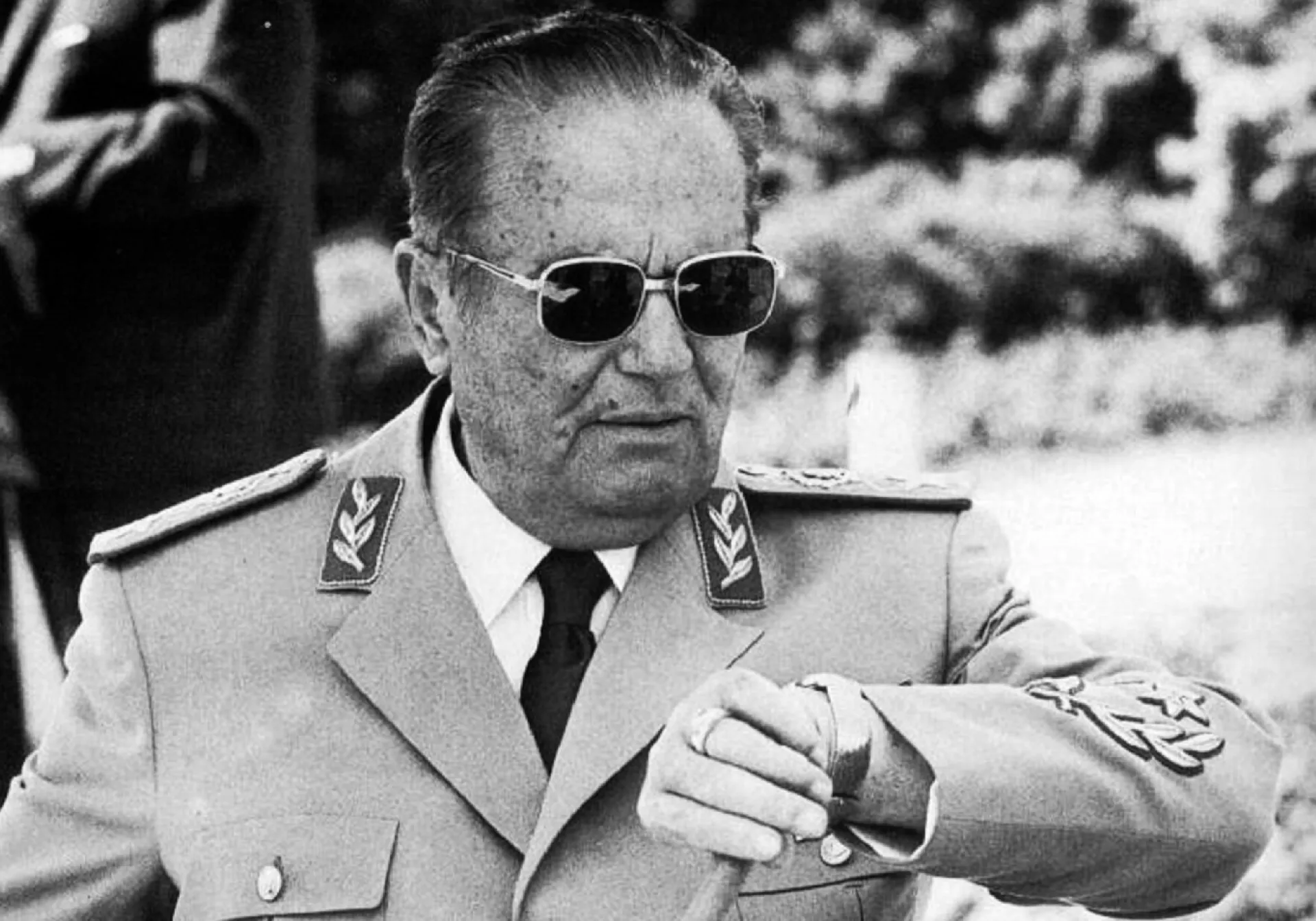
(Patria) - On this day in 1980, the President of the SFR Yugoslavia, Josip Broz Tito, died.
Tito was the leader of the Communist Party of Yugoslavia, the leader of the Yugoslav partisans in World War II, who led the national liberation war and revolution to victory.
In international politics, he was one of the most prominent proponents of peace and active coexistence, the right to self-determination, and equality among peoples.
He led the country out of the Soviet bloc and was the leader of the Non-Aligned Movement. He received the Nehru Award (India) in 1973 for international understanding.
Josip Broz Tito was born on May 7, 1892, in Kumrovec (Croatia). Different dates of his birth appeared in various documents, one of which was May 25, which was later celebrated as Tito's birthday - Youth Day.
He finished elementary school in Kumrovec (1905), and learned the locksmith trade in Sisak (1910), after which he immediately became a member of the Social Democratic Party of Croatia and Slavonia.
After that, he worked in Kamnik in Slovenia, Čenkov in Bohemia, in Munich, in the "Benz" car factory in Mannheim, in the German Ruhr, Vienna, Wiener Neustadt, where he worked in the "Daimler" car factory as a test driver.
He learned German and Czech, improved his existing skills, and learned new trades.
He went to serve his military service in 1913 in Zagreb. During his military service, he attended a non-commissioned officer course and received the rank of sergeant.
World War I found him as a sergeant, and he was sent to the front with his unit. However, while en route to the front, he was imprisoned on charges of glorifying anti-militarism.
He was at the front until May 25, 1915, when he was wounded and captured. He spent thirteen months in a Russian hospital, where he read a lot and learned Russian.
After recovery, Tito was sent as a prisoner of war to work in the village of Kalasijevo. At the end of 1916, he was transferred to Kungur, where he worked on maintaining the railway line.
In June 1917, he went to Petrograd, where he participated in demonstrations. He then went to Finland, where he was arrested and sent to prison in the Peter and Paul Fortress, from which he was transported back to Kungur.
He escaped from transport and reached Omsk, where, after the victory of the October Revolution, he joined the Red International Guard detachment. In the spring of 1918, he requested to be admitted to the Russian Communist Party (Bolsheviks).
In the summer of the same year, he fled from Kolchak's army among the Kyrgyz, where he worked as a mechanic in a mill. Upon the return of the Bolsheviks to Omsk, he returned to that city and became a member of the Yugoslav section of the Russian Communist Party.
In the autumn of 1920, he returned to Zagreb, where he joined the ranks of the Communist Party of Yugoslavia. On party assignments, he went to Kraljevica, Belgrade, and Smederevska Palanka.
In April 1927, he returned to Zagreb again. Due to communist propaganda, the court in Ogulin sentenced him to seven months in prison, suspended for four months.
After his release from prison, Tito united the Party, which was divided into various factions. Due to demonstrations in July 1928, he was sentenced to five years in prison, and in March 1934, he was released from prison.
He went to Samobor, became an underground operative, and the name Tito was mentioned for the first time. There were several stories about how he got the name Tito, but he himself later explained on several occasions that no particular reason prompted him to take that name. It was simply a common name, not particularly rare.
He was included in the Political Bureau of the Central Committee of the Communist Party of Yugoslavia in 1934. For party assignments, he occasionally traveled to Paris and Moscow. At the end of 1937, he became the General Secretary of the Central Committee of the Communist Party of Yugoslavia.
World War II and the occupation of Yugoslavia found him in Zagreb, from where, on his initiative, a proclamation of the Central Committee of the Communist Party of Yugoslavia to the peoples of Yugoslavia and the working people of Yugoslavia was issued, emphasizing the Party's determination to remain at the forefront of the liberation war, opposing the incitement of national hatred and calling on workers, peasants, youth, citizens, and all patriots to unite in the fight for national independence.
In May 1941, he went to Belgrade, from where he directed preparations for the uprising and the beginning of the liberation war.
On his initiative, representatives of anti-fascist forces from all parts of Yugoslavia met in Bihać on November 27, 1942, and formed AVNOJ (Anti-fascist Council of National Liberation of Yugoslavia) as a temporary body of government.
A year later, on November 29 and 30, 1943, AVNOJ met again in Jajce and made historic decisions on the future organization of Yugoslavia as a federative state of equal peoples and nationalities of Yugoslavia. At the same session, Tito was awarded the title of Marshal.
After the partisans liberated Yugoslavia from the occupiers in 1944, with minor assistance from the Red Army, Tito, as an effective political pragmatist, unlike other communist leaders of that era, began working to expand his political base.
After the war ended, the new state, which changed its name to the Federal People's Republic of Yugoslavia on November 29, 1945, under Tito's leadership, became part of the Eastern Bloc, and communism was introduced as the official ideology. The activities of all parties except the Communist Party of Yugoslavia were banned, and, following the example of the USSR, the nationalization of large enterprises and forced collectivization of land began to be implemented.
Tito was elected President of the Republic in 1953, and with the adoption of the new Constitution (1974), he became president "without a term limit".
He passed away at the Clinical Center in Ljubljana on May 4, 1980, at 3:05 PM. He was buried on May 8, 1980, in Belgrade in the House of Flowers.
Around 200 delegations from more than 120 countries attended his funeral. The television broadcast of the funeral was picked up by television stations in more than 40 countries.
Komentari (0)
Prijavite se za komentiranje
PrijavaJos nema komentara. Budite prvi!
Minuta
Sve →Iz drugih kategorija

High Representative Not Elected: Germans, French and British Sabotaged Americans, New Attempt at End of June

ČOVIĆ WITHOUT MERCY: How Those Who Brought Ademović to Office Created a Political Hell for Him



Sunny Saturday, quite warm



Tragedy in Albanian resort: Two minors drown












