
By: Amina Čorbo-Zećo @aminacorbozeco
Mensur Đakić was not an order-giver, not an executor, he had no actual authority, yet in 2019 he was sentenced to eight years in prison. It was a legitimate military action, a legitimate military target, in which collateral damage is possible.
However, Đakić was found guilty of observing a member of the battalion committing the murder of three captured persons of Serbian nationality from close proximity, failing to take necessary and reasonable measures to punish the perpetrator.
Đakić died in prison in July 2021, leaving behind another story about the judiciary in Bosnia and Herzegovina, which is increasingly losing its compass in handling war crimes cases. They are losing it because they have not approached the resolution of cases according to the plan that came from The Hague, where priority cases from the now-famous List A, whose fate the public in BiH has never been informed about, had to be dealt with first.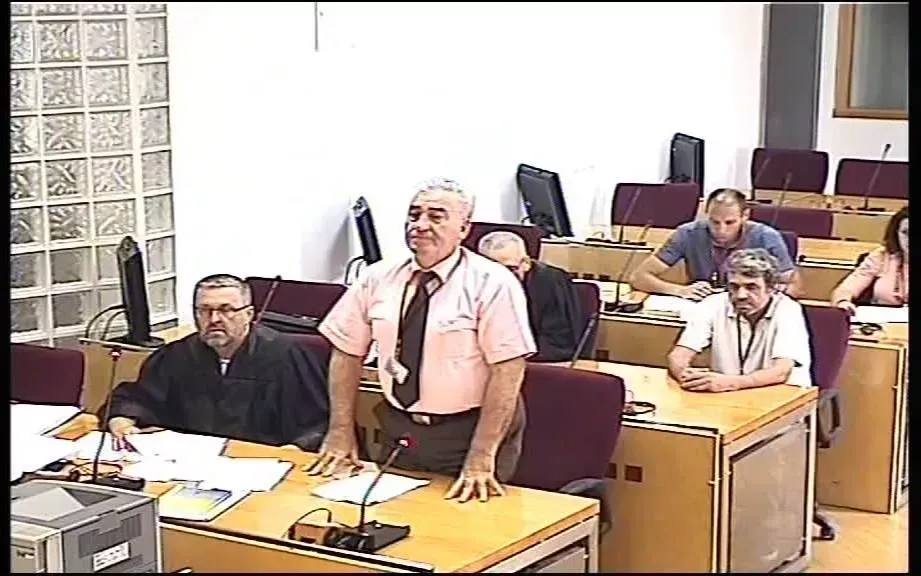 Đakić died in prison in 2021
The following story aims to illustrate the work of the judiciary, which in the years past, and unfortunately in the years to come, brings suffering, legal uncertainty, and destruction of lives, all with the aim of revisionism and rewriting the truth.
In 2019, the Appellate Panel of the Court of BiH sentenced Đakić, former commander of the First Battalion of the 108th Brigade of the Croatian Defence Council (HVO), to eight years in prison for war crimes against Serb civilians in the village of Bukvik near Brčko on September 15, 1992. The first-instance panel had sentenced Đakić to two years in a non-final verdict. The prosecutor in this case was Miroslav Janjić, now a judge at the Court of BiH, and all complaints against him in this case ended as many others – rejected. Janjić became a judge at the Court of BiH
Đakić's lawyer, Osman Mulahalilović, reveals details of the struggle in this process to Patria, and this struggle is not much different from those in the cases of 'Naser Orić', 'Izet Arifović Ćiza', 'Ahmet Sejdić', 'Sakib Halilović', the Jošanica case, the Dobrovoljačka case... and others that were not on the A Hague list. Fabricated indictments, inconsistent judicial practice, manipulated evidence, suspicious witnesses, complete inequality of parties in the proceedings! Mulahalilović: Bring back the investigating judge to the system
Mulahalilović, who served as both a judge and a prosecutor before the war, clearly identifies the shortcomings of today's system and talks about the Đakić case, where he became convinced of the flaws and the vicious cycle in which justice and fairness never prevail.
"I fought legally. I immediately requested that the entire story about the infamous TCMS system, which they violated, be established. Later, several prosecutors were dismissed because of it, and Gordana Tadić, the former chief prosecutor, ended up on the US blacklist. I filed a complaint, but Tadić herself refused to accept it, nor to fulfill my request to be provided with all the evidence. I pointed out throughout the entire process that I was not given all the evidence.
And the person who prevents me from obtaining the case file commits a criminal offense because they are obstructing the evidence. Janjić kicked me out, he physically prevented me from inspecting it. That was arrogant behavior," says Mulahalilović.
He adds that the legislative framework that allows unlimited power to the prosecutor, such that courts do not control everything, results in what is happening.
"I was a judge in Tito's time, and the investigation was controlled by an investigating judge. I was once an investigating judge, I was the chief prosecutor. And I, as a prosecutor, would submit a request to the investigating judge and state what the investigating judge should conduct, which investigative actions. Then the investigating judge would conduct them, as well as actions on their own initiative. Then they would compile a record of it and make a report on the questioning of persons, expert testimonies, etc.
I would immediately have a case file and it would be returned to me as the prosecutor, and I, as the prosecutor, would file an indictment or dismiss the investigation. You see, that system works in France, Italy, that system of so-called Continental Law works throughout Europe. The system we have is Anglo-Saxon, which exists in America and England and nowhere else. That system is the wrong way around for the Criminal Procedure Code, and we must urgently return to the old Criminal Procedure Code system, of course, improve it," emphasizes Mulahalilović.
And it is precisely this inequality in proceedings that lands people in prison, and often acquits them of guilt. Prosecutors behave arrogantly, outside of any legal norms, and the High Judicial and Prosecutorial Council either lacks the strength or knowledge to seriously deal with complaints coming to the Disciplinary Prosecutor's Office.
"I filed a disciplinary complaint, and they rejected it. I filed a criminal complaint for obstruction of evidence, and they dismissed it. It's a closed loop. The investigation must be conducted by an impartial tribunal, and we, as parties, participate, we can propose some evidence. We propose some hearings, expert testimonies, and then the investigation is concluded and returned to the prosecutor. However, the court conducts the entire process, and I am informed of the investigation results, and the prosecutor files or dismisses the investigation.
Why does that model work for two hundred years in Europe, in France, in Germany, the investigating judge. Why, for what reason? And how did it work in the former SFRY, in the Kingdom of Yugoslavia. Why wouldn't it work for us anymore.
And cases are piling up, and it's getting worse and worse. And it will only get worse and worse in the rule of law and legal certainty," warns Mulahalilović.
Specifically, in the case of Mensur Đakić, the perpetrator of this criminal offense has never been prosecuted, nor is it known who he is, and Đakić, although not actually responsible, went to prison for not punishing the perpetrator!
"He was the battalion commander. He was not the head of security in the battalion, so as to investigate and file reports. Here, he is only held responsible for failing to punish, and that in a legitimate military operation.
Evidence is being hidden. A criminal offense is committed, and everything is done intentionally so that one cannot see the forest for the trees. Irrelevant witnesses were involved in the proceedings. The court, however, gave credence to Šefket Lubinović, who changed his testimony several times. And he is not credible, but the Court gave him credence. And I never received all his statements," says Mulahalilović.
The system of impunity must be abolished, he warns.
"Cantonal prosecutors are controlled by the federal prosecutor. District prosecutors of Republika Srpska are controlled by the prosecutor of RS. Who controls state prosecutors? No one, they control themselves.
When you file a disciplinary complaint with the HJPC, they cannot professionally reach those levels. Someone without experience cannot be a prosecutor in the disciplinary office," warns Mulahalilović.
It is impossible to write about this topic without remembering the late Izet Arifović Ćiza, a man who, like Đakić, passed away with a heavy burden of injustice. Arifović died with a heavy burden of injustice
The paradox of BiH justice in this case was reflected in the fact that in two separate proceedings before the Court of BiH, a panel of identical composition characterized the testimony of the same protected witness in completely different ways, which undoubtedly leads to legal uncertainty.
His lawyer, Lejla Čović, reminds that the same panel, in the verdict against Ćiza and others, gave credence to the same witness – who testified under the pseudonym O-2, while the Court panel in the proceedings against Naser Orić did not give credence to the key protected witness O-1.
This witness will also appear in the case of Elfeta Veseli, and there too the Court did not give him credence, because Sakib Halilović was acquitted, and this 'witness tourist' grossly accused him.
"That person has appeared as a witness several times. We also filed a criminal complaint against him, but no one ever acted on it. And that person continues to live at the state's expense somewhere abroad and is protected," states Čović. Čović: Filed criminal complaints
Everyone knew that Ćiza was not even close to the place for which the Prosecution accused him. SIPA members, the acting prosecutor, and the court panel all knew. Everyone knew, but they participated together in sentencing the man to 10 years, and he died a few months later due to injustice.
Well-paid members of judicial institutions just need to do their job and justice will be served, that's what they teach us, but in practice, they prove the opposite.
"Those people who sit in the HJPC cannot reach the virtuosity of experienced prosecutors and judges against whom disciplinary proceedings are initiated. They can be brilliant, I admit, all of them there are more intelligent than me, but they are not more expert.
It requires skill and experience to uncover these illegalities, these are highly sophisticated illegalities," emphasizes Mulahalilović.
But while waiting for a new, brighter future in empty talk about a better tomorrow brought by reforms, which are again arranged by foreigners, lives are extinguished. Đakić and Arifović are no longer among the living, while their persecutors advance in their careers. They move from position to position, and justice dies, or has already died with the late Đakić and Arifović, cases that will be the subject of legal studies.
Suspected criminals today, as in previous decades, flee to Serbia and Croatia, and our judiciary does nothing to prevent this or bring the criminals to BiH, preferring to prosecute members of the Army and the MUP of RBiH instead. And the implementation of the Revised Strategy and Annex B – cases for which the Hague Prosecutor's Office has given consent for prosecution in BiH is slowly becoming a scientific fantasy.
However, it remains unacceptable that in BiH there are no indictments for the sieges of five so-called UN protected zones, and responsibility is sought from those who are clearly consciously obstructing the filing of indictments for the siege, but the HJPC remains silent.
Komentari (0)
Prijavite se za komentiranje
PrijavaJos nema komentara. Budite prvi!
Minuta
Sve →Iz drugih kategorija

High Representative Not Elected: Germans, French and British Against Americans, New Attempt at End of June

ČOVIĆ WITHOUT MERCY: How Those Who Brought Ademović to Office Created a Political Hell for Him



Sunny Saturday, quite warm



Tragedy in Albanian resort: Two minors drown












