
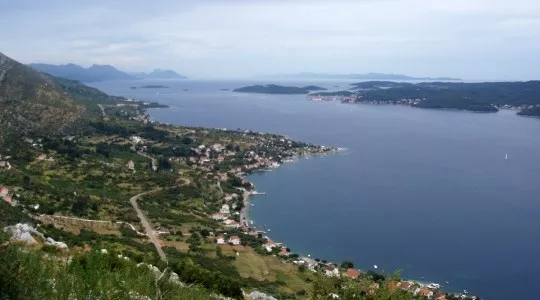
If Bosnia and Herzegovina allows the construction of the Pelješac Bridge, it will become the first country to give up its right to access the open sea. And voluntarily.
Without the consent of the BiH side, Croatia has no chance whatsoever to build a bridge in the Bay of Mali Ston that would connect the Dubrovnik-Neretva County by land to the rest of Croatia. No one has the right to develop their land at the expense of a neighboring country. This bridge would definitely block Bosnia and Herzegovina's access to the open sea. It would be a violation of international conventions, to which official Zagreb is also bound.
The claims being disseminated these days by Croatian media, as well as some in BiH close to the HDZ, that BiH agreed to the construction of the bridge back in 2007, are refuted by documents previously published by Patria, as well as by reviewing Croatian media reports from a few years ago.
Jutarnji list was particularly prominent, uncovering the scandal of an "offshore" company buying 5 million square meters of scrubland and rocky terrain on Pelješac for 40 million euros!? The purchase was made in 2007, and the scandal was revealed to the public in 2009. Today, few people even mention it.
"Corporatie Emac Illyrian Land Fond (CEILF) from the Netherlands bought five million square meters of land on the Pelješac peninsula in March 2007, and the Dutch investor committed to paying around 40 million euros to the three landowners," Jutarnji list claims in its March 23, 2009 issue.
The plots on Pelješac purchased in 2007 are not in a construction zone and are located in the municipality of Duba Stonska. There is no urban plan for that part of the Pelješac peninsula yet, and representatives of the Fund paid 8.20 euros per square meter for scrubland and rocky terrain in Duba Stonska. Let's also mention that a sales contract was published, which claims that the land, as well as family inheritance, was sold through a legal sales contract with all legal conditions met.
"By signing the contract, the former owners acquired the right to an advance payment of 200,000 euros and a second advance of one million euros, while the first installment of 20 million euros was paid in January 2008, to a separate account at RBA," according to Jutarnji, which decided to protect the identity of the individuals who became millionaires overnight.
"Three years ago, when CEILF was founded, the idea of building the Pelješac Bridge was just in its infancy, there were no indications of future infrastructure yet, nor were there finalized projects for county and access roads, one of which, as we learned, passes through Duba Stonska. The fact remains that an investment of around 40 million euros, without the future bridge and new road infrastructure accompanying the bridge construction, most likely cannot have any future," Jutarnji concluded in 2009.
The then journalist of Jutarnji list, Gordan Malić, also shared his insights regarding the mysterious purchase of this land in an interview with Index also in 2009, claiming that the answer to the question "why not abandon the Pelješac Bridge" lies in the large land transactions on Pelješac that began in 2007.
The seemingly worthless areas were purchased by the mysterious Coorporatie Emac Illyrian Land Fond and form the basis of a private investment worth 200 million euros, the so-called Duba Stonska project, which investors, according to Malić, would not undertake without the construction of the Pelješac Bridge, accompanying infrastructure, and guarantees that the General Urban Plan will be tailored to their needs over the next ten years.
"I went to Dubrovnik and Pelješac and discovered that in mid-2007, a sales contract was made with several local families, ordinary people, who sold their land for a lot of money and who did not break the law; they are heirs and it is their ancestral land. The interest in this land is interesting. In 2007, there was no concrete political decision for the construction of the bridge, meaning no funds were allocated for its construction and all its phases. There is no GUP for that land at that time."
Index: How much money is involved?
It should be known that the land itself constitutes only 20 percent of the investment. According to the data I have, and I had access to the sales contracts, the price was 8.2 euros per square meter. That is extremely high for 2007 when it was just a ravine, wasteland, not construction land; the General Urban Plan needs to be resolved, it is unknown if there will be a bridge... All together, for two plots, over 40 million euros were paid in cash, which is slightly less than the price paid for the entire Sunčani Hvar with built hotels and people. Therefore, the value of a complete tourist plan of one of the most elite destinations in Europe is now being invested in wasteland, scrubland, pasture, stone, ravines, with a little bit of forest. It is important that it is still not resolved in the GUP, and it is questionable when it will be.
Index: Why does wasteland cost so much?
My logical conclusion, for which I have no proof, is that this is capital that operated with certain deadlines related to decisions concerning the bridge, access roads, and highways, etc. Because it is a strange investor who, on the eve of a recession, when loan interest rates are starting to rise, spends 40 million euros on wasteland, waiting for it to 'grow'. These euros must grow to over 200 million, as that is the value of the investment, considering the scope and the fact that the land is 20 percent of the total investment. And it must grow in the near future because the value of capital increases and losses can be significant if the entire project is dragged out. And no fund, no real investor would risk such a sum if they were not completely sure that the GUP would be approved in the near future, the bridge would be built, that land would be sold, and that all of this would be worth far more than it is worth now.
Index: Who provided the guarantees?
Everyone well-intentioned, and even some ill-intentioned, advised the Government not to build the bridge during the recession - from the International Monetary Fund, the World Bank, the European Commission, the opposition, the public, the president, even coalition partners who consider it not a priority. Everyone - except the ruling party.
Index: Sanader once justified that the Pelješac Bridge is necessary for establishing the Schengen border, which was later denied by the European Commission. How do you comment on that?
I would not delve into the diplomatic, geopolitical reasons for construction. The point is that there are no economic reasons, and they are always dominant. Even Sanader himself now dismisses these geopolitical reasons - he says we don't need to rush so much into the European Union. And just a few days ago, the government reiterated that the Pelješac Bridge will be built. Economic reasons have always been the most important.
Index: Who is the buyer?
The investor is a Fund called Illyrian Land Fond, which has 28 offshore companies. They all have the same name and are designated only by serial numbers from 1 to 28. According to the commercial register in Amsterdam, it states that it engages in representation exclusively for private individuals and private investors or groups of investors, specializing in real estate. This Fund is managed by three or four people. Some are citizens of Slovenia, some of the Netherlands. There are no Croats, but they manage the offshore company and the Fund; they are not the investors who provided the money they manage. The real owners, as one of the Fund's representatives told me, are Scots, members of the Scottish royal lineage. I asked for phone numbers so I could contact them, but they didn't give me the numbers, nor did they tell me who they were. And knowing the Scots, or rather, stories about Scots, I doubt they would throw 40 million euros at wasteland just like that.
Index: If not Scots, then who?
I suspect they are some of 'our Scots' who are well aware of the developments concerning the Pelješac Bridge and all the repercussions of its construction, except for the social aspect, which they don't care about at all. As soon as something is in a fund or an offshore company, I'm not saying it's illegal, but it's not very transparent, and it's very difficult to trace the source of the money. Of course, it could be the most legal business in the world, but also the biggest scam, because we have two 'cloaks': one is offshore, the other is a fund.
Index: How do the "Scots" communicate with Croats?
When I asked at the Commercial Court where this ILF was registered, I got an address - Mandaljenska number 4. When I looked for this office that handles the largest sums of money in the Dubrovnik-Neretva County and beyond, representing huge investments, I found a family house without any signs or offices, owned by a person named Teodorinko Renco Pecotić.
Index: Who is Renco Pecotić?
He is a peculiar business figure who occasionally appears in the milieu of grey entrepreneurship as a protagonist of controversial deals. For example, the illegal construction of an 11-story building on Korčula by the sea, which was the subject of investigation by the Ministry of Construction. An 11-story eyesore, right by the sea. Another scandal was related to his career as a failed shipowner and a ship that was docked in the Port of Ploče last year. Due to the company's debts, the people on the ship simply didn't have money to pay for the berth, nor for food, so they were helped by the Seafarers' Union, who brought them food on board. They were like mice; this was a year ago. So, this person who didn't pay people their wages, who is in debt and had no money to the extent that people were starving on his ship. That ship, I think, ended up as scrap. Suddenly, he gets involved in a 40 million euro deal.
Index: Why was he chosen as an intermediary?
It's interesting that investors trust such figures. According to his claims, he received a state concession for the construction of wind turbines, whose energy potential is four times greater than the largest we have in the Velebit channel. He suddenly became a player in serious games concerning energy and other issues. When I asked him if he knew anyone from the HDZ and if he was close to the party, he said he knew many people from the business and political milieu. For example, Luka Bebić, with whom he has had a good relationship since 1991, but he was adamant that Bebić knew nothing about it.
Index: So who does know?
The famous Scots, noble, blue-blooded, about whom he doesn't want to say anything. They found him because, probably, from his curriculum vitae, they saw that he was business-savvy, capable, and that he turned everything he touched into gold, and so on.
Index: Does that mean they don't exist?
I can assume anything until I see them. One of the secrets of working with offshore companies is to have as many fictitious, nominal owners as possible while the real owners remain in the shadows. This was the basis of both the first and second waves of Croatian privatization. Everything is teeming with offshore companies, and we cannot prove their true ownership, nor the origin of the money.
Given that a large amount of money was transferred from abroad to Croatia, I believe that the State Attorney's Office, as well as the Office for the Prevention of Money Laundering, should have information about it. For now, I have the impression that they do not have the information. Since this is a large investment that is only feasible if the circumstances for the bridge construction are resolved as soon as possible, I can reasonably suspect, although I have no proof, that this is a project fundamentally linked to the construction of the bridge. Without construction in the near future, it is pure business suicide.
Index: What does Pecotić say will be built there?
He claims that in the future they plan to build a huge apartment complex with an exclusive hotel. I remind you that some leading Croatian developers told me that this is economically completely unjustified. It falls into the realm of business risks of science fiction. Therefore, it seems to me that a large marina or port project would be suitable for such terrain and configuration, at the entrance to the bay itself, behind the Pelješac Bridge, meaning not next to it but behind it. A marina is more likely. However, in that case, investors must count on obtaining a concession for building a marina, for which the state also has a say, and must announce a tender, and so on, and so on. According to economic logic, this investment has a long development period of at least 10 years and has many points of contact with certain decisions of the Government, state and local self-government. From the construction of the bridge, access roads, infrastructure, adoption of the GUP, or eventual concession. It seems that these Scots are more in cahoots with the authorities than many Croats are.
Index: So you reject the explanations that the Pelješac Bridge serves to revitalize southern Croatia, the Schengen regime, create jobs in a crisis year...?
Behind campaigns of so-called national and state interest, profiteering motives are most often hidden. Behind every discussion of important principled issues lie some money in some secret accounts. We only find out about it when the owners of that money quarrel among themselves over money, and then they also 'principally' disagree. There are rare occasions when journalists uncover this, and it has become almost a custom that the topics then become not those who take the money but those who write about it. The theory that I work for the British is spread by those who work for the Scots.
Komentari (0)
Prijavite se za komentiranje
PrijavaJos nema komentara. Budite prvi!
Minuta
Sve →Iz drugih kategorija

High Representative Not Elected: Germans, French and British Sabotaged Americans, New Attempt at End of June

ČOVIĆ WITHOUT MERCY: How Those Who Brought Ademović to Office Created a Political Hell for Him



Sunny Saturday, quite warm



Tragedy in Albanian resort: Two minors drown












