
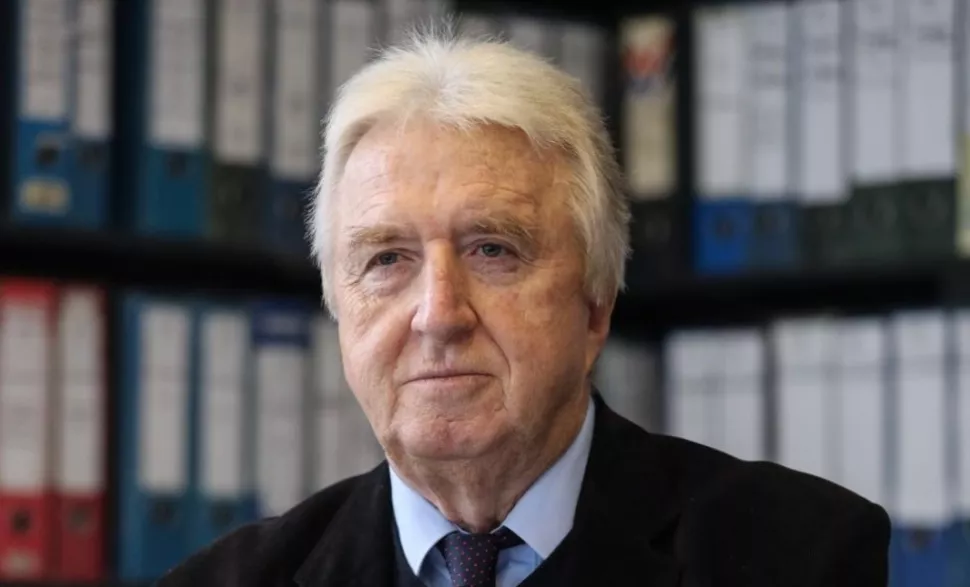
Sociologist Ivan Markešić, in an interview with the Patria News Agency, speaks very openly about the harmfulness of Milorad Dodik's visit to Zagreb and his meeting with Zoran Milanović.
Relations between Zagreb and Sarajevo have deteriorated again after Milorad Dodik visited Milanović. For a long time, no political visit to Zagreb has caused so much turmoil, excitement, and diametrically opposed comments. How do you view this visit by Dodik and everything that followed it?
I have already spoken publicly about this (https://www.jutarnji.hr/vijesti/hrvatska/zagreb-je-opet-pogorsao-odnose-sa-sarajevom-ovo-je-bio-bezobrazluk-kakav-se-ne-pamti-15020030). Firstly, I consider this visit very harmful not only to the Republic of Croatia as a member of the European Union and NATO but primarily to Croats in Bosnia and Herzegovina, especially those who are a minority in the Federation of BiH compared to Bosniaks. All proponents of the policy of 'two without a third' in Bosnia and Herzegovina do not see the abyss into which it is leading us and into which such a policy led us thirty years ago.
Its results are found in cemeteries across Bosnia and Herzegovina, in graves as signs and indicators of the consequences of everyone fighting against everyone. Secondly, this visit is a symbol of disrespect for the institutions of another sovereign, independent, and internationally recognized state. I believe that Mr. Milanović should have made his first foreign visit to Bosnia and Herzegovina for many reasons: political, economic, cultural, and security. Without an apology, it will be difficult to do so in a way that satisfies everyone.
Thirdly, this visit will not result in the adoption of the election law as its proponents would like. And for the following reason: as long as the Dayton Agreement is in force, the member of the BiH Presidency of Serb nationality will be elected by citizens of BiH in the territory of Republika Srpska.
Other nationalities can also cast their votes. However, they cannot vote for one of the two members from the Federation of BiH. Likewise, two members of the BiH Presidency, one Bosniak and one Croat, will be elected by citizens of BiH in the territory of the Federation of BiH. It is not stipulated that only Croats or Bosniaks elect a person who has run as a Croat or Bosniak for the position of BiH Presidency member.
The fundamental question is how to reach an agreement and, in that segment, change the BiH Constitution and the Election Law, and thus the Dayton Agreement. For two ethnic groups in the Federation of BiH to be able to directly elect their representatives in the government bodies, the territorialization of the Federation of BiH is necessary, which in this case would mean the division of the Federation of BiH on a national basis, into a Bosniak and a Croat part. Exactly as it was done with Bosnia and Herzegovina, which was territorialized into two entities.
Whether this will happen or not is a matter of agreement between the two political elites who wish to represent the two peoples. How – if we take Bosnia and Herzegovina and its two-entity division as an example – to ensure the right to vote for Bosniaks or Croats in areas where they are a minority. There are many questions, and the answer is not at all straightforward.
For years, Croatia has indirectly and directly interfered in the internal affairs of BiH, all under the guise of fighting for the equal rights of Croats. However, this time we did not get an answer as to whether Milanović asked Dodik why there are no Croats in RS. How can we fully clarify that relationship, because Dodik very directly denies all crimes in which Croats also suffered. Where does Milanović's attitude towards Dodik come from?
In the answer above to the first question, I stated my position on this visit. It had to have some meaning. Personally, I see no meaning in this visit at this moment, except for the core of future Bosniak-Croat disputes and the creation of tensions that no one needs. However, despite this, I believe that President Milanović should not have received Dodik under these circumstances, not even for a coffee.
The circumstances in which the remaining Croats in the RS live are known to everyone. It seems that on this occasion, the approach was based on the idea – what has been, has been. Let's forget and erase all individual suffering and hardships, persecutions, tortures, rapes, killings; let's forget and erase all without seeking or giving forgiveness, without apology. Can it be like that? It is difficult to say. I think it should not be possible. The guarantor of future peace in these areas is confronting one's own ugly past, seeking and giving forgiveness.
The fact that Croatia and Serbia are guarantors (guarantors, endorsers) of the Dayton Agreement does not mean they have the right to interfere in the internal affairs of BiH, but rather the obligation not to hinder, but to help implement the provisions of the Dayton Agreement, which defines Bosnia and Herzegovina as a sovereign and independent state, a member of the United Nations.
Dodik openly accuses today's Croatia of the Ustaše crime in Jasenovac, and does everything to divide BiH and annex Republika Srpska to Serbia. What are Croatia's interests in this?
In what you have stated, Croatia should have no interest, especially not in the division of BiH, let alone in the need to annex Republika Srpska to Serbia. Then, Greater Serbian politics would also have Zagreb in its sights. Here, it seems to me, either there is nothing but a bit of pre-election warming up, or something big is brewing behind the scenes, and these are just short-lived sparks of new processes or perhaps conflicts. I think Reis Kavazović detected them very well, about which I have already written on the portal Autograf.
It seems that everyone, when in a position of power, can declare any of their moves, including this one, as the highest national interest. All political sycophants, especially those in the public sphere (among whom I primarily include intellectuals as 'the most infected and treacherous by politics'), are doing everything – as we witness these days – to prove that their protégé is right, thereby creating an infallible political deity out of him.
I wish that people in both Croatia and Bosnia and Herzegovina would find the courage to confront all the evils that have occurred in the name of supposedly heavenly (chosen) peoples and then seek forgiveness from the victims. In all of this, it will be hardest for the victims. It is likely that this visit has placed this fact in a special drawer and left it waiting for some new times. Perhaps, if they wish, representatives of religious communities could open it, provided they are not infected by national-party interests and the interests of their leaders.
Komentari (0)
Prijavite se za komentiranje
PrijavaJos nema komentara. Budite prvi!
Minuta
Sve →Iz drugih kategorija

High Representative Not Elected: Germans, French and British Sabotaged Americans, New Attempt at End of June

ČOVIĆ WITHOUT MERCY: How Those Who Brought Ademović to Office Created a Political Hell for Him



Sunny Saturday, quite warm



Tragedy in Albanian resort: Two minors drown












