
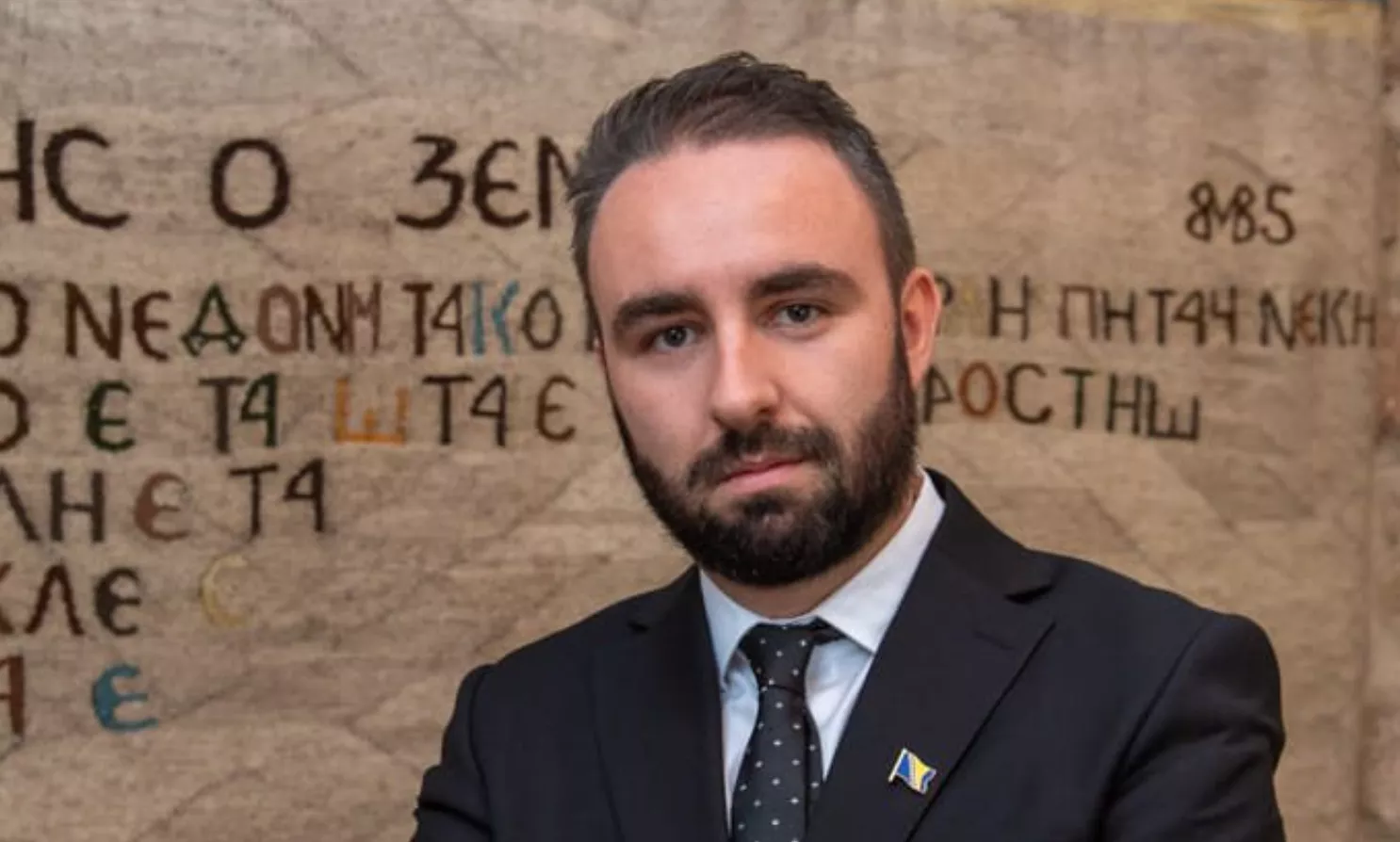
Interview by Delvin Kovač
The foreign policy of Bosnia and Herzegovina must be exclusively created in Sarajevo and must not be influenced by the wishes of Zagreb and Belgrade. Bosniak policy must at all times be subordinate to the interests of the state of Bosnia and Herzegovina, as it was during the most difficult moments of the aggression.
This was stated in an interview with the News Agency Patria by Admir Lisica, a researcher in the field of regional and international relations, who summarized the political events that marked the past year in the Western Balkans region in the context of Bosnia and Herzegovina.
What events would you highlight as the most interesting in 2023 regarding the Western Balkans region?
Lisica: We have had a very turbulent year, so it is very difficult to choose events that are "more important" than others. However, in Bosnia and Herzegovina during 2023, the actions of High Representative Christian Schmidt, who repeatedly made illogical decisions that further complicated the already complex political situation in Bosnia and Herzegovina, certainly attracted the most attention.
In the context of Kosovo, there was the terrorist act by Serb terrorists in Banjska, for which Serbia was not punished. On the other hand, it is important to emphasize that Kosovo, perhaps the most loyal partner of the West in this part of Europe, is subjected to some kind of sanctions, all due to not yielding to the wishes of Serbia, as well as certain leaders of the international community.
Regarding Montenegro, perhaps I would choose the census, which was postponed several times and ultimately became the number one political issue. In the context of North Macedonia, it is important to note that 2023 was unsuccessful in terms of its European path, which was disappointing for the citizens of this country.
In Serbia, the main event is related to the recently held early elections, which are still being discussed as an event accompanied by many controversies.
Bosnia and Herzegovina is still caught in the crossfire between Serbia and Croatia, which are not giving up on the Milošević-Tuđman policy. Vučić, Milanović, and Plenković have loyal "contractors" in our country - Dodik and Čović? On the other hand, there is the Troika, which not only lacks the vision, strength, and will to even attempt to oppose such policies, but has also handed over numerous key positions at the state level on a platter? What should we do?
Lisica: The foreign policy of Bosnia and Herzegovina must be exclusively created in Sarajevo, and must not be influenced by the wishes of Zagreb or Belgrade. Regarding Bosniak policy, it must at all times be subordinate to the interests of the state of Bosnia and Herzegovina, as it was during the most difficult moments for Bosnia and Herzegovina during the aggression, when the Bosniak political leadership clearly articulated its positions and did not succumb to pressure to agree to a loose union, which would ultimately result in the dissolution of the Republic of Bosnia and Herzegovina. I emphasize this because 1993 was far more difficult and seemed more hopeless than 2023, in which we unfortunately saw the political dominance of Milorad Dodik and the axis supporting separatism.
Mistakes were made in the past, but it is clear that due to major geopolitical changes in the world, this generation of politicians has a great responsibility in the context of the future of Bosnia and Herzegovina. We must not rely too much on external factors, i.e., the international community, but our goal must be to strengthen our own capacities.
Let's look at the countries in the region and their foreign policy, and the results it yields. I am aware that the position of Bosnia and Herzegovina is different, due to all circumstances, but this does not prevent Bosniak political representatives, as well as patriotic pro-Bosnian oriented Croats and Serbs, from continuously striving to strengthen Bosnia and Herzegovina in every segment.
All Serbs in one state, or the more popular concept of "Serbian world," is an idea that the authorities in Serbia do not intend to abandon. If it were up to them, they would annex Republika Srpska, Kosovo, and Montenegro today. How can such territorial pretensions towards other countries, as we have seen in Gaza and Ukraine in recent months and years, be conceived and interpreted in the modern era?
Lisica: Former British diplomat Robert Cooper, in his 2003 work titled "The Breaking of Nations: Order and Chaos in the 21st Century," presents a thesis that European Union member states, unlike in the past, no longer have pretensions towards each other in terms of appropriating their territories. Of course, this thesis is true in the context of European Union countries, but outside that circle, it seems to have become common for certain countries to strive for territorial pretensions towards a particular state.
In the context of Serbia's continuous pretensions towards Bosnia and Herzegovina, the current member of the Presidency of Bosnia and Herzegovina, Denis Bećirović, wrote an important work titled "Serbia's Territorial Expansionism towards Bosnia and Herzegovina." By thoroughly analyzing the content of this book, one can see that Serbia does not abandon its territorial pretensions towards its neighboring countries.
Milorad Dodik has repeatedly stated that a state comprising Serbia, the RS entity, and Montenegro should be created. We have not had serious reactions from international officials to Dodik's statements, nor to Aleksandar Vulin's earlier aspirations. The "Serbian world" is a reality, and its product is certainly the terrorist action in Banjska in 2023. It is up to the political representatives of Bosnia and Herzegovina, especially the Bosniak component, to unite and strongly stand against ideas that would ultimately lead to the disintegration of the state of Bosnia and Herzegovina.
At the elections in Serbia, Vučić and his Serbian Progressive Party (SNS) once again achieved a convincing victory. However, in recent days, and even months, numerous protests have been held in larger Serbian cities. Citizens are dissatisfied with the current government, and Vučić has no one to "stand up to him" in elections - it is clear that these two things are in conflict. How do you see this?
Lisica: The elections in Serbia have shown that democratic processes in this country are currently stagnating. Regarding recent events, it is evident that the current political system in Serbia is democratically competitive, but not fair, as factual observations across Serbia indicate objections to the electoral process and, ultimately, the results.
The opposition has finally managed to largely set aside "difficult topics" and focus on the current needs of citizens and the change of the long-standing authoritarian regime. The weakness of such an opposition is their excessive focus solely on Belgrade, neglecting the rest of Serbia.
If the opposition manages to gain greater trust outside of Belgrade in the coming period, it will pave the way for possible changes in future elections. However, until then, Vučić's SNS will rule sovereignly and very successfully politically remove or discipline, as in the case of Ivica Dačić and his SPS, all those who could disrupt the current rule of the SNS.
At the end of last year, the census in Montenegro was completed. Preliminary data should be known by the end of January. Can a tectonic shift be expected in Montenegro if it turns out that Belgrade and Moscow have drastically interfered in the census process itself?
Lisica: The census in Montenegro is certainly a political issue that marked the past year, because several controversies were recorded in the context of its implementation. The census itself was postponed several times, and the political opposition in Montenegro at one point threatened to boycott the entire process due to alleged irregularities. Ultimately, the census was held, and during the process, a number of irregularities were recorded, including the "write-erase" affair, where sixteen enumerators had pens that allowed for the modification of census data.
Ultimately, I do not expect the tectonic shifts that Montenegrins feared. Serbs will increase their numbers, which has been the main goal of official Belgrade in the recent period, but it will not seriously disrupt relations in Montenegro. It is possible that Turks, Russians, and Ukrainians will increase their numbers due to their immigration to Montenegro in recent years.
There has been no progress in the dialogue between Kosovo and Serbia for a long time. In the European Union, it seems, there is either no will/desire or no one brave enough to slam the table in front of Vučić and Albin Kurti and give them a deadline to resolve their disagreements as soon as possible. Do you expect these negotiations to remain in a stalemate in 2024, or could a resolution to this Gordian knot be expected, and in what way?
Lisica: Without much media attention, Serbia accepted the license plates of the Republic of Kosovo, which in previous years was a contentious issue and a topic that often led to tensions between Serbs and Albanians. Serbia has effectively made a concession to Kosovo, shifting the ball to Kurti, who will have to form the Community of Serb Municipalities (CSM) during 2024, which the international community has long insisted on.
It is clear that the issue of Kosovo burdens not only the two states - Serbia and Kosovo, but also the rest of the Western Balkans. It is in the interest of the region to finally normalize relations, however, it is difficult to expect that in 2024 the two sides will agree on all "difficult" topics.
Regardless, there will be several rounds of negotiations in the coming year, and unlike in 2023, I expect some progress (without a final solution) to occur, as it is in the interest of the international community.
Komentari (0)
Prijavite se za komentiranje
PrijavaJos nema komentara. Budite prvi!
Minuta
Sve →Iz drugih kategorija

High Representative Not Elected: Germans, French and British Against Americans, New Attempt at End of June

ČOVIĆ WITHOUT MERCY: How Those Who Brought Ademović to Office Created a Political Hell for Him



Sunny Saturday, quite warm



Tragedy in Albanian resort: Two minors drown












