
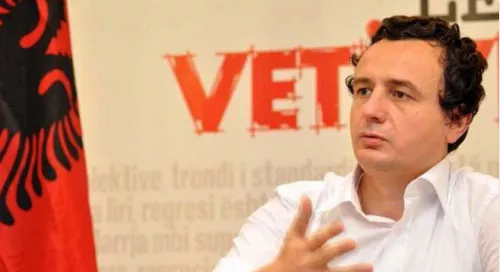
Albin Kurti was born in 1975 in Priština. During Milošević's regime, as a student, he spent three years in prisons in Požarevac and Lipljan. He has an uncompromising and always original stance on Kosovo's political problems. In an interview with the BiH news agency Patria, he presents almost identical dilemmas for Bosnia and Kosovo in the face of Serbia's new aggressive policy.
He precisely diagnoses and detects Serbian policy that produces political crises in the neighborhood. It is noticeable that he speaks more thoroughly and comprehensively about Bosnia and Herzegovina's problems than most Bosniak politicians.
At first glance, your life seems to be 41 years of "storms and thunder." You are constantly active, in conflict, and persecuted, from Milošević's criminal regime to today's conflicts with the views of the Republic of Kosovo's authorities. You are not a classic opposition figure. Although you are in politics, your methods are active, effective, and yield results.
The "Vetëvendosje!" (Self-determination) Movement believes that democracy should be both direct and representative, but under no circumstances only representative. It is not enough to fight only on the streets or only in parliament. We need to have direct actions, and that is, in fact, our vocation as a movement that is not a political party. Our methods remain entirely political and democratic. To this day, the "Vetëvendosje!" Movement has not harmed any citizen; on the contrary, its activists have been arrested, physically mistreated, and even killed by the ruling regimes.
You recently stated that Milorad Dodik, the president of an entity in BiH, is closer to Putin than to Vučić, and that if a community with a majority Serb population is formed in Kosovo, it will immediately, metaphorically speaking, connect with Putin.
The community of majority Serb municipalities will have the right to establish diplomatic relations with other sister communities, for example, as they say, with similar entities in Republika Srpska, Serbia, Russia, Belarus. We know that Milorad Dodik has much better relations with Putin today than with Vučić. If the community of majority Serb population comes to life in Kosovo, it will immediately connect with Putin. We cannot allow this, and we are ready to prevent the "Bosniakization" of Kosovo. Before Republika Srpska was created, the Community of Municipalities with a majority Serb population was initially established.
Dodik has already offered Mother Russia Republika Srpska at its disposal. Do you think Putin has already settled in Bosnia and Herzegovina? Some say that Russia, through Dodik, has already taken over Mahovljani Airport and has no problem "entering" Europe.
Russia most consistently fuels the long-term failure of Bosnia and Herzegovina, producing the Balkan version of South Ossetia from Republika Srpska. Putin mentions Kosovo once a week, comparing it to Crimea. Let's not be surprised if one day "Russian peacekeepers" appear on the borders of the Republika Srpska entity.
You once said that Serbia wants to be Russia in the Balkans, and that's why it imposes itself as a local power. Do you believe that Kosovo and BiH are exposed to a kind of peacetime aggression from Belgrade? Some claim that this influence is strongest through the intelligence underground. What scale do you think this can reach?
The collapse of the Soviet Union resulted in a large octopus. The Russian Federation is the head of this octopus, while the tentacles of this octopus are Belarus, eastern Ukraine, Gagauzia, Transnistria, Kyrgyzstan, Armenia, South Ossetia, and Abkhazia.
The collapse of Yugoslavia resulted in a small octopus, or rather a quadruped. In this case, the head of the octopus is Belgrade, i.e., Serbia. Brussels wants to detach the quadruped from the octopus. But the quadruped insists on its efforts, telling Brussels: if you want me to distance myself from my mother, then help me strengthen my tentacles in the Balkans.
In Bosnia, Serbia has Republika Srpska; in Montenegro, it has strong neo-fascist and neo-conservative opposition structures; in Kosovo, it has its northern part and enclaves directed by Serbian state structures, while in Macedonia, influence is exerted through the pro-Serbian government of Nikola Gruevski and the Serbian Orthodox Church.
What Serbia failed to achieve quickly during the war, it wants to achieve slowly in peacetime. I think Vučić and Dačić are the legacy of Milošević and Šešelj. And I see no difference in their goals; I only see a difference in strategy and methods because the circumstances are different. Serbia's current goal is not to occupy Kosovo but to "Bosniakize" it. Likewise, they currently say they do not want the division of Bosnia. Vučić went to Banja Luka on January 9th and said he loves Republika Srpska, and that day was declared an unconstitutional day for Bosnia. I think there is a double imitation – on the one hand, Vučić imitates Milošević, his Greater Serbian ideas and goals, and on the other hand, there is an imitation of Putin in terms of satellite quasi-states in neighboring countries. This double imitation will not lead to long-term peace, security, and stability in the Balkans. On the contrary.
What is the status of the formation of the "Community of Serb Municipalities"? What will its functions be? Is it about autonomy within the Republic of Kosovo? According to announcements, is it a federal or confederal structure (you once said it could involve diplomatic relations with Russia, Serbia, Republika Srpska, etc.)? Could it be a replica of Republika Srpska?
As a result of the actions of the united opposition, the President of Kosovo, Atifete Jahjaga, was forced to forward the signed agreement in Brussels to the Constitutional Court for an assessment of its constitutionality, during which it was determined that 23 articles of the Agreement contradict the Constitution. The "Community" project is blocked, however, the government is still trying to revive it at all costs. The Community, as stated in the agreement, would have its own president, flag, and symbols, full oversight of economic development at the local level, urban and rural planning, healthcare, education, and culture. The ZSO would have a head of administration and an executive board and, in a way, be a "mini-government" of seven people. It will be the link connecting municipalities inhabited by Serbs and a vertical link to Belgrade, "federalizing" Kosovo into a "Kosovo" and a Serbian entity, not forgetting that the Republic of Kosovo is not recognized as a sovereign state by Serbia!
When Milošević and the Dayton Agreement finally recognized Bosnia and Herzegovina, Serbs were one-third of the population in Bosnia and received half of Bosnia. Here, Serbs in Kosovo are only 6 percent of the population, and we do not feel threatened by Serbs, but Belgrade intends to control a quarter of Kosovo through the community of municipalities with a majority Serb population. This will further defunctionalize Kosovo, turning it into another Bosnia and thus, in the long run, trying to create more favorable opportunities for Serbia.
Why agree to negotiations on the Community of Serb Municipalities? Shouldn't Serbia recognize the Republic of Kosovo first, and only then proceed with the formation of this community?
The dialogue conducted with Serbia so far has not imposed any conditions on Serbia, yet they are discussing Kosovo's internal affairs. Consequently, the outcome could not be just. In principle, we are not against dialogue, but we are against this dialogue that treats Kosovo as a topic and Serbia as the one determining the agenda of that topic. Serbia needs to fulfill a long list of conditions before it can qualify for dialogue with us. And for us, in the state we find ourselves in, without confirmed political subjectivity and state sovereignty, Serbia will become worse and the situation in Kosovo more difficult.
In the initial statements, we were told that the dialogue was about technical issues, and then it turned out to be political in nature. Then they said that the outcome would be the recognition of Kosovo by Serbia and international organizations. But we see Serbia strengthening within Kosovo, and Kosovo is neither recognized by Serbia nor a member of relevant international organizations. We cannot have normalization, let alone reconciliation, without mutual recognition. This dialogue creates the impression of normalizing relations, but in essence, it only deepens antagonisms, segregation, and ethnic divisions within Kosovo.
The Community of Serb Municipalities is not the result of protests by Serbs in Kosovo. Vučić wants the ZSO; he never asks about any Serb from Kosovo, what problems that person has; he doesn't care about Serbs at all; he only cares about his power. Serbs in Kosovo cannot have their own opinion at all. Belgrade does not allow Serbs from Kosovo to represent themselves. We have not heard the opinion of Serbs here yet. The ZSO is a project of Belgrade, not of the Serbs in Kosovo. And the corrupt government in Priština accepted it. We must stop the closed, diplomatic dialogue in Brussels, where Mrs. Mogherini tells Vučić and Mustafa – you have an agreement, now go and "present" it to your people. I do not believe in this top-down method of this vertical. I think real dialogue starts from the bottom up. "Self-determination" proposes a social, open, and democratic dialogue with minorities, including Kosovo Serbs. That's what we need, not dialogue with Belgrade about Kosovo's internal affairs.
Kosovo is an abnormal country and has two key problems for building stable relations: a divided city, Mitrovica, and a high unemployment rate. Serbia also has major problems; it has not confronted its past, it does not know where its borders begin and end, and moreover, it is becoming an autocratic society. I think both Kosovo and Serbia need to become normal countries, and then they need to establish normal relations with each other.
Currently, we cannot have normal relations.
BiH today has problems with the most basic political and economic relations with the Republic of Kosovo because there is no consensus within our country regarding mutual recognition. Dodik constantly vetoes recognition and normalization of relations. At the same time, goods from Serbia are duly cleared at the border, marked with their origin in stores as imported from Serbia. And this stance of Dodik's seems dictated from Belgrade.
It is a known fact that the relations between Bosnia and Kosovo are a consequence of the imposed policy by Serbia and Russia through Republika Srpska. These policies not only block the sustainable sovereignty and internal development of Bosnia but also its foreign policy. Policies of mutual regional trade exchange are a consequence of the wrong policies of central authorities and the lack of internal and external sovereignty (referring to Bosnia and Kosovo), resulting in a lack of reciprocity in trade exchange. Therefore, the full sovereignty of both Bosnia and Kosovo is vital as a response to the projects of internal ethnic division of our countries, as countries paying the highest price for the hegemonic policy of Serbia.
For example, Dodik does not want BiH in NATO, while Vučić has granted immunity to NATO soldiers. These controversies surrounding Dodik, who is a very obedient pawn of Belgrade, have led to stories resembling conspiracy theories. For instance, Serbia allowed NATO onto its territory while introducing Russian intelligence structures into Bosnia and Herzegovina. When they do their job in BiH, NATO will simply be expelled from Serbia. So, the question is, how can Serbia prevent Kosovo and BiH from joining NATO?
Serbia continues to play on two fronts. It continues its policy of military "neutrality" in relations with NATO and Russia. The goal is not to abandon Russia but to cooperate with NATO. Serbia radicalizes its positions and thus gains a better negotiating position with both Russia and NATO. The fact that Serbia is supplied with weapons from Russia, just as Croatia is from America, indicates a situation that should be taken very seriously. The example of Montenegro best illustrates the difficulties that Bosnia may face tomorrow in joining NATO. As for Kosovo, Belgrade is already blocking the formation of the Kosovo Army!
Throughout this time, Serbs from RS have spoken about the "exchange" of Kosovo for Republika Srpska, practically territorial compensation for Serbia. The problem is the horrific war crimes and ethnic cleansing on which Republika Srpska was created here.
Such an analogy cannot be drawn between the Republic of Kosovo and Republika Srpska. Republika Srpska is the product of Serbia's genocidal state policy against Bosnia. The Republic of Kosovo is the fruit of the legitimate and historical liberation war of the people of Kosovo for liberation from that same Serbia. The parallelism that can be considered when talking about the Republic of Kosovo and the Republic of Bosnia and Herzegovina is that both countries were victims of genocidal and aggressive Serbian aggression! But the dominant approach in Serbia regarding this issue best shows that Serbia has not yet undergone its inevitable catharsis and has not confronted its past at all. Serbia's approach to Bosnia and Herzegovina, and especially to Kosovo, i.e., its approach to the Bosniak and Albanian nations in general, can best shape and represent today's Serbia, or rather its state policy!
When we talk about war crimes against your people, how much justice has been served? In Bosnia and Herzegovina, defenders are tried for mistreatment, and at least criminals for mass murders...
Around 160,000 non-Serbs, i.e., Croats, Bosniaks, and Albanians, were killed in the three wars in the former Yugoslavia. The Court for War Crimes and Organized Crime in Serbia, established 12 years ago, has so far prosecuted only 160 Serbs, and from this, it can be understood that each of them killed 1,000 people. Former Serbian President Milan Milutinović and former Head of State Security Jovica Stanišić (first instance) received acquittals. Seventeen years after the end of the war in Kosovo, we have not yet seen the action of justice or the request for an apology for the 12,000 killed in Kosovo. We still don't know where the bodies of 1,700 missing persons are. The perpetrators of rape against thousands of women have still not been brought to justice, let alone compensation for the 120,000 destroyed, burned, and damaged homes. Serbia has not paid a single cent for all of this so far.
And in the meantime, that Serbia still needs to return cultural artifacts, bank savings, pension contributions, civil registries, and cadastral documentation to us.
Komentari (0)
Prijavite se za komentiranje
PrijavaJos nema komentara. Budite prvi!
Minuta
Sve →Iz drugih kategorija

High Representative Not Elected: Germans, French and British Against Americans, New Attempt at End of June

ČOVIĆ WITHOUT MERCY: How Those Who Brought Ademović to Office Created a Political Hell for Him



Sunny Saturday, quite warm



Tragedy in Albanian resort: Two minors drown












