
By: Nevena Kovačević
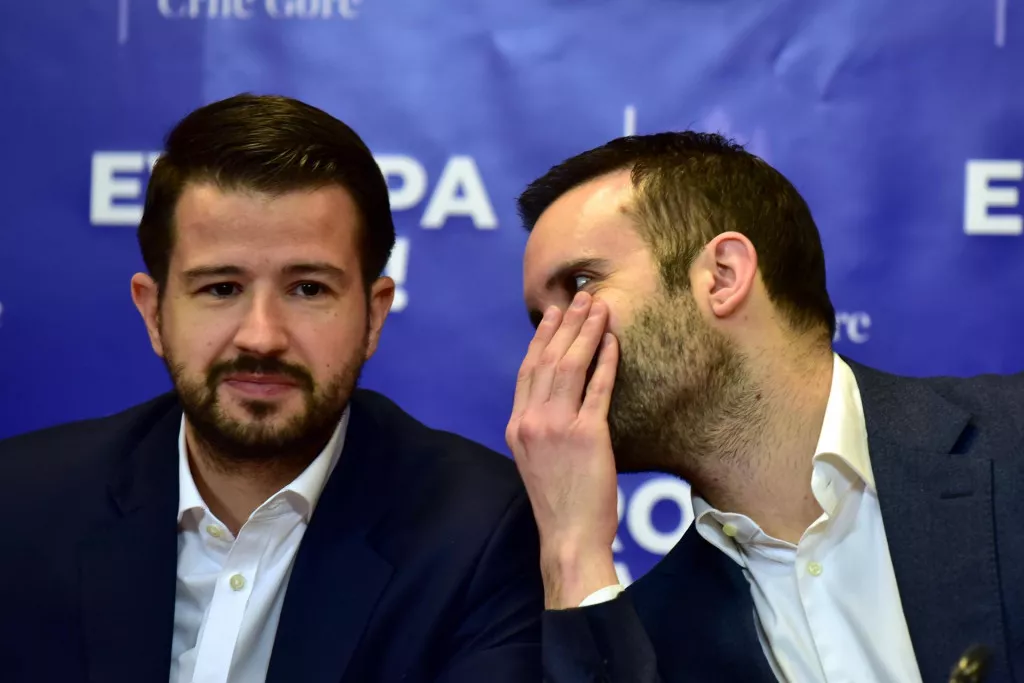
The path from the political top to the political bottom is very short, as best seen in the example of the currently ruling Montenegrin party - the Europe Now movement. To recall, PES was founded by former ministers in Zdravko Krivokapić's Government, and current President and Prime Minister Jakov Milatović and Milojko Spajić, predominantly on the basis of unsustainable economic reforms and populist promises.
Seizing the moment when citizens' satisfaction grew due to increased wages through the Europe Now 1 program, Milatović and Spajić realized that as the ideologues of such economic policy, they could politically profit. Even campaigns for local elections were mostly reduced to discussions about improving living standards through increased minimum wages and pensions. Local issues were almost neglected.
The movement, founded under the political patronage of the Serbian Orthodox Church, with dubious connections to the Dodik family, which have never been publicly denied. Nevertheless, PES, by participating in the first local elections in several Montenegrin municipalities in 2022, achieved notable results and dizzying growth in support, especially in Podgorica.
In several municipalities, they became an integral part of the government, while the position of Mayor of Podgorica was supposed to go to Jakov Milatović. However, after Spajić's presidential candidacy was rejected due to the affair with alleged dual citizenship, Milatović gave up the mayoral position and became the PES candidate in the presidential elections held in March last year.
Even then, the first serious friction between Milatović and Spajić began to emerge, from the moment Milatović started publicly criticizing Spajić for misleading the public about not having dual citizenship and a Serbian passport.
There were also rumors of stormy events and discussions at party body meetings, but these incidents were skillfully covered up. An anti-visionary party without a clear ideological profile, based on the unusual principle of dual leadership, without strong infrastructure, composed of politically inexperienced individuals, and numerous turncoats, infiltrated the political scene at lightning speed.
The greatest rise of PES occurred when, in the second round of the presidential elections, with the support of the parties of the so-called August 30th majority, Jakov Milatović defeated Milo Đukanović and took over the presidential office. In the parliamentary elections, PES achieved 25 percent support, positioning themselves as the strongest parliamentary party.
During the months-long arduous negotiations on forming the Government, the conflict between the president and the future prime minister became increasingly evident. The two leaders convened separate party body meetings. Milatović unreservedly criticized Spajić, accusing him of unprincipled negotiations.
His active interference in the process of forming Spajić's Government resulted in the entry of pro-Russian structures from the ranks of the former Democratic Front into power, the appointment of the Chetnik duke Andrija Mandić as the head of the Montenegrin parliament, and the coalition agreement on the reconstruction of the Government also envisages the imminent infiltration into the executive branch of power through ministerial positions.
Local coalitions with Russian-Serbian agents were also formalized at the state level. Culmination of the conflict and final split Immediately before the formation of the Government, MPs Jevrosima Pejović and Radinka Ćinćur, who were inclined towards Milatović, left the movement.
Although the simmering conflict between Milatović and Spajić was the most visible, it was clear from the founding of PES that within the movement, besides Milatović's hard wing and Spajić's softer wing, there was at least one more, initially ideologically undefined, current. After the formation of the Government, cohabitation proceeded through constant confrontations between the two formal co-leaders of PES.
Spajić, at least in public appearances, largely stayed away, and the party's PR service exchanged statements with Milatović, while the president unreservedly criticized the Government's work, suggesting what were the right and wrong decisions, thereby constantly exceeding the constitutional framework, which was apparently too narrow for him.
The poorly concealed conflict, with clumsily staged public performances, finally culminated at the end of February, when Milatović announced on X that he was resigning from all party positions. A move that surprised few, it signaled the disintegration of the movement's already fragile party infrastructure. After Milatović's resignation, the Podgorica committee of PES was disbanded, causing the ruling party to lose five councilors in the Assembly of the Capital City.
This marked the beginning of a months-long crisis in the Podgorica government, which could end with the dismissal of Mayor Olivera Injac and early local elections. After leaving PES, Milatović's councilors formed a separate councilor club called the Movement for Podgorica and entered into a coalition arrangement with Dritan Abazović's URA and Nebojša Medojević's Movement for Change, the fiercest critics of Spajić's and Milatović's economic expertise. It seems to be preparing the ground for the formalization of the decision to establish the president's party.
Shortly after Milatović's resignation, at a party leadership meeting, the current Minister of Justice, Andrej Milović, was expelled from the movement. Milović claims he did not attend the meeting, nor was he informed of the reasons for his expulsion. Although expelled from the party, Milović remained at the head of the Ministry of Justice, allegedly until the report on the assessment of the fulfillment of interim measures (IBAR) for chapters 23 and 24, whose adoption is expected at the end of June, and further tenure is conditioned by achieved results.
It is worth recalling that Milović firmly stood by Spajić during the pre-election Do Kwon affair, wholeheartedly defending him from public attacks. The real reason for postponing Milović's dismissal was apparently Spajić's assessment that such a move was politically unprofitable, as Milović could publicly disclose information potentially compromising to the Government and PES as a political entity. However, it was only a matter of time before the political animosity between the prime minister and the minister culminated.
Indeed, although the Ministry of Justice drafted nine out of a total of 12 so-called IBAR laws, which were unanimously adopted by the Parliament of Montenegro on Friday evening, Milović was prevented from explaining the remaining three laws within his department's jurisdiction on the last day of the debate. Such a decision was made at an electronic Government session held on Thursday evening, because Milović, by accepting the amendment of the Social Democrats, disregarded the Prime Minister's binding instruction that amendments to IBAR laws must not be accepted without the Government's consent.
Although the purely technical amendment could not in any way jeopardize the obtaining of IBAR, Milović was promptly replaced by Deputy Prime Minister Momo Koprivica, bypassing the prescribed procedures and competencies. Thus, Spajić, arbitrarily and autocratically, took an unprecedented step in the history of parliamentarism, replacing the proposer with a compliant minister and undermining the constitutional separation of powers by preventing MPs from amending.
However, it was immediately clear that such a decision had a political background. Milović, who since taking over the ministerial post has revealed a series of details regarding the abuses of the security sector by Dritan Abazović's Government, has expressed readiness for constructive cooperation and dialogue with the opposition, even through a critical stance towards the Government's decisions, and has not shied away from openly exposing behind-the-scenes dealings and games. Even at the session itself, defending principles, he accepted criticism regarding controversial and hastily passed legal solutions and promised to continue the dialogue after IBAR, refusing to be Spajić's puppet without opinion and integrity, like the ministers from the Democrats.
Although his department is most responsible for proposing the laws within the deadline, instead of praise, he received a sanction. In this regard, Milović, two days ago at an extraordinary press conference, called on Spajić to finally settle institutional and political accounts and, in accordance with constitutional powers, initiate proceedings for his dismissal, which will be debated in the Assembly. As he stated, IBAR broke the silence.
Spajić yesterday submitted a formal proposal to the Assembly for Milović's dismissal under an urgent procedure, accusing him of damaging the government's reputation and jeopardizing its priorities with his actions. Milović expressed his expectation to be invited to the session, because, as he stated, he has something to say.
Undoubtedly, we can expect another undemocratic debate, full of serious accusations, without regard for the real interests of the citizens. Personal conflicts will once again overshadow the need for further reform processes that would lead to the substantive democratization of society and the finalization of the EU accession process.
This time, the arguments seem to be on Milović's side, so Spajić's political justification for the minister's dismissal will further unmask the dysfunctionality of Montenegro's most non-transparent and strategically and communicatively weakest government. Furthermore, Milović's dismissal could deepen divisions not only within PES but also among other government constituents, such as the Democrats, within whose ranks a kind of split is emerging, while they are silently hoping to take over Milović's portfolio.
Although according to the earlier coalition agreement, the position of Minister of Justice belongs to PES, the silence and subservience of the Democrats could be rewarded with the appointment of Momo Koprivica as Milović's successor. Besides PES and the Democrats, there is an option for the Ministry of Justice to go to one of the constituents of the reconstructed Government, but such changes to the coalition agreement are unlikely, as it is difficult to expect the current constituents to easily give up their share of the political pie.
The Speaker of the Parliament, Andrija Mandić, avoided taking a clear stance on supporting Milović's dismissal, saying that political quarrels should be left for the period after obtaining IBAR. The votes of 41 MPs are necessary for Milović's dismissal. From the perspective of the current government's political-trading mentality, it is most likely that the majority, in order to remain in their positions, will nevertheless lean towards Spajić, because the opposite outcome of the vote would fuel a crisis that would ultimately result in the formal fall of the Government.
In addition to opening the question of the balance of power in a potential reconstructed government, the parliamentary confrontation between Spajić and Milović could mark the final phase of PES's political collapse. Let us recall that the ruling party suffered a fiasco in the local elections in Budva and Andrijevica compared to the parliamentary elections. It is clear that unprincipled coalition-making and boundless populism are coming to collect.
Milović's statement could encourage the continuation of cohabitation turmoil, as the long-standing conflict between the president and the prime minister, despite the formal separation, does not subside. Every move by Milatović, whether right or wrong, is a kind of political response to Spajić, while Spajić's reactions are quite clumsy and consist of settling scores through party statements. Through party statements, claims are made that Milović and Milatović are coordinating to obstruct the Government's work.
It is difficult to expect that immature politicians like Spajić and the rest of PES, who are unable to clean their own house and calm passions within their own ranks, can ensure a way out of the political crisis and be a guarantee of social stability. On the contrary, accidental politicians without the courage to resist Vučić and his players who control the Government, by collecting protest notes like a collector, are daily damaging the regional position, the European perspective, and radically changing Montenegro's value orientation.
IBAR is a technical matter, and fundamental reforms are a long and complex process that profiteers and politicians are incapable of even understanding, let alone implementing.
The separation of Milo and Momir, it turned out, was beneficial for Montenegro, and historically speaking, a decision that paved the right strategic and value course for the country. This long-standing split among ideologically lost politicians could have far-reaching consequences. While they play an endless political game, Mandić and Knežević, under Moscow-Belgrade dictate, manage the processes, holding the reins of power.
Political trading, endless torment, and a difficult-to-stop stumble, while the question of whether we have the strength for resistance and a civic response constantly hangs in the air.
Komentari (0)
Prijavite se za komentiranje
PrijavaJos nema komentara. Budite prvi!
Minuta
Sve →Iz drugih kategorija

High Representative Not Elected: Germans, French and British Against Americans, New Attempt at End of June

ČOVIĆ WITHOUT MERCY: How Those Who Brought Ademović to Office Created a Political Hell for Him



Sunny Saturday, quite warm



Tragedy in Albanian resort: Two minors drown












