
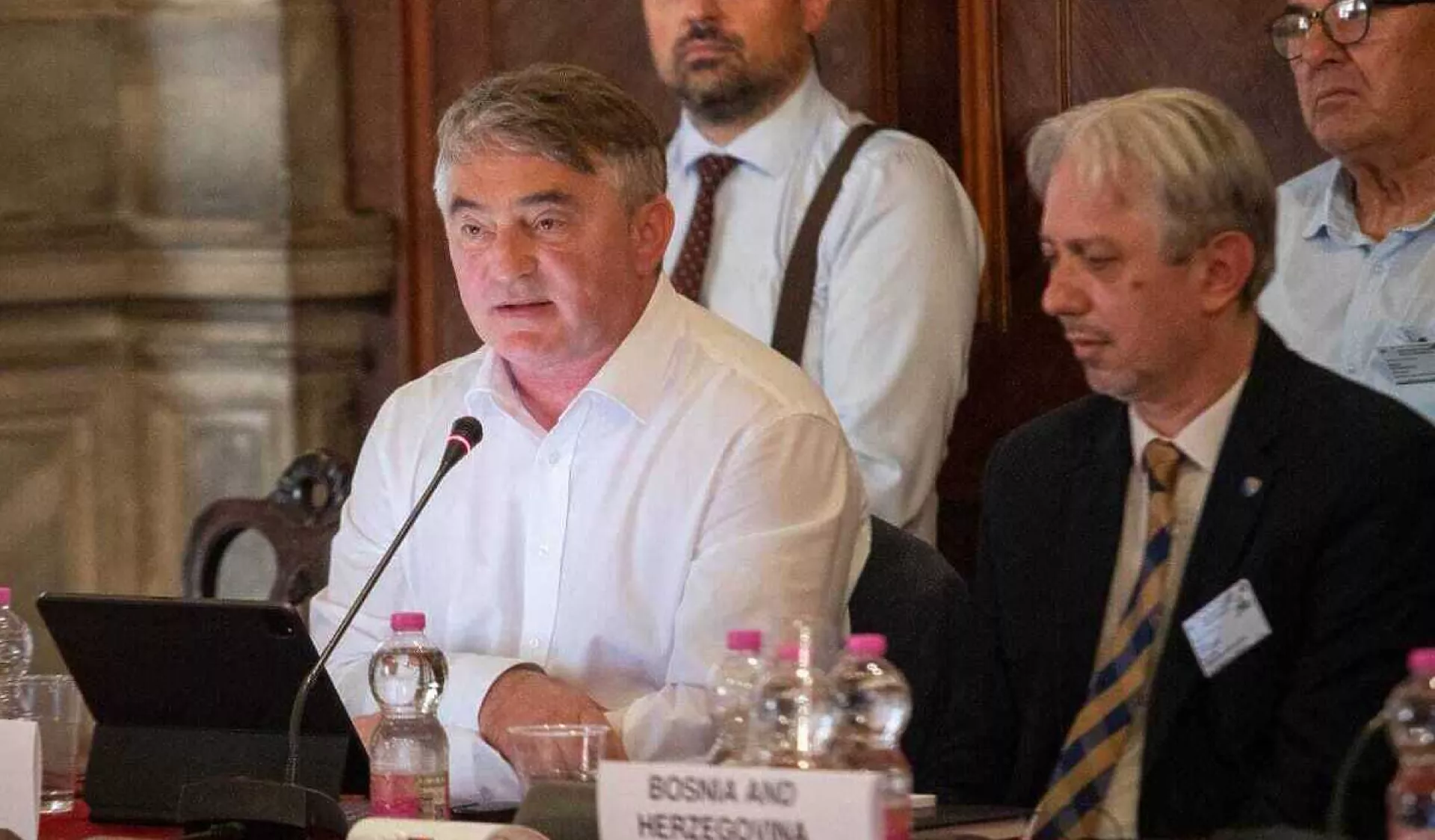
(Patria) - The Democratic Front (DF) did not achieve the results it expected in the recent elections, nor the results the public expected from the DF. DF President Željko Komšić himself, as a guest on BHRT, expressed dissatisfaction with the election results, but also stated the reasons for such an outcome for the DF.
Komšić, among other things, stated that the DF will have to articulate its political positions more clearly, and it is clear from this that the DF will return to the fundamental principles of its policy.
These have been, for the past ten years since the party's existence, essentially – constitutional patriotism and civic state-building nationalism. In the meantime, or in the last few years, the DF's political agenda has been supplemented by an attempt at real-political anti-colonialism, embodied in the DF's stance that not all political suggestions coming from foreigners and representatives of the international community in Bosnia and Herzegovina must be accepted at all costs.
With constitutional patriotism, the DF strives to legally and lawfully place citizens of Bosnia and Herzegovina in an equal position before the Constitution and the law. It is precisely the representatives and officials of the DF who are the bearers of a series of legal battles, both before the Constitutional Court of BiH and before the European Court of Human Rights.
Civic state-building nationalism, which the DF propagates, proves that not all nationalisms are the same. In a country where inequality of citizens is defined by the Constitution and law, advocating for civic equality from state-building positions is not an expression of any ethnic or national chauvinism, but an expression of the same struggle for equality that numerous political and civic movements for national and state liberation waged around the world decades earlier.
Real-political anti-colonialism, which is only nascently visible in Bosnia and Herzegovina through the actions of certain DF members who do not hesitate to oppose foreign interventionism, i.e., the interventionism of the High Representative, to the detriment of BiH citizens.
These three fundamental principles form the backbone of the ideology around which the DF gathers. They have been profiled within the DF in recent years through political processes, including conflicts in which this political organization has participated.
It is precisely the ideological and political potential possessed by this political option, which, despite all its real flaws, is not burdened by crime and corruption scandals, that DF's ideological opponents see as a danger.
The problem is not that the DF is often a surplus party in coalition equations, but the problem is the fact that the DF has the potential to develop and gather all those who are not willing to be servants of foreigners or servants of neighbors in their own country.
The danger, therefore, lies in the "fourth nationalism," as one of the international officials in Bosnia and Herzegovina characterized the DF's policy. This fourth nationalism is based on the aforementioned ideological principles, to which no ethnic-religious radicalism can be attributed, which some policies in Bosnia and Herzegovina try to delegitimize.
The ideology of DF's "fourth nationalism," or the ideology of civic state nationalism, is secularist, which represents a fundamental problem for the enemies of the state of Bosnia and Herzegovina in their attempt to confront the citizens of Bosnia and Herzegovina.
Hence, the attacks on this political organization, which in the past period, under various influences, has partially muffled its basic political tone, are even greater than they were before. The less the DF broadcasted its basic political tone in public, and the lower the intensity of that ideological intonation, the more the attacks from those who see danger in the aforementioned ideology intensified.
These attacks are culminating precisely these days when the authorities and the High Representative in BiH are trying to overturn the judgment in the "Kovačević" case before the European Court of Human Rights. This judgment best reflects the ideological-political approach of the DF to the issue of the current and future organization of the state of Bosnia and Herzegovina.
Unlike other political options, whose political moves do not go beyond issues such as the election of the Mayor of Sarajevo and the composition of the Sarajevo cantonal government, what the DF is trying to do is an attempt to create preconditions for a normal and sovereign state.
M.T.
Komentari (0)
Prijavite se za komentiranje
PrijavaJos nema komentara. Budite prvi!
Minuta
Sve →Iz drugih kategorija

High Representative Not Elected: Germans, French and British Against Americans, New Attempt at End of June

ČOVIĆ WITHOUT MERCY: How Those Who Brought Ademović to Office Created a Political Hell for Him



Sunny Saturday, quite warm



Tragedy in Albanian resort: Two minors drown












