
Bosnia and Herzegovina is expected to decide by the end of the month whether to file a request for a review of the verdict against Serbia before the International Court of Justice in The Hague, due to violations of the Convention on the Prevention and Punishment of the Crime of Genocide in the early '90s.
In 2007, the International Court in The Hague ruled that the Army and police of the Republika Srpska entity were responsible for the genocide in Srebrenica, and Serbia was punished for knowing about and failing to prevent the genocide. Ten years later, the BiH side wants a review of that verdict. It is believed that there is a large amount of evidence that the regime of Slobodan Milošević, the former president of Serbia, directly participated in the crimes and genocide in Bosnia and Herzegovina.
The story about the review of this verdict has strained political relations in the country. Representatives of Bosnian Serbs oppose initiating the procedure for reviewing the verdict. They claim that Bosnia and Herzegovina can only file a request for a review of the verdict in case of new evidence of Serbia's participation in the war against Bosnia and Herzegovina. And, according to them, Bosnia and Herzegovina has no new evidence.
On the other hand, a large number of domestic and international lawyers, as well as historians, believe that there is evidence. And plenty of it.
Academician Smail Čekić, a professor at the Faculty of Political Sciences in Sarajevo and a collaborator at the Institute for Research of Crimes Against Humanity and International Law, states that the highest command structure of the "Army of Republika Srpska" consisted of officers of the Army of Yugoslavia, members of the 30th Personnel Center of the General Staff of the Army of Yugoslavia, including General Ratko Mladić, who is currently on trial before the International Court in The Hague.
- All members of the General Staff of the "Army of Republika Srpska" and many other officers, non-commissioned officers, and civilian personnel in the "Army of Republika Srpska" (in key positions in corps, brigades, battalions, and companies, at various command levels of the "Army of Republika Srpska") were de jure and de facto members of the Army of Yugoslavia, meaning they were an organ of the state of the Federal Republic of Yugoslavia, who, in accordance with the Decision on determining tasks and the territory on which service is performed under difficult (special) conditions, carried out tasks on the territory of the Republic of Bosnia and Herzegovina, which was defined as an integral part of the territory of the Federal Republic of Yugoslavia – states, among other things, academician Čekić in his commentary.
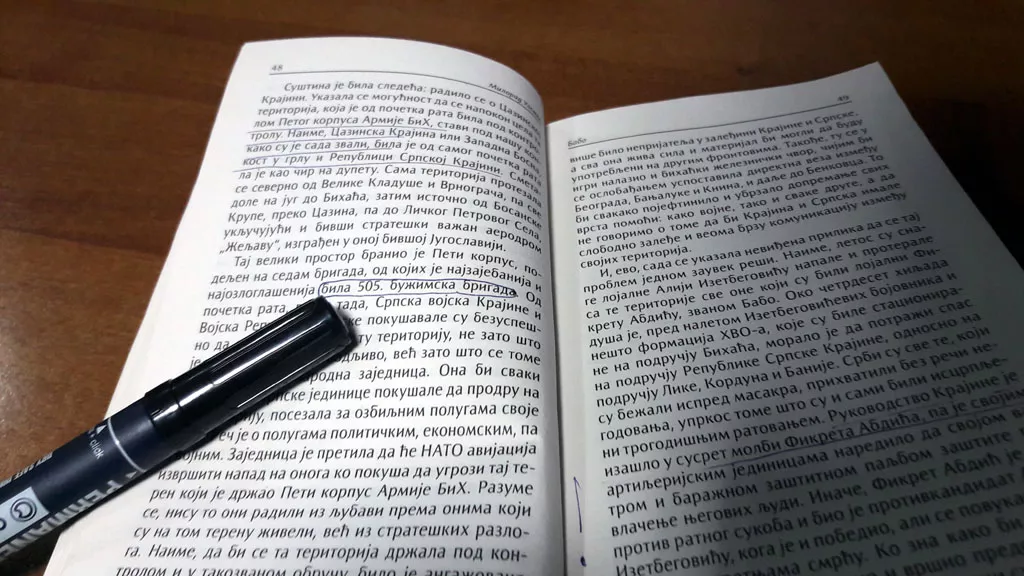
The book "Babo - the battle we shouldn't have lost" by author Milorad Ulemek Legija also testifies to the participation of Serbian soldiers in the aggression against BiH. Ulemek was a member of the Serbian Volunteer Guard (Arkan's Tigers), a unit that became known in the '90s for numerous war crimes in Croatia and Bosnia and Herzegovina. The Serbian Volunteer Guard was under the direct command of the State Security Service of Serbia. There are numerous military reports in which Serbian authorities are informed about the situation on the battlefields in BiH.
In his book "Babo - the battle we shouldn't have lost," Ulemek describes in detail the war days in Bosnia and Herzegovina, his cooperation with Fikret Abdić, and his connection with the authorities from Serbia...
- Of all the books I have written so far, this book came from me with the greatest difficulty. It is a lived and true testimony of events that happened more than two decades ago, which, like flashbacks, evoked very strong emotions in me, largely fueled by my emotional attachment to that father's homeland, which I visited in my childhood. This refers to the area near Petrova Gora, where Serbs have lived and survived since ancient times, as well as in the entire Krajina region – wrote Ulemek, among other things, in the book.
***
- This fat man, I later learned he was the commander of the 21st Kordun Corps, was named Mirko Bosanac. In my opinion, he could only command some "lamb brigade," which he probably did, judging by his appearance.
- Gentlemen, I don't think there's any particular need for introductions, we all know why we're gathered here...
I raised my hand. The general interrupted his incipient speech and looked at me askance.
- Comrade General, I apologize for interrupting your presentation. But I really don't know why I was invited, and what the reason for our gathering here is – I said, feigning surprise, although at that moment I didn't care why we were gathered, as I would find out in the next half hour... The situation was that I had been pondering for three days where they had sent me. That no one knew or wanted to tell me, and now I was sitting in a room with about fifty officers and this fat general, and everyone except me seemed to know why they were there...
- If you had just waited a little, you would have found out why and for what. But you, Legija, have to do your thing – he told me with a smile, but his tone suggested it was better for me to shut up.
At the mention of my name, many turned their heads to get a better look at me. It wasn't that I was that famous, but people knew who I was here and there. I nodded, and he continued his presentation.
The essence was as follows: It was about Cazinska Krajina, an opportunity arose to finally bring that entire territory, which had been under the control of the Fifth Corps of the Army of BiH since the beginning of the war, under our control. Namely, Cazinska Krajina, or Western Bosnia as it was called now, had been a thorn in the side of the Republic of Serbian Krajina since the very beginning of the war – writes Ulemek in the book...
- The territory itself stretched from Velika Kladuša and Vrnograč, all the way south to Bihać. Then, east of Bosanska Krupa through Cazin to Lički Petrov Selo, including the former strategically important airport of Željava... This large area was defended by the Fifth Corps, divided into seven brigades, of which the toughest and most notorious was the 505th Bužim Brigade – Ulemek further describes his first days on the battlefield in Bosnia and Herzegovina.
Komentari (0)
Prijavite se za komentiranje
PrijavaJos nema komentara. Budite prvi!
Minuta
Sve →Iz drugih kategorija

High Representative Not Elected: Germans, French and British Sabotaged Americans, New Attempt at End of June

ČOVIĆ WITHOUT MERCY: How Those Who Brought Ademović to Office Created a Political Hell for Him



Sunny Saturday, quite warm



Tragedy in Albanian resort: Two minors drown












