
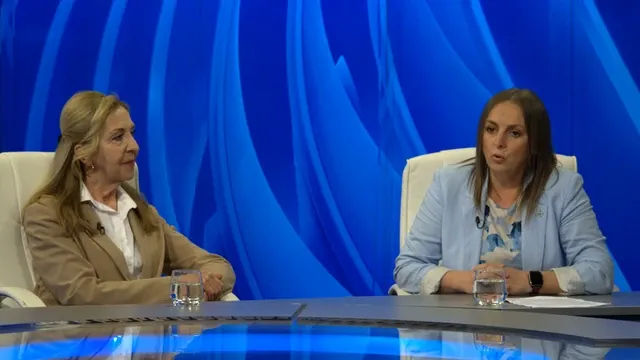
(Patria) - The events of May 2nd, 1992, are inseparable from what followed on May 2nd and 3rd, 1992, when upon returning from negotiations in Lisbon, the delegation of the Republic of Bosnia and Herzegovina, led by the President of the Presidency of the Republic of Bosnia and Herzegovina, Alija Izetbegović, was taken from Sarajevo Airport to Lukavica, where they were practically prisoners.
Sabina Berberović, daughter of Alija Izetbegović, who served as an interpreter, Zlatko Lagumdžija, and Alija Izetbegović's escort Nurudin Imamović - Dinče were also in the delegation of the Republic of Bosnia and Herzegovina.
In an interview with Istraga sedmice, she stated that the Republic of Bosnia and Herzegovina was already in the process of UN admission.
"The airport was in the hands of the aggressor army. For that reason, my father and our delegation refused to go to Lisbon for negotiations via the airport. My father insisted that the negotiations continue in Sarajevo. The European Community, which was leading these negotiations, came with guarantees that they would ensure our departure from Sarajevo via the airport by their plane to Lisbon, as well as our return. My father had objections to the hostilities and always said that one cannot negotiate under shelling and bombs; he demanded a ceasefire. They said there would be no hostilities during the negotiations. With those guarantees, we set off for Lisbon," Berberović said.
Amina Čorbo-Zećo, editor-in-chief of the Patria News Agency, who is following the trial in the Dobrovoljačka case, points out that the indictment was filed in 2022 against the highest military, police, and civilian leadership of the Republic of Bosnia and Herzegovina. It was jointly signed by prosecutors Mladen Vukojičić and Milanko Kajganić, and confirmed by judge Braco Stupar.
"If the verdict is as the Prosecution desires, we will have what they call a 'civil war' in Bosnia and Herzegovina instead of an established aggression. This is truly a horrific case, which is a joint criminal enterprise led from Belgrade with its prosecutors in the BiH Prosecutor's Office, its investigators, and the judge who confirmed such an indictment. This case has been concluded multiple times in The Hague, and they stated that the convoy in Dobrovoljačka was a legitimate military target. What is good is that the Trial Chamber allowed the defense to return to May 2nd," said Čorbo-Zećo, adding that on May 2nd, the plan to seize the Presidency of the Republic of Bosnia and Herzegovina was thwarted, and the kidnapping of President Izetbegović was intended for further bargaining.
Berberović emphasizes that the negotiations in Lisbon, which had not actually begun, were interrupted because of the shelling of Sarajevo by Serbian forces. On May 2nd, institutions in Sarajevo were attacked, the Post Office building was shelled, and there was an attempt to seize the Presidency of the Republic of Bosnia and Herzegovina.
"We never even started those negotiations. And we are heading back to Sarajevo, and I must now inform everyone that we are returning early, and our people must know that we are coming. I cannot inform anyone because the communication lines are cut. We are leaving Lisbon without our people knowing we are returning. The pilot tells us he has no contact with Sarajevo but that we will depart. We stopped in Rome for fuel, and the plane set off for Sarajevo again. The pilot says he has no contact with Sarajevo and tells us we can head towards Zagreb or Belgrade. We are heading towards Zagreb. After a few seconds, the airport responds because we were circling a bit and then headed there. They say we can land, but the situation is uncertain, and the pilot asked my father what we should do; he said he would like to land in Sarajevo, and then the pilot decided to land," Berberović said.
She points out that she saw several tanks and a group of people emerging from the building. The delegation disembarked from the plane, which immediately taxied off the runway. They were met by the civilian director of the airport, the commander, and officers.
"They led us into an office. They brought in three soldiers with rifles, which they removed and held in their hands. As soon as we sat down, my father asked for a phone. The answer was that the phone lines were down. We were kidnapped; we were prisoners; there is no doubt about it. My father insisted on getting a phone to speak with the Presidency and Sarajevo. The commander asked us to proceed towards Lukavica and said that if we didn't, he would use force. At that moment, the phone on the table rang, and I picked up the receiver, fearing that if my father went for the phone, they might kill him. My father took the receiver and relayed to the woman who was inquiring about flights what had happened and told her to call everyone in Sarajevo and inform them of what was happening and that we would be taken to Lukavica," she recounted.
In Lukavica, they were housed in General Đurđevac's office, and she noticed that some soldiers had red stars on their uniforms while others did not.
"The General immediately began some kind of negotiation, but my father asked for a phone and requested to be transferred to Sarajevo. After some time, they started saying, 'You cannot go; you are safer here,'" Berberović said.
She recalled that General Gagović said that people were gathering around the barracks and asking for Alija.
"Communication lasted until late at night. We heard gunfire. Around 2 AM, there was a lull. I had a virus, and a doctor took me to her room to rest. I returned in the morning around 5 or 6 AM and found my father in the same chair. At one point, while talking to Ejup Ganić, he said to take over his position while he was away. Dr. Ganić was a representative of the Others; clearly, my father had reasons for transferring authority to him."
Producer Avdo Huseinović also joined the program and recounted that he came into possession of a set of intercepted conversations from May 2nd and 3rd.
"One of those conversations on May 2nd took place precisely during President Izetbegović's landing, between the Airport and the command of the IV Corps of the Yugoslav Army, with the code phrase: 'The bird has landed.' It is assumed that General Đurđevac was speaking from Lukavica, and an unidentified person from the airport reported to the command of the Fourth Corps. Đurđevac reported to Blagoje Hadžić that Alija Izetbegović had been arrested; he reported to Branko Kostić, and Kostić said, 'He wasn't arrested, but he was detained and saved,'" Huseinović stated.
Berberović and Čorbo-Zećo in Istraga sedmiceČorbo-Zećo pointed out that witnesses are now testifying differently compared to their earlier statements, claiming that "Alija was saved on May 3rd," and most of them do not remember the actions against Sarajevo on May 2nd, even though they stated the opposite in their initial testimonies.
Čorbo-Zećo emphasized that the process has been ongoing for four years, very few witnesses have testified, and around 270 witnesses have been proposed.
"All these people sitting there are in their third age and are humiliating themselves in this way. And we don't have a single indictment for murdered children and the siege of Sarajevo."
Berberović points out that negotiations continued on May 3rd, and UNPROFOR and General MacKenzie became involved.
"Negotiations are proceeding slowly, various ideas are being put forward. At one point, my father managed to speak with Bakir, my brother, and said, 'Let's speed this up; we don't know where this is leading.' My father picks up the receiver and says to Kukanjac: 'General, let's you and I make an agreement. I will come for you. You will leave the barracks with your army.'"
Berberović said that they left Lukavica and entered the barracks in Bistrik and were escorted to General Kukanjac's office.
"I think I saw Mr. Pušina there, and I was glad to see one of our people. The General tried to negotiate something again, and MacKenzie interrupted him and said that a convoy should be formed," she said.
After that conversation, the arrangements for realizing it began.
"The conditions were clearly agreed upon. No military equipment or weaponry would leave the barracks. Now are the moments when everything can go wrong. I noticed that large quantities of documentation were being burned in the barracks courtyard, as bonfires were smoldering. I know that General MacKenzie entered one transporter, and he took Lagumdžija with him; he placed us with General Kukanjac; Pušina was also there. Dinče remained in Lukavica as a form of security. They asked me to stay, then Dinče said he would stay. The convoy stops, that transporter stops, Zoka Čegar opens it from the outside and attacks Kukanjac. My father says, 'Son Zoka, quieter,' Čegar then undresses and shows his wounds. At that moment, I saw a military truck with a machine gun pointed at us," recounted Berberović, who emphasized that Kukanjac also had a pistol on him.
After the incident, the convoy continued towards Lukavica, and Alija Izetbegović towards the Presidency of the Republic of Bosnia and Herzegovina.
Huseinović also recalled intercepted conversations in which soldiers celebrated the capture of Alija Izetbegović.
"In some conversations, there were also certain ideas to set off again during the night; I received those recordings, and it was shocking to listen to those conversations. In the Second Military District, as well as in other barracks, there was a significant number of Serbian reservists, even mercenaries. Many of them say they came under contract to the barracks in January or February. Some who were in the convoy came under contract as mercenaries. One of those who died in the incident is Zdravko Tomović, who is on the list of fallen soldiers of the Army of Republika Srpska," said Huseinović.
Čorbo-Zećo concluded by saying that if there were justice, the Dobrovoljačka case should be dropped.
"And the way it's going now, there won't be an end for another ten years. If experts from The Hague need to come and review the indictment, let them say so, but people are being tormented for Serbia's sake."
Komentari (0)
Prijavite se za komentiranje
PrijavaJos nema komentara. Budite prvi!
Minuta
Sve →Iz drugih kategorija

High Representative Not Elected: Germans, French and British Against Americans, New Attempt at End of June

ČOVIĆ WITHOUT MERCY: How Those Who Brought Ademović to Office Created a Political Hell for Him



Sunny Saturday, quite warm



Tragedy in Albanian resort: Two minors drown












