
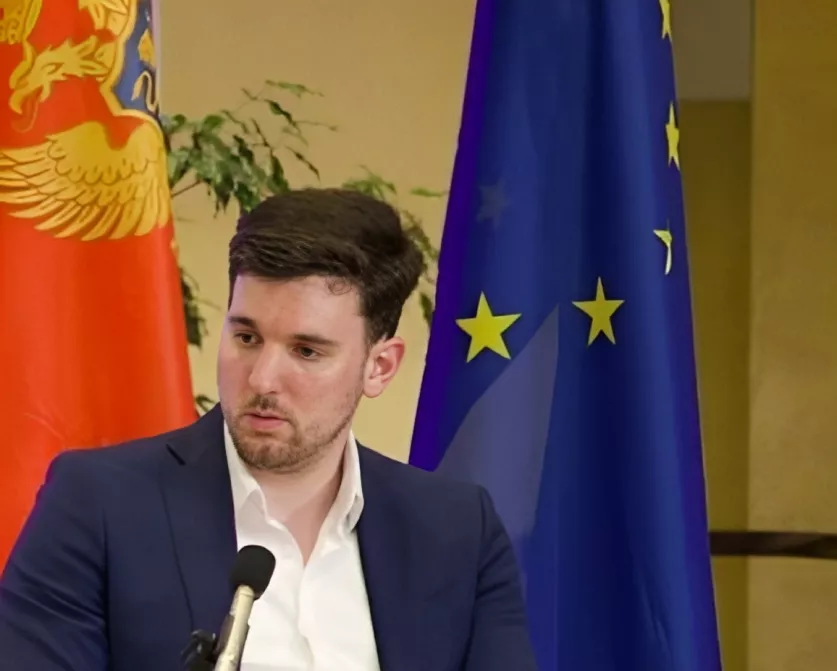
Interview by Nevena Kovačević
Montenegrin Prime Minister Milojko Spajić recently presented a platform called Barometer 26, with the aim, as he stated, of accelerating the European path and achieving broad social consensus, especially concerning identity and polarizing issues. Political analyst Danilo Kalezić tells Patria that this is a not-so-literate, nor creative, nor politically wise trick, which, as he points out, Spajić and his coalition partners intend to present themselves as European and progressive, i.e., pro-Western.
“But in essence, everything behind those few paragraphs, which mean nothing semantically or politically, is actually the entire ideological abyss into which Montenegro has sunk since 2020, culminating with Spajić's Government,” Kalezić emphasizes.
The truth, as he indicates, is that there is a will in Brussels for Montenegro to join the European Union as the next member.
“Primarily for geopolitical reasons, especially due to the two wars being fought – one in Europe and the other in the Middle East. This is precisely the wind in the sails that masks all the shortcomings of Montenegrin society,” Kalezić notes.
He believes that without some significant changes, there will be no changes in the implementation of the reform agenda.
“However, everything else is problematic,” Kalezić is categorical.
Commenting on the invitation extended by President Jakov Milatović to Prime Minister Milojko Spajić to overcome disagreements for the sake of the European perspective and establish more constructive institutional cooperation, Patria's interlocutor assesses that it is clear to everyone that the reconciliation between the two is happening under the patronage and mentorship of the West, which, as he states, sees an opportunity to neutralize the Democratic Front.
“This is a deeply wrong, short-sighted policy that is not logically based and can only do the opposite,” Kalezić points out.
It is, the interlocutor of Patria is explicit, so-called “makeup on a corpse,” which would ultimately lead to the disintegration of the Europe Now Movement, the destruction of Milatović's credibility and authority, and in the long run, strengthen the position of the pro-Russian “Democratic Front.”
“Anything else is better for Montenegrin society than that. It is up to Milatović to prove that he is consistent in what he has been stating for almost a year,” the interlocutor of Patria emphasizes.
As he adds, it is up to Milatović to be the one who will fulfill the will of the citizens.
“The will of the citizens in both Podgorica and Budva is to change the government. Otherwise, they would vote for the ruling parties,” Kalezić notes.
As he warns, Montenegro will be exposed to a new wave, or rather a tide, of Russian aggression in the coming period.
“One part of this is the danger that arises for Putin's regime in Georgia, in Syria, and the ability of the Ukrainian army to use offensive weapons on Russian territory itself,” Kalezić emphasizes.
As he stresses, whenever Russia is in such a situation, it is forced by inertia to open new hotspots and new fronts.
“Montenegro is the first and logical prey, and that is what poses a danger to Montenegrin society,” Kalezić warns.
He reminds that, unlike some other stages, Russian agents now control the structures of the executive government and security services.
Speaking about the Bosniak Party's idea to support constitutional amendments by declaring Bosnian an official language, a demand identical to that tirelessly repeated by pro-Serbian parties, Kalezić points out that the initiative itself represents the fruit of a rotten compromise by the BS, which has abandoned the positions on which it was built, and which, as he points out, is again short-sightedly and unwisely trying to flirt with Greater Serbian nationalism.
“Every time, that flirtation has ended to the detriment of Bosniaks, and it will be the same this time. You don't need to be too smart or intelligent to notice that,” Kalezić is categorical.
He states that such initiatives serve to turn Montenegro into a second Bosnia and Herzegovina, i.e., to turn Montenegro into a Republika Srpska on the sea.
“That is what they want – Montenegro as a modern RS on the sea, or Montenegro as the historical Zeta Banovina. These are variants of the same theme – shades of black, if one can say so,” Kalezić is explicit.
He points out that today in Montenegro, various shades of dark black are in power.
“And political and historical darknesses do not forgive and will not forgive this generation of Montenegrins if they do not show meaningful resistance to Greater Serbian fascism in its new disguised form,” Kalezić states.
Regarding the formation of the government in Podgorica, Patria's interlocutor assesses that the key to solving not only the Podgorica but also the Montenegrin crisis lies precisely with President Milatović.
“It is difficult to predict, as things change from hour to hour. At this moment, new elections are the most likely outcome, but we will have to see how that situation develops,” Kalezić concludes.
Komentari (0)
Prijavite se za komentiranje
PrijavaJos nema komentara. Budite prvi!
Minuta
Sve →Iz drugih kategorija

High Representative Not Elected: Germans, French and British Against Americans, New Attempt at End of June

ČOVIĆ WITHOUT MERCY: How Those Who Brought Ademović to Office Created a Political Hell for Him



Sunny Saturday, quite warm



Tragedy in Albanian resort: Two minors drown












