
By Dean Džebić
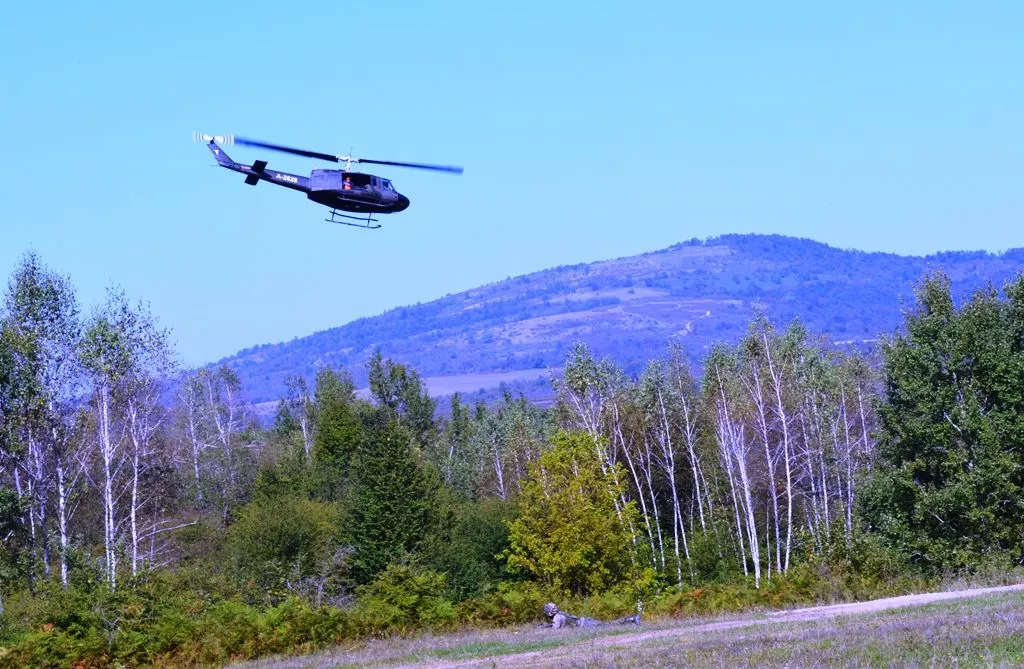
Not even the biggest optimists could have expected the repeated decision to allocate 3.6 million marks for American helicopters to be adopted, nor could the biggest critics have expected so much ignorance in an officially published document.
It is unrealistic that among so many experts and specialists, no one noticed that the American UH-1I-II Huey II helicopter was christened UH II. But the ignorance and blunders in this document do not end there; the real culmination, permeated by the desire to politically justify certain things in the entity of Rs, is the classification of the helicopter as "multi-purpose non-combatant".
Therefore, the nonsense never ends, considering that according to the needs and classification of purpose in the BiH Armed Forces, all helicopters from the Huey family are declared as light transport, so multi-purpose non-combatant represents not a stupid pleonasm but complete dilettantism. There is no doubt that the father of helicopters, Igor Sikorsky, is turning in his grave over these political reshuffles forced by ignorance.
On the other hand, there is no money from BiH, or rather, that symbolic amount with which BiH participates, but the new UH-1I-II Huey II are indeed arriving, and by the end of the current year. Of course, the United States, through its FMS (Foreign Military Support) program, will successfully complete and thereby significantly strengthen the capacities of the Air Force and Anti-Aircraft Defense Brigade.
Current Situation and Capacities
With the arrival of new helicopters in the number and configuration they are coming in, the number of operational helicopters significantly increases, as does the number of existing flight personnel, which is explained by the recently signed contracts of the BiH Ministry of Defense for pilot training. Of course, any increase in the number of aircraft entails a whole series of other capacity upgrades, both personnel and material, from overhaul stations and workshops to hangars, tools, spare parts, and so on.
Specifically for the BiH Armed Forces, one of the biggest challenges is new engines and their overhaul for the fleet of older UH-1s, which we also acquired from the United States in several batches. The existing UH-1 fleet is more than significant; however, there is currently no company in the world that manufactures engines for that helicopter model, which greatly strains the efforts of technicians and mechanics. On the other hand, since the equipment was donated or purchased from another country, that country has exclusive responsibility for permission for any type of technical overhaul and supervision, and in this case, it is the United States.
Also, one of the solutions, and the most expensive one, is the engagement of retired engineers and experts from the USA who are heavily employed in private companies. But in conditions of financial bypassing, this is an absolutely unrealistic option.
A particular challenge in itself is the loss of medium-category helicopters, namely the Mi-8T and Mi-8MTV-1 helicopters, whose service life has expired and whose fate is uncertain. Therefore, the existing helicopter fleet in the 1st and 2nd Helicopter Squadrons of the BiH Armed Forces relies exclusively on single-engine helicopters from the Huey family and Yugoslav SA 342/342 Gazelles, which were produced by the Mostar company "Soko" under French license.
Hangar Collapse and New Helicopter Incident
Since the collapse of the hangar roof in Rajlovac in 2012, no significant projects have been implemented. Technical personnel working on maintenance need to be provided with better working conditions, along with the necessary improvement of career management within the Air Force Brigade and the entire BiH Armed Forces.
Of course, helicopter crashes and accidents are quite normal, and according to some calculations, in large air forces, one aviation accident occurs for every 500 to 600 flight hours. A similar event happened with the newly arrived UH-1H-II Huey 2, which lost control and crashed during training.
With complete damage to the engine and transmission system, this helicopter was written off from the fleet, and its fate will be decided later. Cannibalizing parts is not possible due to the practice that a helicopter that experiences an aviation accident is not used further, except for some parts. When we talk about the fate, the question of the fate of Soviet helicopters from the Mil family is also significant.
Sale and Replacement for Mi-8
In the domain of medium transport helicopters, the Soviet Mi-8 helicopter with all its variations represents the Kalashnikov of helicopters. In BiH, one part remained as a legacy of the JNA, used by the VRS during the war, while the other part, the more modern one, was purchased by the Republic of Bosnia and Herzegovina during the war. Despite all the difficulties with overhauls in 2007 and 2011, the popular "eights" have been grounded and are awaiting a decision on sale, which opens up a whole series of new questions.
First and foremost, the key issue is the successor to the medium transport helicopter for the BiH Armed Forces, which must be a twin-engine aircraft and, as things stand, must be of Western European or American production. It is important here to deviate from the statement of the Minister of Defense, Zukan Helez, who told FTV that it is necessary to get rid of these helicopters because we cannot join NATO with Russian or Soviet equipment. But that simply is not true; several NATO member states actively use Mi-8 and Mi-17 in various versions, with modernization that has enabled interoperable operation with Western helicopters of other member states.
Given that the overhaul of these helicopters is impossible in Russia and Ukraine, there are backup options like Lithuania or Estonia, but in the long run, given the condition they are in, it could be a very expensive undertaking. A similar situation awaits the remaining Gazelles, which are at the end of their service life and cannot be overhauled anywhere except in some destinations that would charge a high price, so considering the capabilities, service life, and price of the aircraft, it would not be cost-effective.
Prospects for Aviation Development
Given that BiH has renounced fixed-wing aviation as well as combat helicopters, according to the doctrine of the use of armed forces, the central place of air forces is occupied by light and medium transport helicopters. With the existing fleet of UH-1 and UH-1H-II, the light transport helicopter category is complete, while with the exit of the Mi-8 fleet, a significant reduction in the operational capabilities of the BiH Armed Forces has been created.
This is significantly clearer with a concrete example. According to the tasks of the Air Force and Anti-Aircraft Defense Brigade, these include firefighting and fire suppression operations. Twin-engine helicopters have a greater carrying capacity, and unlike the UH-1 and UH-1H-II, which carry 1000-liter buckets for extinguishing, a twin-engine helicopter could carry 2000 to 2600-liter buckets.
In the near future, the procurement of a medium transport helicopter must be one of the priorities, and consideration should also be given to changing the doctrine and legal regulations governing the necessary non-combatant nature of Bosnian-Herzegovinian aviation. Because aviation is a very expensive sport, but sovereignty, freedom, and independence are far more expensive sports.
Komentari (0)
Prijavite se za komentiranje
PrijavaJos nema komentara. Budite prvi!
Minuta
Sve →Iz drugih kategorija

High Representative Not Elected: Germans, French and British Against Americans, New Attempt at End of June

ČOVIĆ WITHOUT MERCY: How Those Who Brought Ademović to Office Created a Political Hell for Him



Sunny Saturday, quite warm



Tragedy in Albanian resort: Two minors drown












