
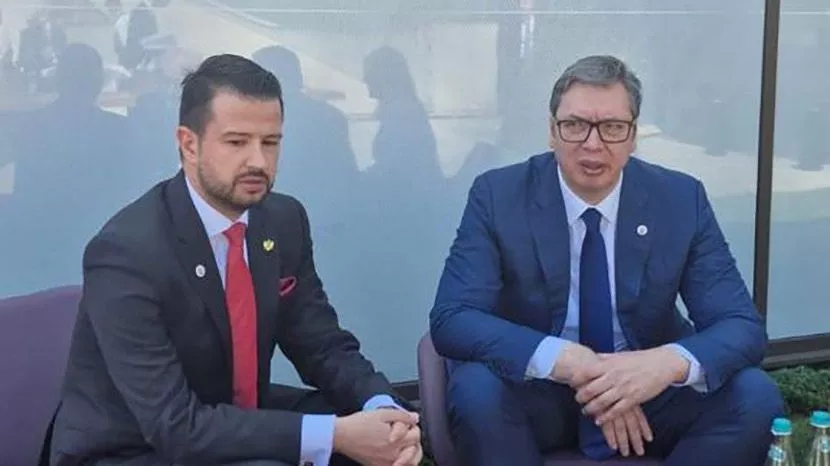
From Podgorica for Patria, Nevena Kovačević
The President of Montenegro Jakov Milatović and the mandate holder for the composition of the Government Milojko Spajić met last night, and the topic of discussion was, according to numerous Montenegrin media, the process of forming the Government, as well as the increasingly evident conflicts and power struggles within the Europe Now Movement (PES).
The details of the meeting are not known to the public, but it is speculated that the disobedience of MPs Radinka Ćinćur and Jevrosima Pejović was discussed, who, due to their inclination towards Milatović, did not support Spajić's Government at the session of the party's Main Board, making it almost certain that the mandate holder cannot count on their votes at the parliamentary session either.
On the other hand, the president, who uses every opportunity to interfere in the negotiation process, contrary to his constitutional powers, recently hinted that the number of MPs who will not raise their hands in support of the Government in the Assembly could be even higher, thus publicly announcing the conflict and animosity that has been simmering between the two leaders for a long time.
Thus, from the calculation of 44 MPs' votes, which Spajić spoke about, we have come to the question of whether the mandate holder will even manage to secure a majority of 41, or if the number of votes might fall even below 40.
It is clear that Milatović is trying in every way to persuade a part of the MPs belonging to his faction not to support the Government with the Democrats and minorities, according to the concept proposed by Spajić, unless parties recognized as part of the Russian-Serbian agency are not part of the executive power.
In addition to advocating for the entry of the For the Future of Montenegro coalition into the executive government, which the president strongly insisted on even when answering journalists' questions during his recent visit to Croatia, the lobbying has extended to Dritan Abazović's Civic Movement URA, which has given wind in the sails to Abazović, who cannot come to terms with the fact that he will almost certainly lose all levers of power, to continue in his usual manner of a bad comedian with jokes about stale cake and proposing some new, obviously unconstitutional solutions that would help him retain a technical position at least until the end of the year.
Citing long-non-existent and fictitious support from international partners, whose trust Abazović has betrayed through unquestioning obedience to Belgrade and Moscow and by blocking the country's European path, the outgoing prime minister continues his attempts to deceive the public.
The reason for Abazović's fear is most likely the tendency of mandate holder Spajić and officials from his ranks to take control of the security sector, which could lead to the exposure of numerous abuses committed by the prime minister and his closest associates due to the security chaos they themselves created, starting from preventing the exposure of the Russian spy network in Montenegro, through cigarette smuggling, and numerous other affairs that have shaken the Montenegrin public for months.
According to media reports, Milatović informed Spajić by letter last night that he is seeking two strong portfolios in exchange for the two parliamentary votes of Radinka Ćinćur and Jevrosima Pejović, one of which is the Ministry of Economy, headed by Nebojša Vuksanović, a former official and list holder of the Socialist People's Party in the parliamentary elections held on June 11.
The SNP's decision on supporting Spajić's Government could be crucial for forming a majority of 41 MPs, which is why a new request followed - that the SNP be given one vice-presidential position and two portfolios, including, according to media reports, the Ministry of Agriculture, currently headed by the party's leader. The SNP has so far received several offers from Spajić, which they have not definitively agreed to.
The party's leader, Vladimir Joković, recently met with Ivica Dačić, with whom he discussed the SNP's participation, as a typically pro-Serbian party, in the new Government and received the support of official Belgrade on that occasion, which, apparently, along with the fundamental role in reaching the final agreement, has also increased their appetite for the portfolios they would like to manage, even though it is a party that is practically disappearing from the Montenegrin political scene with barely crossing the census.
If the president has indeed asked his party colleague for the Ministry of Economy, to be managed by a former official of the openly pro-Serbian SNP, it is clear that Belgrade's strategy is being consistently implemented - either loyal structures will be in the Government who would, through important portfolios, ensure Vučić's control, primarily over the Montenegrin economy, which would make the country economically dependent on Serbia, or the Government will not be formed at all.
Since Aleksandar Vučić has in his corner the overly ambitious Montenegrin president, who does not care that he constantly violates his constitutionally defined responsibilities, and the president's closest associate and security advisor Dejan Vukšić, an agent of Russian-Serbian intelligence services, the implementation of the outlined strategy is going smoothly.
It no longer matters what the Western partners say; apparently, no one dares to put an end to Vučić's regional games.
Although the Europe Now movement claims that the new Government could be formed by September 20, the mutual bickering of officials and hints from some coalition partners that they will not vote for the Government without ZBCG suggest otherwise.
Whether, and how, the mandate holder will manage to fight the increasingly intense pressure and form a government that will undoubtedly be neither pro-European nor stable, and what the relations between the prime minister and the president, who will strive for unconstitutional control over the government's work, will be in that case, are questions for which answers are not yet in sight.
Although composed of programmatically and value-wise different constituents, among whom almost all, except for minority parties, are more or less close to the Serbian Orthodox Church, and therefore closer to the center-right than to the civic option, Spajić's Government is currently a better solution than a new election cycle and the continuation of the state's and destroyed institutions' torment.
One thing is certain - there is no end in sight to the political crisis caused by the wave of clerical nationalism and the influence of powerful structures from outside Montenegro.
Komentari (0)
Prijavite se za komentiranje
PrijavaJos nema komentara. Budite prvi!
Minuta
Sve →Iz drugih kategorija

High Representative Not Elected: Germans, French and British Sabotaged Americans, New Attempt at End of June

ČOVIĆ WITHOUT MERCY: How Those Who Brought Ademović to Office Created a Political Hell for Him



Sunny Saturday, quite warm



Tragedy in Albanian resort: Two minors drown












