
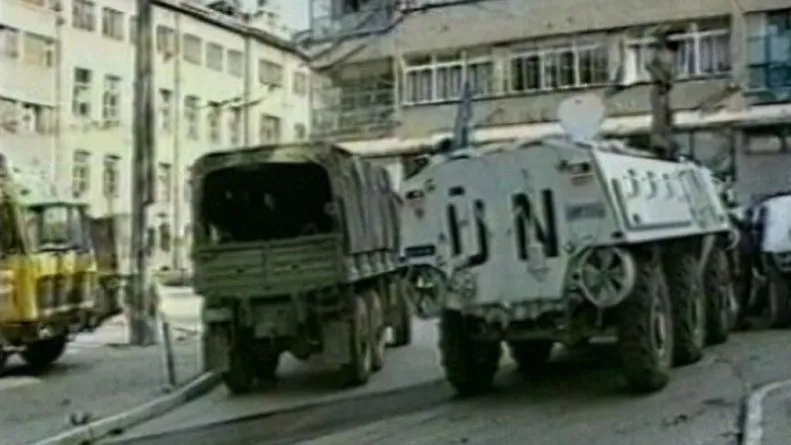
(Patria) – “This case is closed, how it is closed. And I tell you that you will not be criminally liable!”
Prosecutor Mladen Vukoječić uttered this sentence today to witness Edin Selmanović at the hearing in the case of “Ejup Ganić and others,” better known as the Dobrovoljačka Street case.
Precisely in that sentence lies the entire meaning of the process that has been ongoing for years before the Court of Bosnia and Herzegovina. Because, clearly, the goal is not to establish the truth, which has long been considered and established in The Hague, but an attempt at historical revisionism and political equalization of the victim and the aggressor, according to the matrix of written indictments from Belgrade.
However, the prosecutor's remark to his witness did not seem to provoke a particular reaction from the Court Panel.
Selmanović, who testified about the events of May 3, 1992, in Dobrovoljačka Street, today repeatedly could not recall details he had previously stated in his testimony given to foreign investigators of the BiH Prosecutor's Office in 2011.
Thus, today he could not remember that during the investigation he claimed that one person shot a soldier driving a JNA (Yugoslav People's Army) transport vehicle in the back of the head. He had previously said that it was a person nicknamed Šulc, whose name and surname he did not know, and that he had never seen him again.
Selmanović stated that in April 1992 he was a member of the “Bosna 200” unit. He recounted that JNA members were arresting passers-by and beating members of the reserve police, which is why citizens were afraid to pass by the Second Military District building.
He could not confirm that they surrounded the barracks on Bistrik because of this.
“We were not deployed, maybe I used that word, but we were not deployed to shoot and capture,” said Selmanović.
He said that on that May 3rd, he was near the bakery on Bistrik and saw soldiers coming out of the barracks, and that they had “alcohol in their hands, caps, cockades, and rifles.”
He also confirmed that a member of his unit, Rašid Selak, was lying in the park and shooting, and that Sarajevo was shelled during those days.
He also recalled a situation when a JNA officer told a younger soldier not to talk to them, but could not confirm his previous statement that he had hit him two or three times on that occasion.
Selmanović also spoke about a woman from the column, a Muslim employed by the JNA, who was wounded and taken to the Health Center, adding that he later heard that she had succumbed to her injuries.
He also said that on May 3rd, they voluntarily went out into the street to see what was happening, and that he does not remember when they received weapons from the Territorial Defense or when the “Green Berets” became part of it.
Another witness, Muhamed Hukara, said that he was a driver in Ramiz Delalić Ćelo's unit. He stated that they had a headquarters in Vratnik, but that he did not know which unit they belonged to, nor could he confirm that they were part of the Territorial Defense.
“At that time, everyone who offered resistance was colloquially called territorial defense,” said Hukara.
He recounted how Delalić called them to the Old Town Municipality when the withdrawal from the barracks began, after which they went to Dobrovoljačka Street.
According to him, Delalić climbed onto the transport vehicle and spoke with President Alija Izetbegović.
After the column stopped, as he stated, Jovan Divjak also climbed onto the transport vehicle and said not to shoot.
Hukara said that Delalić took several bulletproof vests and rifles that individuals had taken from soldiers in the column.
During the examination, photographs showing Hukara were also presented. Lawyer Asim Crnalić asked for one photograph to be shown again, pointing to a civilian building in the background completely riddled with bullets.
When asked if the damage occurred earlier during the shelling and shooting in Sarajevo, Hukara replied:
“Yes, it did. Because that day I heard maybe three shots. What is on the building is a greater effect.”
The Prosecutor's Office tried to present certain recordings of conversations to the witness, but the Court Panel did not allow it after the defense's objection.
Defense attorney Jesenka Rešidović stated that it is not known who recorded the conversations and when, nor how they were obtained, adding that part of the material had been manipulated.
The Panel decided that the Prosecutor's Office could eventually call the witness again after proving the legality and authenticity of the recordings.
Hukara finally confirmed that he was not mobilized when Delalić called them, that he does not know in whose formation Delalić operated, nor from whom he received the weapons he later distributed.
The continuation of the trial is scheduled for June 10.
Komentari (0)
Prijavite se za komentiranje
PrijavaJos nema komentara. Budite prvi!
Minuta
Sve →Iz drugih kategorija

High Representative Not Elected: Germans, French and British Against Americans, New Attempt at End of June

ČOVIĆ WITHOUT MERCY: How Those Who Brought Ademović to Office Created a Political Hell for Him



Sunny Saturday, quite warm



Tragedy in Albanian resort: Two minors drown












