
From Podgorica for NAP writes: Nevena Kovačević
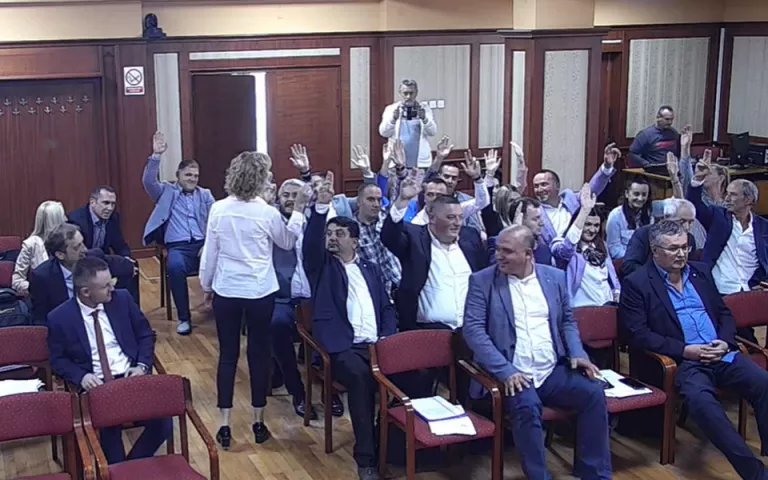
At yesterday's session of the Pljevlja Municipal Assembly, a decision on amendments to the municipal statute was passed, according to which the Municipality Day would be celebrated on October 27 instead of November 20, the date of the Orthodox religious holiday of Saint Petka.
The initiative came from the President of the Municipality, Dario Vranješ, and the rest of the parties of the former Democratic Front, and it was supported by 19 councilors, including three councilors from the Democratic Montenegro, whose leader, Aleksa Bečić, has been nominated for the President of the Montenegrin Parliament.
Councilors from the ranks of Dritan Abazović's URA and the coalition gathered around the Democratic Party of Socialists were against it.
The decision on this initiative was preceded by a letter from the Bishop of the Serbian Orthodox Church, Atanasije, which, as it turned out, represented an open order to the Pljevlja councilors favorable to the SOC, especially the Democrats, who claimed they would not vote for the change of the Municipality Day.
However, three out of four councilors changed their minds, because the church's order is more important than preserving the inter-religious and multi-ethnic harmony that these self-proclaimed and declarative civic nationalists allegedly promote.
More interesting than the not at all unexpected move by the Democrats is the fact that the councilors of the Europe Now movement, whose leader Milojko Spajić is the mandatary and potential Montenegrin Prime Minister, left the session, with the proposal that citizens decide on the date of the Municipality Day celebration in a referendum.
Therefore, while Bečić's councilors humbly carried out the church's order, Spajić's and Milatović's, not brave enough to vote against the command of the clergy of the Serbian Orthodox Church, cowardly left the session.
Shortly after the session, public praise came from Bishop Atanasije, who, among other things, stated that the Pljevlja councilors had inscribed themselves in the history of Serbian history, because, as he said, they had corrected a historical injustice done to the people of the Pljevlja region.
Among the extremely unscrupulous arguments presented before and during the session, one stands out regarding the importance of celebrating two historical events from 1912 and 1918, when Pljevlja was liberated from the Turks and Austro-Hungarians.
The background is clear - mythomania, revisionist falsification of history, and discrimination against all who do not belong to one faith, or rather, are not followers of one specific religious community. The most devastating aspect is that this is happening precisely in Pljevlja, a city with a large percentage of non-Orthodox population, which, until the assumption of power by the thirty-August liberators, was a symbol of multi-ethnic harmony and religious tolerance.
With such a decision, once again, for the umpteenth time, attempts are being made to nullify the achievements of the national liberation struggle, because the current date for celebrating the Municipality Day symbolizes precisely the liberation from the occupiers and the victory of anti-fascism. It is up to the Government, which can refuse to approve the decision on amendments to the municipal statute.
While stormy reactions from politicians, civic activists, and the non-governmental sector are pouring in, interim Prime Minister Dritan Abazović stated that the initiative has not yet reached the Government. He advocates for the determination of general dates, whatever that may mean.
The Democratic Party of Socialists announced an appeal to the Constitutional Court, while the Majlis of the Islamic Community sent a protest note.
Anarchy and Lawlessness in Montenegrin Municipalities
Parties of the former Democratic Front, with their coalition partners, hold power in 13 out of 25 Montenegrin municipalities.
We have already written about the situation in the municipalities of Budva and Nikšić and the conduct of their leadership.
While the President of the Municipality of Budva, Milo Božović, signs salaries for employees from prison and thus manages the municipality even after his arrest and recent indictment, the President of the Municipality of Nikšić, Marko Kovačević, was questioned yesterday regarding accusations of damaging the state's reputation, when he gave the middle finger during the anthem of Montenegro at a celebration marking the 13th anniversary of the Day Care Center in Nikšić.
Let us recall that Kovačević was previously prosecuted for denying the genocide in Srebrenica.
When we wrote about the decision to declare the feast of Saint Basil of Ostrog as the patron saint of Nikšić, which was also supported by the Nikšić opposition, we stated that such a violation of the fundamental constitutional principles of a civic and secular state should in no way be considered an isolated case.
This is shown by numerous examples of lawlessness and anarchy in Montenegrin municipalities. The local elections in Šavnik have not concluded even after a year, and the last attempt to hold them was in December.
The work of the Municipal Assembly of Andrijevica is blocked due to the presence of citizens at sessions where the dismissal of the President of the Municipality of Andrijevica was to be decided. In the newly formed municipality of Zeta, the former DF's initiative to adopt a declaration on the non-recognition of Kosovo is still active, and a few days ago, when Serbia was observing a day of mourning for the death of the attacker on the Kosovo police near the monastery in Banjska, flags in Zeta were flown at half-mast.
Although numerous local initiatives have exclusively political backgrounds and cannot produce any legal effect, such examples of endangering, and practically suspending, the legal order could have far-reaching consequences and encourage the deepening of social tensions.
In a country that lacks functional institutions, where the Constitution and laws often do not apply, and coalition partners of former Front members remain silent as if muzzled to keep their positions, principledly protecting discriminators, state deniers, and haters of all who are not members of one faith and one nation, the question of the legitimacy of submitted initiatives and adopted decisions is almost never asked, nor are those responsible adequately prosecuted, even though they violate constitutional principles.
Local Clero-Nationalist as Part of State Authority
Exercising power and making decisions at the local level reveals the essence of the political actions of current and potentially future constituents of state authority.
While Abazović's local councilors distance themselves from the actions and decisions of their coalition partners with platitudinous statements, desperately defending their positions and refusing to initiate or vote for their dismissal, Bečić's Democrats, even under the guise of pro-European centrists, cannot hide their neo-Chetnik spirit.
However, by signing the fundamental agreement and insisting on holding the census as soon as possible to satisfy the strategic interests of official Belgrade, Abazović has effectively already fulfilled his task.
Now, if the plan to sabotage the formation of Spajić's Government fails, other players, led by the President of the state, could be in play.
The key question is: how can actors who support decision-making based on ethnic lines contribute to the development and prosperity of a country that has strayed from the path of Europeanization and democratization? Because the biggest problem in Montenegro is not the former Democratic Front.
A bigger problem are the formal civic nationalists, who, as is becoming increasingly evident, essentially follow the same ideological matrix, and for whom civic and European values serve exclusively as a means of political marketing.
It is worth considering the following: what if a group of local extremists becomes a key link in the state apparatus?
And local extremists are not only councilors of the former Democratic Front, but also those parties that openly or tacitly support discriminatory, anti-civic, and anti-secular decisions.
And precisely the conduct of the councilors of the Europe Now movement in Pljevlja, if examined more closely, is a sign of such tacit support, which will guide them, at least until they officially become part of the state government. We have examples in the region concerning voting along ethnic lines, even at the state level.
This is the situation in Bosnia and Herzegovina, after the imposition of the election law, which is an expression of arbitrariness and appeasement of certain ethnic groups.
Precisely, the implementation of any form of ethnic engineering is the key strategy of Aleksandar Vučić's regional policy and his political servants, and achieving this goal at the state level, perhaps through constitutional amendments, would represent his victorious step.
It is time to wake up and finally recognize the elements of criminal liability, which are abundant.
Among us, there are certainly many individuals with a genuine civic orientation who, unlike accidental politicians and historically illiterate showmen, hidden or overt celebrators of Chetnik leaders, correctly interpret historical records and the letter of the Constitution and laws that are still in force, even if they are not applied in practice. Instead of sharp condemnations, active engagement in defense of state integrity and protection of the rights of citizens.
Komentari (0)
Prijavite se za komentiranje
PrijavaJos nema komentara. Budite prvi!
Minuta
Sve →Iz drugih kategorija

High Representative Not Elected: Germans, French and British Against Americans, New Attempt at End of June

ČOVIĆ WITHOUT MERCY: How Those Who Brought Ademović to Office Created a Political Hell for Him



Sunny Saturday, quite warm



Tragedy in Albanian resort: Two minors drown












