
Written for NAP by: Prof. Dr. Hazim Bašić
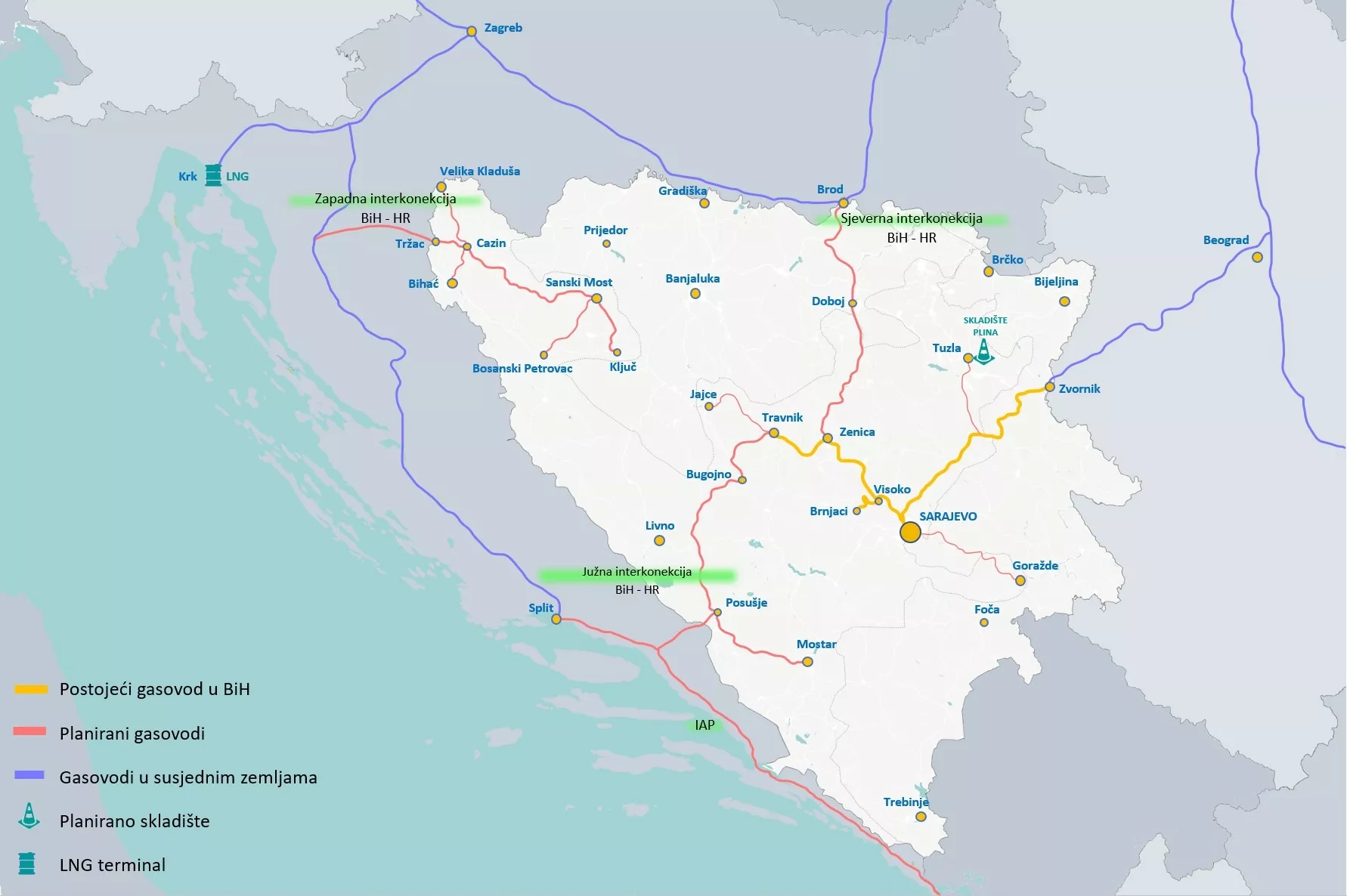
The construction of the Southern Gas Interconnection between Bosnia and Herzegovina and Croatia has been presented for years as a strategic project that would reduce dependence on Russian gas. However, recent political and legal moves have opened a series of serious contradictions: from amending the law to change the investor, to the emergence of a relatively unknown (newly established) company with no references as a potential investor. In such circumstances, the question justifiably arises whether the current model of building the Southern Gas Interconnection is in the interest of Bosnia and Herzegovina or represents a transfer of part of its energy sovereignty to a dubious partner.
Last year, the Parliament of the Federation of Bosnia and Herzegovina adopted the Law on the Southern Gas Interconnection, which clearly defined that the investment holder is the domestic public company BH-Gas. Article 5 of that law states that "the holder of the investment for the Southern Interconnection gas pipeline project is BH-Gas d.o.o. Sarajevo." This meant that an important infrastructure project remained under the control of a domestic institution.
'American investor' without clear references
However, amendments to the law have been initiated to exclude BH-Gas from the project, and the role of the project holder is given in the very text of the law (!) to a private company, the American investor AAFS Infrastructure and Energy. Such a move raises a fundamental question: why is the law being changed after it has just been adopted, and not in a technical part, but in an essential one? Such practice in the strategic energy sector represents a serious precedent.
Additional concern is raised by the profile of the company presented in public discourse as an 'American investor'. According to available information, it is a firm that appears interested not only in the gas pipeline but also in a broader package of infrastructure projects, including airports(?). Publicly available data indicate that the company has no known references in the implementation of large energy infrastructure projects, nor in the field of transport system management. The contradiction also lies in the breadth of interests of the newly formed company; interest in airports and other strategic facilities further raises questions of competence.
The Southern Gas Interconnection project already has a pronounced geopolitical dimension. It is certainly part of a broader strategy to strengthen energy influence in Southeast Europe. The media reports that individuals connected to the company AAFS are close to the political circle of the US president.
However, this also opens a sensitive question: could the easing of political pressure on regional actors, especially Milorad Dodik, possibly be linked to this energy arrangement? Especially because representatives of his party must also vote for this project at the state level. Direct evidence of such a link has not been publicly confirmed, but political-economic practice shows that infrastructure projects often serve as a platform for broader political compromises. The fact that the project is being awarded to an unverified private investor connected to the US political leadership increases the scope for such speculation.
Energy sovereignty or transfer of control
Analyses by energy organizations further problematize the economic rationale of the project. According to a study by the CEE Bankwatch Network, the planned capacity of the Southern Gas Interconnection would be as much as six times greater than the current gas consumption in Bosnia and Herzegovina, while gas accounts for only about 3% of the country's total energy consumption.
Such data indicate that the project may not be primarily driven by real energy needs, but by (someone else's) strategic interests. When added to the possibility that management of key infrastructure could be taken over by a private company with no clear references, the question arises: is Bosnia and Herzegovina gaining energy security or losing part of its energy sovereignty?
Strategic project in a grey zone and contrary to EU strategy
The Southern Gas Interconnection itself can have strategic merit; diversification of energy sources and reduction of dependence on a single supplier is a legitimate goal. However, the way the project is currently being managed raises serious dilemmas: the law is being changed to accommodate an investor with no clear references for such large projects, there is a risk of transferring control over infrastructure to a private entity, and finally, the economic justification of the project remains questionable.
It is important to note that the EU does not support such projects and insists on its vision of the energy future of BiH and the Western Balkans. The EU's position is that it will not support energy solutions that are not based on renewable energy sources. Their financing does not include projects that increase long-term dependence on fossil fuels. EU energy policy is based on the transition to clean energy and achieving the goal of climate neutrality by 2050.
The EU considers gas as a transitional solution; as CBAM is gradually introduced, production with a high carbon content will face additional costs when exporting to the EU. For the economy of Bosnia and Herzegovina to remain competitive, the country will have to reduce emissions and invest in cleaner energy. The EU also offers a mechanism for these investments - the Growth Plan for the Western Balkans.
Energy policy is, at its core, a policy of survival in a world where power is increasingly measured by control over energy. In such circumstances, the initiative to build the Southern Gas Interconnection, in its current form, can hardly be considered unequivocally in the interest of Bosnia and Herzegovina and its citizens. Diversification of energy sources must not be an excuse for non-transparent arrangements and projects that are not in line with EU strategies. Bosnia and Herzegovina does not need a gas pipeline at any cost, especially not at the cost of losing control over its own energy sovereignty.
Komentari (0)
Prijavite se za komentiranje
PrijavaJos nema komentara. Budite prvi!
Minuta
Sve →Iz drugih kategorija

High Representative Not Elected: Germans, French and British Against Americans, New Attempt at End of June

ČOVIĆ WITHOUT MERCY: How Those Who Brought Ademović to Office Created a Political Hell for Him



Sunny Saturday, quite warm



Tragedy in Albanian resort: Two minors drown












