
By Dean Džebić
A black Land Rover Discovery 3, with Belgrade plates and a discreetly covered coat of arms, is driven through the famous Bosniak Mahala in Mitrovica the day after the terrorist attack. Inside the vehicle is a high-ranking official of the Security-Information Agency (I.G.) who, unknowingly, is subjected to counter-intelligence measures by Kosovo's forces and security services. After leaving the vehicle, he is intercepted by a Kosovo intelligence officer (P.B.) who assures him that their next meeting will end with him being tied to a power pole.
Things have functioned in Kosovo in a similar modus operandi from 1999 to the present day. The population in the northern part of Mitrovica, according to locals, is generally peaceful, but the problem is caused by criminals from within Serbia, or criminal groups from Serbia that have a strong foothold in Kosovo. The strength of this foothold is indicated by footage from Milan Radoičić's hacienda, who, along with the criminal group he led, had a complete monopoly on the import of goods from Serbia to Kosovo. In 2022 alone, food items worth 1.5 billion euros were imported to Kosovo from Serbia, and there is no doubt that Radoičić could not have organized and carried out this lucrative business without the authorities in Belgrade.
And sometimes, those same authorities in Belgrade have certain demands in exchange for monopoly and power. What if this time Radoičić had a request to give Serbia a 'casus belli' (pretext for war) for the formation of the ZSO, or to intimidate the Vojvodina liberals through pilgrims in Banjska, or perhaps both?
Kosovo Police Rescued Robbed Pilgrims
The public has moved on too easily from the information that the terrorists who stormed the Banjska monastery robbed the pilgrims, taking their mobile phones, money, and other valuables. It's quite confusing, then, that the fighters for the freedom of the Serbian people in Kosovo stormed a monastery and robbed Orthodox pilgrims within it. To make things even more interesting, pilgrims from the north of the country are being robbed by compatriots from the south, known for their hospitality. The unusual connection of most barricade leaders and all terrorist activities in Kosovo can probably answer the thread of doubt arising from these logical questions.
Unusually, all paths of the group lead to Novi Sad, or Vojvodina, where, for example, Zvonko Veselinović has a strong base and logistical support. Let's also recall that several of the wounded who escaped from the monastery were taken to Novi Sad for rehabilitation. In fact, the Veselinović – Radoičić group represents the nexus of organized crime and terrorism that dominates the northern part of Kosovo.
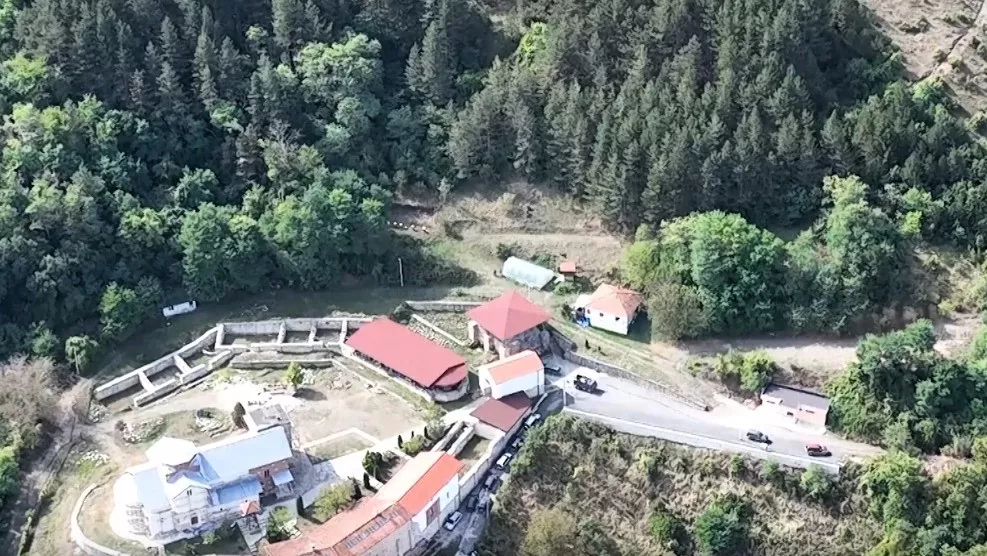
In this regard, the Banjska monastery was not chosen by accident, just as the only statement from the surviving pilgrims, who said they decided to issue an official statement on their behalf in agreement with the monastery's clergy, is not accidental at all. Ultimately, the scenario was much more disastrous for the Vojvodina pilgrims, who were actually saved by the Kosovo police, specifically the patrol of the murdered policeman Bunjaku, who happened upon the barricade while Radoičić's terrorists were already at the barricade and in the monastery.
According to our sources from Kosovo's security agencies, the goal of Radoičić's group was to carry out a false flag operation with the aim of provoking revolt and rebellion among the Serbian population. But they would have carried out that operation in captured Kosovo police uniforms, not against the local population, but against Orthodox pilgrims from Vojvodina! All members of Radoičić's terrorist group speak Albanian very well, and with a few words in Albanian and full uniforms with Kosovo insignia, the entire operation would have looked like a brutal and savage attack on Orthodox pilgrims in the monastery.
Then, the psychological-informational segment of the yellow press in Serbia would certainly have heated the atmosphere to boiling point, pouring gasoline on the fire, and the momentum of events would have turned in a completely different direction. Serbia would have gained a pretext for war with a whole series of prepared measures and countermeasures, and the Kosovo side, while proving its innocence in the upcoming events, would have lost all control.
On the other hand, Aleksandar Vučić's rule is increasingly tarnished by the growing number of protests precisely in the peaceful Vojvodina. For example, a few days ago, opposition protests and Vojvodina liberals, who are at the forefront of criticizing the current situation in Serbia, were held in Novi Sad. Therefore, the operation of the Veselinović-Radoičić group in the Banjska monastery had its primary and secondary goals. The primary goal of provoking a Serbian population rebellion was not achieved and is postponed to some future 'next year', while the outcomes of the secondary goal remain unclear. If the regime close to the mafiosi needs to calm down the opposition and the people there by harassing pilgrims from Vojvodina, then that says a lot about the state of that political regime.
Weapons from Tuzla, Tanks from Pazar
Milan Radoičić's statement that he bought weapons in Tuzla is a classic example of a drowning man grasping at the smallest straw. There is no doubt that a significant amount of firearms remains illegally in the possession of citizens in Bosnia and Herzegovina, but the thesis about Tuzla is contrary to logic. As such, it should not be dealt with in detail; after all, among the seized weapons is a Yugoslav Zastava M84 machine gun, which was fired by an intoxicated person at a corona party in a cafe in Pale two years ago. Yet, no one pointed a finger at RS, where it is normal to fire a machine gun in a catering establishment.
Furthermore, despite all the efforts of the Chief of the General Staff of the Serbian Army, Lieutenant General Milan Mojsilović, to remove Radoičić's terrorist groups, there is a whole series of evidence of the complete involvement of the Serbian Army in the planning and execution of this operation. The Black Arrow anti-materiel sniper rifle in 12.7 mm caliber is a sniper rifle used by the special units of the Serbian Army as well as the Gendarmerie. It could only have been issued from its warehouse by Kragujevac's Zastava, which produces it, or by the Serbian Army, given that we are talking about weapons that entered operational use only in 1998. A similar situation applies to the M-93 automatic grenade launcher as well as the Browning M2 heavy machine gun of American production, which is part of the Gendarmerie.
On a practical level, it should be noted that units of the Serbian Army conducted armored unit movements from Pazar and the depths of Serbia along the border for several days. Interestingly, these movements were monitored along the border, except for the part around Mount Rogozna, which was the entry point for the terrorists, implying that the army's role was to attract the attention of Kosovo's security forces so that the terrorists' incursion and entry would be unimpeded.
Today, a little more than two weeks after the terrorist attack, a heated discussion is ongoing among police and intelligence structures in Serbia about betrayal, which is a ubiquitous constant in the argumentation regarding unsuccessful campaigns. By calming and frightening the opposition, but also by inciting the people in the north to rebellion, someone made a bad calculation.
Komentari (0)
Prijavite se za komentiranje
PrijavaJos nema komentara. Budite prvi!
Minuta
Sve →Iz drugih kategorija

High Representative Not Elected: Germans, French and British Sabotaged Americans, New Attempt at End of June

ČOVIĆ WITHOUT MERCY: How Those Who Brought Ademović to Office Created a Political Hell for Him



Sunny Saturday, quite warm



Tragedy in Albanian resort: Two minors drown












