
Written by: Amra Vrabac
A new session of the Council of Ministers of Bosnia and Herzegovina is scheduled for January 22. The agenda has not been published, but according to political circumstances and announcements from coalition leaders, no reform laws from the 14 priorities of the European Commission will be on the agenda. According to announcements from the EU, on that day, the President of the European Commission, Ursula von der Leyen, is expected to visit Bosnia and Herzegovina to discuss precisely the obligations on the European path with officials. What can be heard is that the EC is ready to "shorten" the list of obligations so that Bosnia and Herzegovina can meet at least the minimum and receive the opening of accession negotiations with the European Union in March. However, everything is still up in the air.
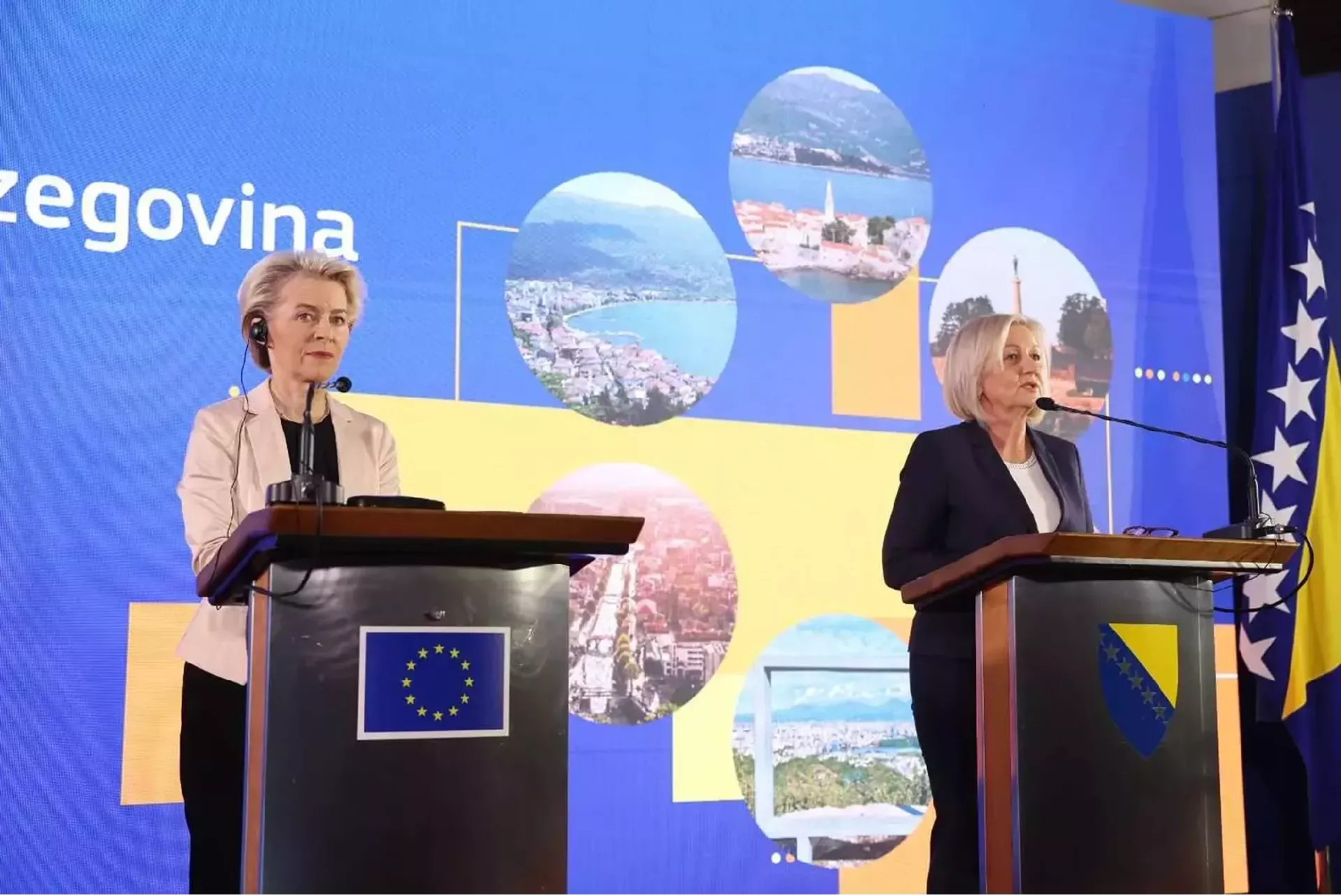
Von der Leyen visited Bosnia and Herzegovina on November 1, and since then, the state authorities have failed to agree on and adopt two laws highlighted by the EC President. At a press conference she held with the Chairwoman of the Council of Ministers of Bosnia and Herzegovina, Borjana Krišto, she stated that key laws in the area of the rule of law, such as the Law on Courts and the Law on Conflict of Interest, are crucial.
Although Krišto then said that the Decision on FRONTEX, the law on preventing money laundering, and the law on conflict of interest were almost completed, it is evident that there is no agreement on most legal solutions.
On December 14, the Council of Ministers of Bosnia and Herzegovina only adopted the Proposal for the Law on Preventing Money Laundering and Financing of Terrorist Activities, but it has not yet been considered in the House of Peoples of the Parliamentary Assembly of Bosnia and Herzegovina, even though the Council of Ministers of Bosnia and Herzegovina proposed that it be considered under an expedited procedure.
The last session of the House of Representatives of the Parliamentary Assembly of Bosnia and Herzegovina was held on December 29, and the House of Peoples of the Parliamentary Assembly of Bosnia and Herzegovina on December 28. According to the parliamentary calendar, no sessions have been scheduled yet this year.
The state coalition, consisting of SNSD, HDZ BiH, and the parties of the troika - SDP, NIP, Our Party, should meet today for the first time since October 16, when they held their last meeting.
The President of SNSD, Milorad Dodik, has stated on several occasions, and repeated yesterday, that no law will be adopted until the issue of the Constitutional Court of Bosnia and Herzegovina is resolved, i.e., until foreign judges are replaced by domestic ones. However, for the parties of the troika, such a demand is currently unacceptable, and they are not in favor of the option of adopting a new law on the Constitutional Court of Bosnia and Herzegovina.
Regarding the Law on Courts, Dodik insists that the Appellate Division be in Banja Luka, while the troika proposes that it be in East Sarajevo due to the cost-effectiveness of proceedings. Due to this disagreement, the law is not on the agendas of the Council of Ministers of Bosnia and Herzegovina sessions. Another stumbling block is the Election Law of Bosnia and Herzegovina, given the request of HDZ BiH to enable "legitimate representation," but to make changes without amending the Constitution of Bosnia and Herzegovina, which requires a two-thirds majority that the current government does not have.
Instead of laws, the Council of Ministers of Bosnia and Herzegovina is dealing with forming working groups, changing certain members with those from the ruling coalition, appointing directors, deputies, management boards, announcing tenders...
It is difficult to expect that by the arrival of the European Commission delegation, which will also include Croatian Prime Minister Andrej Plenković, any miracle could happen, leading to the adoption of some reform laws. The state authorities will, by all accounts, appear before Von der Leyen almost empty-handed.
Komentari (0)
Prijavite se za komentiranje
PrijavaJos nema komentara. Budite prvi!
Minuta
Sve →Iz drugih kategorija

High Representative Not Elected: Germans, French and British Against Americans, New Attempt at End of June

ČOVIĆ WITHOUT MERCY: How Those Who Brought Ademović to Office Created a Political Hell for Him



Sunny Saturday, quite warm



Tragedy in Albanian resort: Two minors drown












