
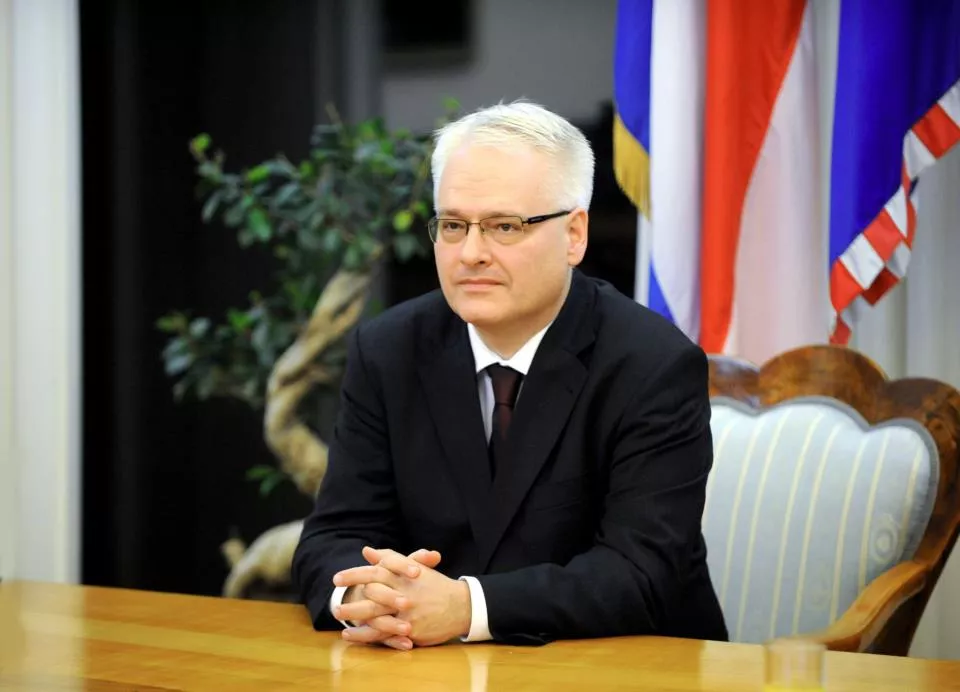
Former Croatian President Ivo Josipović is remembered fondly by the citizens of Bosnia and Herzegovina as a moderate and tolerant head of the neighboring country. After leaving the SDP of Croatia, Josipović founded his own party, Naprijed Hrvatska. In an interview with the Patria news agency, he talks about his political career, the situation in the region, the rehabilitation of Draža Mihailović and Slobodan Milošević in Serbia, and also offers recommendations on how to improve relations between BiH and Croatia.
PATRIA: You are a man who created peace and never agreed to gain election votes by exploiting political tensions and fabricated ethnic conflicts. We in BiH know such actions very well, and it is the general opinion that you lost the elections precisely because of this. What is your opinion on this today?
JOSIPOVIĆ: Unfortunately, many politicians build their careers and success on inciting conflicts, extreme nationalism, and fostering intolerance of all kinds. Perhaps being different is one of the reasons why a part of the electorate did not like me. There were also my weaknesses in the campaign, as well as serious obstruction from those from whom I expected support. Now those elections are in the past, and I want to continue contributing to peace and cooperation among countries, as well as harmony in Croatian society, obviously in a different way than when I was president.
PATRIA: Why did you leave the SDP? Was it because you were president of all Croatian citizens for two terms, and was this fact the reason for your independent further political path?
JOSIPOVIĆ: I had to leave the SDP by force of the Constitution when I was elected president. After my term ended, I decided not to return to the SDP for two reasons. First, the SDP is not at all inclined towards what Croatia urgently needs: serious institutional reforms. The poor results of the government led by the SDP show that the mandate was spent without real results. Second, it is clearer today than ever before, the leadership of the SDP no longer represents the political values that once bound me to that party. President Milanović's statements today are more reminiscent of a right-winger's escapades than of a politician committed to social democracy, peace, and cooperation among countries. I will be happy if what we have heard from Milanović turns out to be just a bad election campaign, not a real value system. I have chosen a difficult path, perhaps one that does not lead to political success, but it leads to a clear conscience.
PATRIA: It was shocking that you narrowly lost the election for a second presidential term by only 32,500 votes, and that ten months later, your party Naprijed Hrvatska had poor election results. Is it possible to explain this electoral paradox?
JOSIPOVIĆ: The matter is quite clear. In both elections, especially the first one, and in these elections that I lost, I received significantly more votes than the SDP with its partners ever did. However, the electorate thinks differently in parliamentary elections than in presidential ones. They stick to established parties, often irrationally continuing to vote for the party they have "always voted for." Voters also find it difficult to place us as individuals in roles they are not accustomed to. In addition, votes within certain political options are grouped around the strongest party, for fear that the votes will be wasted. I call this social inertia. Unfortunately, this phenomenon allows so-called large parties, regardless of having disappointed their voters countless times, to still remain their choice. To this, we must add that new and small parties struggle to gain media attention, finances, and other infrastructure required for a successful election performance. In the last elections, as a completely new party, together with our partners, we had a total of three times less funds than the large parties in just one electoral unit. However, in politics, one must be persistent and fight for the values one believes in, even when there is no immediate success.
PATRIA: How do you assess the current situation in the region? The diplomatic visits of Joe Biden to Serbia and Kosovo, and then Swedish Prime Minister Stefan Löfven to Serbia, all seem surprising to us in BiH, with inflammatory and warmongering statements coming from Serbia. How do you interpret this?
JOSIPOVIĆ: Unfortunately, there are many politicians who like to stir up hatred and conflicts. Unacceptable statements from Serbia come every now and then. We have recently seen that there is no shortage of problematic messages from Croatia either. But, as far as BiH is concerned, the situation in the country depends primarily on you in BiH. If you have policies that lead to de-escalation of tensions, if you are resistant to attempts to influence the political scene from the outside, if you have a European vision and the capacity to realize it, if you know how to balance individual and collective rights of citizens and peoples, you don't have to worry. Your destiny is, after all, in your own hands.
PATRIA: On one hand, we have Mr. Aleksandar Vučić, who constantly talks about the threat of war. If an ordinary person looks around, they don't see any gunfire, not even in the sky, no ethnically motivated murders, no recognizable war danger. It is obvious that the threats of war come directly from political leadership, which is confusing. How does all this seem to you? Is some new conflict in the region truly possible?
JOSIPOVIĆ: It is very difficult to build peace. Conflicts of various kinds, including wars, are easily ignited. Perhaps it is difficult to imagine today that a total war of all against all, as it was in the nineties, could be repeated. However, various forms of political, economic, and other pressures and disputes, terrorist or other attacks, are not excluded. Nevertheless, I hope that people have had enough of hatred and suffering and that politicians will follow the same path.
PATRIA: As far as we know, you were one of the few politicians who directly reacted to media reports and threatening statements from Serbian politicians regarding the beatification of Cardinal Stepinac. The Republic of Serbia has officially rehabilitated the war criminal Draža Mihailović, but lectures Croatia on Stepinac. After all, there is now a move towards the official rehabilitation of Slobodan Milošević. And all this while the main war criminals are still being tried in The Hague. We do not see, unfortunately, serious reactions to the rehabilitation of fascism from the democratic international community.
JOSIPOVIĆ: The lack of equal criteria for oneself and others is the main problem for many politicians. Indeed, the fact that those who have rehabilitated Draža Mihailović, and are rehabilitating Milošević or Nedić, object to the rehabilitation of Cardinal Stepinac is, to say the least, tasteless. Mihailović is a convicted criminal, judicially and historically. You don't have to like the work of Cardinal Stepinac, but he is certainly not a criminal; after all, he was not even tried for war crimes. The neo-Chetnik movement in Serbia has gone further than the neo-Ustasha movement in Croatia. Both phenomena are completely alien to me, and I consider them equally destructive. I am not happy that criminals and terrorists are being rehabilitated and that monuments are being erected to them in any country. In our region, such things carry an additional negative message and create new tensions. Honestly, I regret that such things are happening in Croatia as well. Streets and monuments to Budak, a monument to Barešić, calls for Jure and Boban, are the best examples of this.
CHETNIKS AND USTAŠAS SERVED HITLER AND MUSSOLINI
PATRIA: Speaking of these double standards, there is a deafening outcry from the world when Croatia occasionally makes a mistake in its anti-fascist steps, but when Serbia makes one, the reactions are almost mild. Why is that?
JOSIPOVIĆ: I always advocate for equal criteria. Both Chetniks and Ustashas served Hitler and Mussolini and were clearly on the wrong side. In the war, they were together in operations against the Partisans, they hardly had any battles among themselves, and they retreated together through Bleiburg. But that is history. Today, it is completely irrelevant whose grandfather or father was an Ustasha, Chetnik, or Partisan. What is important is that we correctly evaluate history and accept that anti-fascism, the struggle of the Partisans, was the right path, and that helping Hitler was not. Therefore, any attempt to affirm Chetnik or Ustasha ideology should be clearly condemned. It is completely unbelievable that a non-negligible part of the people who were on the winning side in World War II desperately wants to join the defeated, those whom the entire democratic world has condemned and recognized as the wrong choice.
THE FIGHT FOR HISTORICAL TRUTH
PATRIA: The fact that Croatia is a country with a huge anti-fascist tradition, yet many do not recognize it, confuses every normal person. At one point, more than half of Tito's Partisans were Croats. Croatian anti-fascists made huge sacrifices at the Neretva and in Drvar. At Sutjeska, 787 Partisans from Šibenik and 688 from Split perished, while a total of 67 fighters from Belgrade participated. There is also your Makarska, where the first anti-fascist fleet was formed. Why is Croatia mostly talking about fascists, and not about such a magnificent anti-fascist struggle?
JOSIPOVIĆ: I think that a strong, well-financed, and organized campaign of historical revisionism, aided by the right wing of our political scene and a vocal segment of the Catholic Church, has imposed the thesis that the Ustashas were good Croats and the Partisans were traitors to Croatian identity. In one of my speeches in Brezovica, on the Day of Anti-Fascist Struggle, I said that the main culprits for the neglect of the anti-fascist tradition are, however, the sons and grandsons of the Partisans. They do not fight for historical truth with anything near the persistence and passion with which Ustasha sympathizers fight for historical revisionism. We even had the SDP in power, and there was no real, organized, and adequately financed activity to preserve the anti-fascist tradition and historical truth.
PATRIA: You are a tireless advocate for good relations between Croatia and BiH. What, in your opinion, needs to be done to improve these relations?
JOSIPOVIĆ: We need to trade more for mutual benefit, exchange cultural projects, travel, get to know each other... If people know and socialize with each other, respect each other, it certainly influences political relations as well. At the political level, correctness and non-interference in internal affairs have special weight. Of course, it is understandable that relations within BiH, the satisfaction or dissatisfaction of Croats with their position, as well as the position of Bosniaks and Serbs originating from BiH in Croatia, also have an influence. But, clearly, there should be no interference in the internal affairs of another country. In addition, unresolved issues from the breakup of former Yugoslavia remain, from borders to property and other relations. Governments should finally start closing these issues, because the fact that they are not "hot" today does not mean they will not be tomorrow.
Komentari (0)
Prijavite se za komentiranje
PrijavaJos nema komentara. Budite prvi!
Minuta
Sve →Iz drugih kategorija

High Representative Not Elected: Germans, French and British Sabotaged Americans, New Attempt at End of June

ČOVIĆ WITHOUT MERCY: How Those Who Brought Ademović to Office Created a Political Hell for Him



Sunny Saturday, quite warm



Tragedy in Albanian resort: Two minors drown












