
ZAGREB, (Patria) - The Youth Initiative for Human Rights of Croatia once again firmly opposed radical right-wing ideologies in these areas, in this case Croatia, and stated that not all young people are imbued with hatred and nationalism, as is often emphasized.
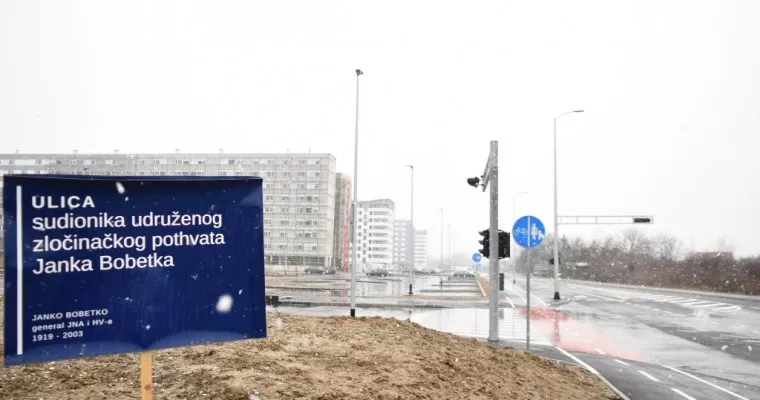
The City Assembly of the City of Zagreb will consider at its session on February 22 a proposal to name a street in the Zagreb neighborhood of Podrbrežje after former Croatian Army General Janko Bobetko. The proposal came from the Committee for Naming Settlements, Streets and Squares.
The Youth Initiative for Human Rights of Croatia once again reacted to the increasingly frequent occurrence in Croatia of honoring persons convicted or linked to war crimes from the 1990s in this or a similar manner.
The Initiative warned city councilors, who will vote on the proposal at the session, about the endangerment of human rights values and civilizational standards that could occur if a majority of representatives support the said naming proposal in the vote.
Janko Bobetko was a participant in a joint criminal enterprise in Bosnia and Herzegovina aimed at changing the ethnic composition in the territory of the Croatian Community (Republic) of Herceg-Bosnia in BiH, as established by the International Criminal Tribunal for the former Yugoslavia. In addition, Bobetko was charged with war crimes before the ICTY for his participation in Operation Medak Pocket, and he refused to go to The Hague to stand trial.
Before the Zagreb County Court, in a final verdict against Mirko Norac and Rahim Ademi, it was established that Janko Bobetko was at the head of a parallel command chain in Operation Medak Pocket, during which war crimes were committed against civilians and prisoners of war.
The Initiative believes that naming a street after a person such as Janko Bobetko would be contrary to the guidelines and recommendations of international human rights organizations of which the Republic of Croatia is a member. In this case, the Youth Initiative for Human Rights of Croatia particularly emphasizes the inconsistency of the naming proposal with the UN's Basic Principles and Guidelines on the Right to a Remedy and Reparation for Victims of Gross Violations of International Human Rights Law and Serious Violations of International Humanitarian Law, the Ljubljana Guidelines on Integration of Diverse Societies, and the OSCE's Graz Recommendations on Access to Justice and National Minorities.
- As representatives of the City Assembly, you have committed to representing citizens and making responsible and conscientious decisions for the benefit of the local community you represent. We hope you understand that the names of public spaces have a strong symbolic significance and promote the values behind the society that participated in the naming.
We warn you that you bear great responsibility because your decision on naming will also affect the international reputation of the city of Zagreb and the Republic of Croatia, and will indicate how we relate to victims of human rights violations, respect for documents of international organizations, and the possibility of confronting our own past - stated the Initiative.
The Initiative believes that city councilors, with their votes at the session, will decide whether Croatian society promotes the values of coexistence and tolerance or promotes the commission of war crimes. They emphasized that the consequences of the vote at the session could be felt by future generations of citizens of Zagreb and Croatia.
In this way, the Youth Initiative for Human Rights of Croatia once again confirmed its determination in the fight for a different and more positive Croatia than the one represented in recent years by numerous representatives of radical right-wing associations. It is precisely because of such individuals that Croatia has recently come under criticism from the EU and the US State Department, which in its annual report warned of the rise of right-wing radicalism in Croatia.
Ustasha ideology and iconography have become mainstream on the Croatian political scene, and numerous individuals who publicly advocate Ustasha views and express sympathy for the former criminal NDH have become regular guests at all party rallies of the ruling HDZ. Many such figures could also be seen at the inauguration of the current Croatian President Kolinda Grabar-Kitarović.
The Croatian state leadership has never decisively condemned Ustasha iconography and the singing of Ustasha songs at sports venues in the country, and President Grabar-Kitarović has several times come under fire from liberal media for her statements about the "great atmosphere" at football matches of the Croatian national team, even though an integral part of that "great atmosphere" is most often the chanting of the Ustasha salute "Za dom spremni".
It should not be forgotten that, alongside numerous intellectuals, the loudest voice against hate speech and the glorification of war criminals after the verdict against Jadranko Prlić and others in Croatia was precisely the Youth Initiative for Human Rights.
The existence of such a group of young people, which also exists in Serbia, gives new hope for a better and brighter future in these areas. Different from the one promised to us by the current political elites.
Komentari (0)
Prijavite se za komentiranje
PrijavaJos nema komentara. Budite prvi!
Minuta
Sve →Iz drugih kategorija

High Representative Not Elected: Germans, French and British Sabotaged Americans, New Attempt at End of June

ČOVIĆ WITHOUT MERCY: How Those Who Brought Ademović to Office Created a Political Hell for Him



Sunny Saturday, quite warm



Tragedy in Albanian resort: Two minors drown












