
By: Nevena Kovačević
At yesterday's intergovernmental conference, Montenegro officially received a positive report on the assessment of the fulfillment of interim benchmarks (IBAR) for chapters 23 (judiciary and fundamental rights) and 24 (justice, freedom, and security).
In accordance with the new methodology for accession to the EU, which Montenegro adopted in 2020, work remains to be done to fulfill the six final benchmarks and close the negotiation chapters.
For a pro-European and civic Montenegro, the IBAR is an important step, marking the entry into the final phase of the integration process. For the current government, the IBAR is just another technical issue that needed to be handled, to take credit for others' work, and to quickly return to strategic issues.
Thus, Andrija Mandić, less than 24 hours after receiving the IBAR, took an expected step, proposing an amendment to the agenda of tomorrow's parliamentary session with a resolution on Jasenovac, the adoption of which was maneuvered to be postponed until the end of June due to potential Croatian blocking of the IBAR.
One might say, a swift turn – from the European to the Greater Serbian agenda. Understandably, it wasn't easy for Mandić and his team to pretend to be Europeans while reporting to Vučić behind the scenes. The play is over, time is running out, and the leader's patience has long been exhausted.
Merits and Misconceptions
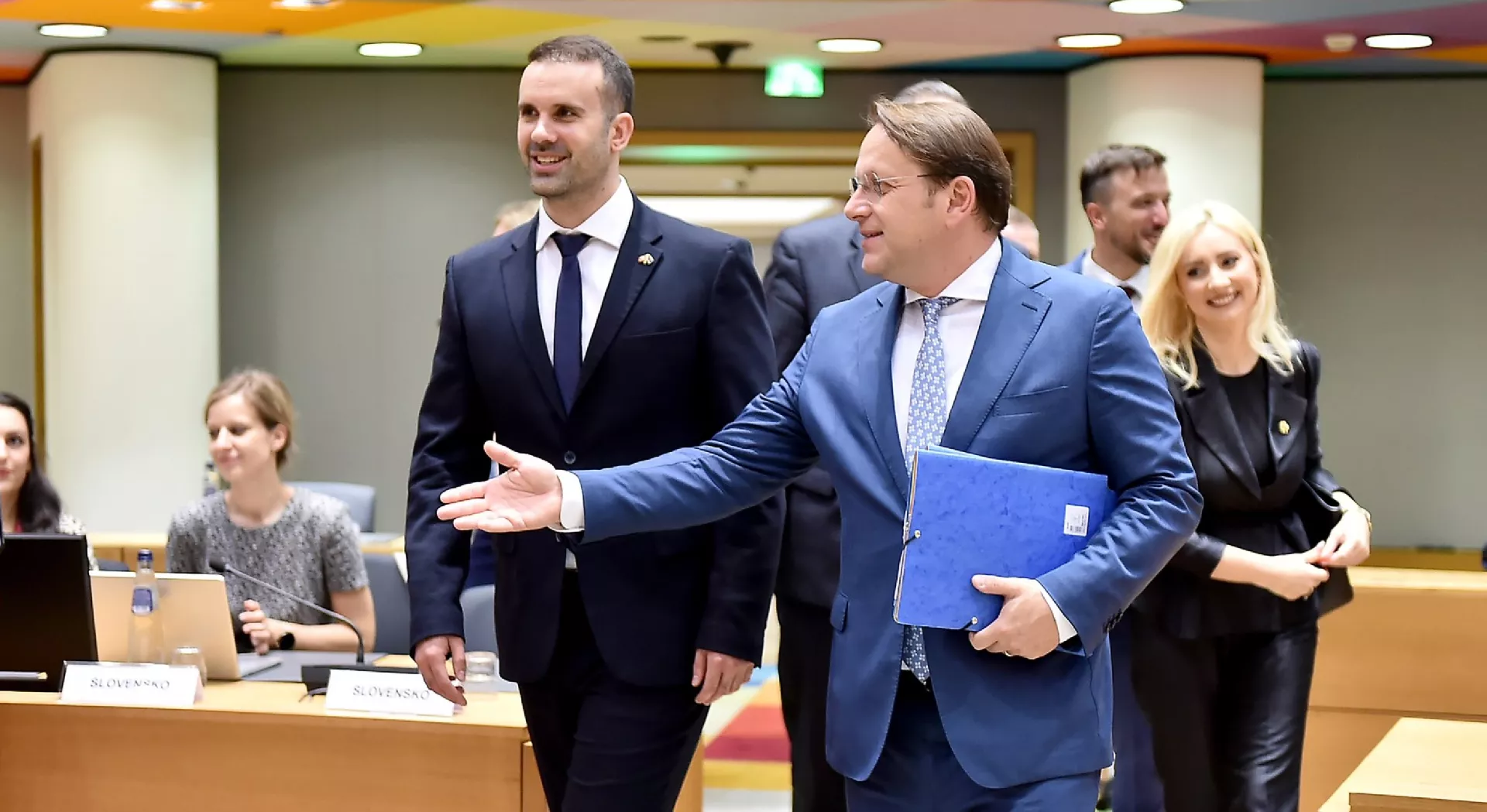
European officials sent encouraging messages to Montenegro, agreeing with Prime Minister Milojko Spajić's assessment that obtaining the IBAR is a historic moment.
Prime Minister Spajić, among other things, stated that the intergovernmental conference where the positive IBAR was formalized was like the Berlin Congress of the rule of law. Judging by Spajić's comparison, the celebration on the streets of Montenegro should have been at least as significant as a referendum celebration.
Europe would have forgiven us for a few tricolor flags and Russian flags displayed in celebratory fervor. This, let's recall, was an integral part of the folklore that adorned the celebrations of all election victories since August 30, 2020.
Objectively speaking, the IBAR is a product of geopolitical circumstances. Due to the rise of the far-right in Europe, Russia's aggression against Ukraine, and the genocide in Gaza, the European Union desperately needs a successful Western Balkan story.
For the EU to regain global strength, the doors in Brussels are wide open for Montenegro, as a long-standing regional leader in the EU integration process, with many shortcuts and side passages.
The IBAR, as an incentive for Montenegro, according to the Brussels administration, is the easiest way to revive the enlargement process. Montenegro was given a pass.
Legal solutions were rushed through, and some contained very controversial, even unconstitutional provisions. With good political will from Brussels, form, not substance, was decisive.
An assessment of the overall situation in the country, whose system is falling apart at the seams thanks to irresponsible and ignorant authorities at all levels, was once again absent.
The tragicomedy was completed by a letter from Oliver Varhelji to Andrija Mandić, congratulating him on his exceptional leadership and parliamentary achievements.
Thus, the duke who suspends parliament at every opportunity and openly works against state interests, for the benefit of the Belgrade-Moscow center, has transformed from an undesirable partner into a pillar of Montenegro's European path through peaceful transformation.
The truth, however, is quite different. The IBAR is the least thanks to those who boast about it the most. The West's disregard for internal affairs in Montenegro, on the other hand, is very dangerous.
In the post-IBAR period, there are no privileges. Everything is left to Montenegro, and the EU's attention will gradually decrease. This is the most favorable moment to finalize the project of turning Montenegro into a Russian-Serbian province.
Pro-European Actions of an Anti-European Government
We will mention only a few examples that expose Spajić's constant deceptions that his government is the initiator of the integration process, which began and will end during its term.
It is true that the systemic inaction of Montenegrin institutions resulted in years of stagnation in negotiations with the EU, starting from June 2020, when the last negotiation chapter was opened.
During the mandate of the Dritan Abazović government, Montenegro's EU path was blocked, with threats of a complete halt to the integration process. However, Spajić's government merely adhered to the technical standards defined by Brussels' political decision to give Montenegro a historic chance.
From the government crisis at all levels to the consistent execution of Greater Serbian orders – it is clear that the current government is pro-European only in rhetoric.
The Podgorica crisis will almost certainly end with early local elections. There are two opposition initiatives on the table – to dismiss Mayor Olivera Injac and to shorten the term of the city parliament, which will be discussed in the coming days.
A government crisis is also looming in Danilovgrad.
The election saga in Šavnik is still not over. Under pressure from the opposition, the government repealed the illegal decision to impose forced administration in that municipality, and President Jakov Milatović previously refused to call new elections because the current electoral process has not been completed.
However, it is unknown whether and when the government will create the prerequisites for conducting the vote at the two remaining polling stations. Let's recall that the electoral process in Šavnik has been ongoing since October 2022, and the last attempt to vote was in December of the same year.
In Budva and Andrijevica, complicated post-election negotiations are underway, with an uncertain outcome, accompanied by accusations of election fraud, threats, and intimidation.
In Pljevlja, Cyrillic is flourishing, the mayor Dario Vraneš is organizing a celebration of Serbia's Statehood Day, and streets are being renamed after soldiers of the aggressor JNA. The Serbian Prime Minister Miloš Vučević knows more about the situation in Pljevlja than the citizens of the municipality headed by one of the most prominent neo-Chetnik offspring and SNS informants.
The mayor of Nikšić, Marko Kovačević, announced in his latest statement that he will deal with everyone who does not want to be brothers with the Chetnik and neo-Chetnik group as he would with Turks. The prosecution is still investigating whether there are elements of hate speech in Kovačević's statement.
While the URA in Nikšić has withdrawn its support, the Democrats are keeping his seat for him, so the opposition initiative to remove Kovačević will clearly not have the majority support of Nikšić councilors this time either.
Marko Kovačević was previously acquitted in proceedings against him for denying genocide, while in the case of giving the middle finger during the singing of the Montenegrin anthem, which he explained as adjusting his watch, and insulting DPS MP Oskar Huter, the prosecution assessed that there were no grounds for initiating proceedings for violating state dignity and hate speech.
The prosecution, in conjunction with the local and state authorities, has long positioned itself as a factor in legitimizing rampant fascism.
At the state level, burning issues are the law on dual citizenship and the reconstruction of the Government. Amendments to the Law on Montenegrin Citizenship are one of the demands with which Milan Knežević conditioned the Democratic People's Party's further support for Spajić's Government.
A few days ago, the Prime Minister grossly misled the public by claiming that new citizens would only be able to obtain voting rights after ten years. However, Article 45 of the Constitution stipulates that the condition for obtaining voting rights is two years of residence, which means that the provision announced by Spajić would be unconstitutional and likely annulled by the Constitutional Court.
After prominent lawyers and political opponents exposed Spajić's deception, his cabinet announced constitutional amendments, which require a two-thirds majority vote of 49 MPs, and then a three-fifths referendum confirmation.
Since the proposal for constitutional amendments would not have even a hypothetical majority for now, an unconstitutional solution remains, which would then be annulled by the Constitutional Court, returning the original provision of two years, as defined by the Constitution.
This would formally enact a law tailored to the will of Aleksandar Vučić, and instead of Montenegrin citizens, SNS groups temporarily registered in Montenegro, who are brought in by sandwich and bus, would decide on the fate of the country. Vučić's and Dodik's scenario would become Montenegrin reality.
While citizens fear for their safety due to the chaotic security situation and criminal showdowns in public places in broad daylight, anti-crime fighters are busy acquiring police vehicles with Cyrillic inscriptions.
Minister of Energy Saša Mujović, promoted as a non-partisan figure, has been appointed head of the Podgorica PES. This is a reward for the culmination of chaos in the energy sector, caused by the party-family appointment of suitable and incompetent personnel.
The fight against corruption has turned into the persecution of dissidents, with political arrests presented as public spectacles with pompous handcuffing, and convictions before verdicts.
The case of former chief special prosecutor Milivoj Katnić, as an act of revenge by Mandić and Knežević and an attempt to close the case known as the state coup, is just one of many examples of political persecution. And such examples certainly do not reflect progress in the rule of law in a substantive sense.
Relations with neighbors are at an all-time low. In eight months, we have managed to collect as many as four protest notes. Two from Zagreb due to the refusal to continue dialogue about the ship Jadran and the announced resolution on Jasenovac, and two from Sarajevo, due to the non-display of the BiH flag at Mandić's meeting with Dodik in the Assembly building, and Mandić's statement that the all-Serbian assembly is a gathering of two countries.
The instigator of confrontations with Croatia is Aleksandar Vučić, whose strategic goal is to halt Montenegro's EU integration.
In the case of BiH, Mandić's majority considers only Dodik a friend, while the attitude towards official Sarajevo is extremely hostile.
In addition to Zeta not recognizing Kosovo, MPs from the ruling majority did not support Kosovo's admission to the Council of Europe.
Deniers of genocide, defenders of Kosovo, and relativizers of Greater Serbian aggression have infiltrated all levels of government. Our neighbors have forgiven us so far, but, by all accounts, they won't for much longer.
The consequences of adopting the resolution on Jasenovac, which Vučić is pushing Montenegro to do, would be far-reaching – Croatian blockade of the integration process, severance of diplomatic relations, regression in resolving open issues.
While the EU turns a blind eye, Montenegro has once again strayed from its path in less than 24 hours. At this turning point, with a clientelist-trading majority, we are closer to the Greater Serbian train than the Western one.
While Mandić and Knežević, through the obedient Spajić, are creating a southern province by quarreling with our neighbors, there is certainly no reason to celebrate. The dream of a European path could be formally shattered as early as tomorrow.
Komentari (0)
Prijavite se za komentiranje
PrijavaJos nema komentara. Budite prvi!
Minuta
Sve →Iz drugih kategorija

High Representative Not Elected: Germans, French and British Against Americans, New Attempt at End of June

ČOVIĆ WITHOUT MERCY: How Those Who Brought Ademović to Office Created a Political Hell for Him



Sunny Saturday, quite warm



Tragedy in Albanian resort: Two minors drown












