
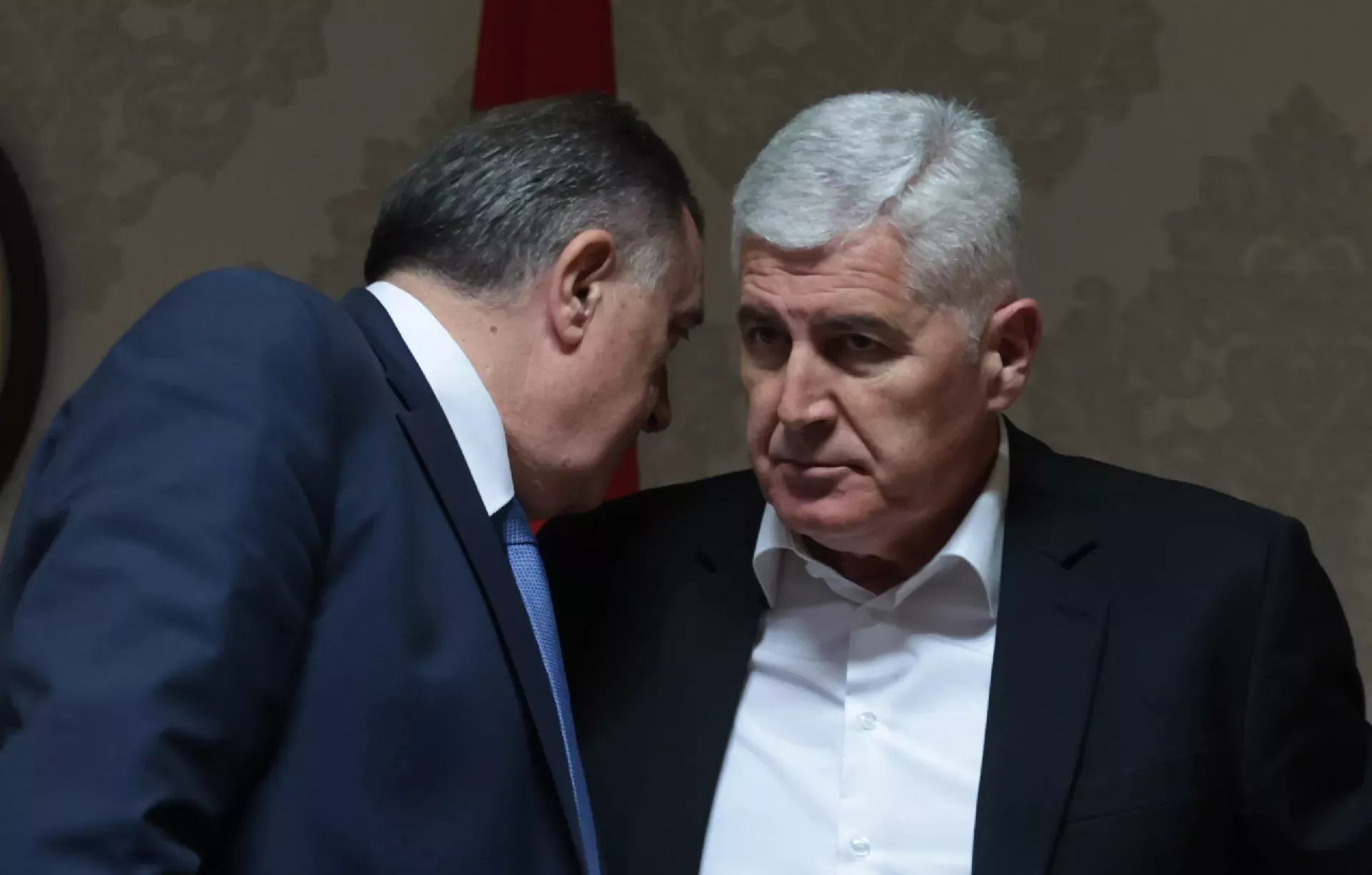
By: Amina Čorbo-Zećo
How naive it was to believe that Dragan Čović had turned his back on Milorad Dodik is best evidenced by the events in the House of Peoples of the BiH Parliament, as well as the fact that in the heated atmosphere in BiH, Čović put ANOTHER DIFFICULT ISSUE on the table – the BiH Election Law. Such behavior was absolutely understood as assistance to Dodik in his undermining of the constitutional order.
Nebojša Vukanović understood this immediately, who, if the HDZ and the Speaker Borjana Krišto (HDZ) had the will, could have already been sitting in the chair of the Minister of Security of BiH.
This is how he commented on the meeting announced for tonight between the Prime Minister of Croatia, Andrej Plenković, and Dragan Čović.
"Many things will soon become clearer and come to light, first of all, whether Milorad Dodik is still a vital Croatian national interest and whether he will be supported, indirectly, with gloves on, or whether Plenković will come to Mostar tonight with different messages from Brussels for Dragan Čović and HDZ BiH," said Vukanović.
In the complex political scene of Bosnia and Herzegovina, the phrase 'vital national interest' is used as a mechanism for protecting constituent peoples – often as a political tool to achieve goals that are not necessarily directly related to the vitality of the people, but to the interests of political elites.
What is clear for now is that Dodik's survival is Čović's vital interest.
Today, the question arises: are Croats now returning the favor to Serbs – or rather to Milorad Dodik?
One of the most striking examples is when Serb delegates in the House of Peoples of the Parliamentary Assembly of BiH refused to support the request to initiate a dispute against Croatia due to the construction of the Pelješac Bridge, even though Bosniak representatives claimed that BiH was losing its right to access the open sea.
And it was precisely the Serb delegates who then declared the Pelješac Bridge a vital interest – thereby effectively protecting a project that has no direct connection with BiH, other than that Bosniak politics sees it as an encroachment on sovereignty. Why did they do it? The answer is simple: Serbs at that time saw Croats as useful allies in balancing Bosniak political influence.
In a series of political upheavals, HDZ BiH and SNSD often coordinate their actions – whether it concerns electoral reforms or other issues.
Thus, it is evident that Croatian Prime Minister Andrej Plenković and HDZ BiH leader Dragan Čović comment very cautiously and mildly on Dodik's unconstitutional statements, while at the same time insisting on the need for equality of Croats. In practice, this means that they often tacitly support Dodik, because his rhetoric against Bosniak actions is also useful for the Croatian political agenda.
In this sense, it can be said that Dodik – regardless of all the controversies – is de facto a Croatian 'vital interest', as he ensures a balance of power in BiH, at least from the perspective of political Zagreb and HDZ BiH.
We might witness this tonight as well, when the topics of the meeting and its conclusions are officially announced.
What unites Croats and Serbs in BiH is not love, but a common fear of Bosniak political dominance, i.e., the realization of their war aims through peaceful means.
In translation, yes, Croats are 'returning the favor', but not because they have to – because it pays off. The political pact with Dodik allows them a stronger position in Sarajevo, especially in the context of electoral reform and the fight for 'legitimate representation'.
Komentari (0)
Prijavite se za komentiranje
PrijavaJos nema komentara. Budite prvi!
Minuta
Sve →Iz drugih kategorija

High Representative Not Elected: Germans, French and British Sabotaged Americans, New Attempt at End of June

ČOVIĆ WITHOUT MERCY: How Those Who Brought Ademović to Office Created a Political Hell for Him



Sunny Saturday, quite warm



Tragedy in Albanian resort: Two minors drown












