
By: Rasim Belko
Behind the diplomatic whispers and closed meetings of European officials, behind the scenes of the "concern" and "worry" of the international community, a poisonous soup is being brewed that they want to serve to Bosnia and Herzegovina. Their "concern" increasingly resembles the euthanasia of a state – quiet, without fanfare, but with deadly consequences.
The latest findings obtained by Patria indicate that the question is being increasingly raised in Brussels, Berlin, and other power centers: is Bosnia and Herzegovina even sustainable as a state? A question posed not out of curiosity, but as an introduction to seeking "realistic solutions." And "realism" in the diplomatic language of the West is most often a code word for the capitulation of justice to force.
The strategy of renewed Western cooperation with Milorad Dodik is openly and unreservedly underway. Signals from the European Union not to go against the "de facto reality" in Bosnia indicate an agreement that must not be publicly acknowledged, but which in practice is taking shape – recognition of secession. They are just waiting for the moment when this agreement will be formalized as a "compromise".
A change in part of the narrative in the West should set off alarms in Sarajevo, if anyone is left to hear them. Because Dodik's narrative about Bosniaks as a religious group (a SANU-esque repetition of the term 'Muslims') is increasingly present in the language of European diplomats and politicians, especially when meetings are far from public view. Thus, the European leadership has accepted the narrative, and this is not an insignificant fact in the new attempt to resolve the Bosnian issue, which in this case becomes a Muslim issue in the Balkans.
In their, Western, analyses, the "Muslim majority" is no longer a democratic term, but a security threat. A threat to "European values," which translates to a threat to the values of Christian Europe. Because only in this way can European fears of democracy in Bosnia and Herzegovina be defined.
In this story, Christian Schmidt, the High Representative of the International Community, plays the role of a silent bomb with a delayed fuse. Schmidt will not "impose" anything soon, he said recently in an interview, but he "does not rule out" doing so when the time comes. What does that mean? It means he is waiting for a signal. Not from Sarajevo, not from the BiH Constitution, but from Brussels, London, Paris, perhaps Washington. They are waiting for the main players to agree – about us, without us. About the fate of the state, the people, the identity – as if it were a chess game, not the lives and future of millions of people.
It is clear: we have never been closer to the institutional division of Bosnia and Herzegovina. Not by the model of peace, but by the pattern of blackmail. The EU does not want enlargement without "stability," Dodik does not want stability without entity independence, the international community does not want conflict – and here is the agreement. Expect a declaration called the "new European order of BiH," which hides an old map of division, only now with golden stars around it.
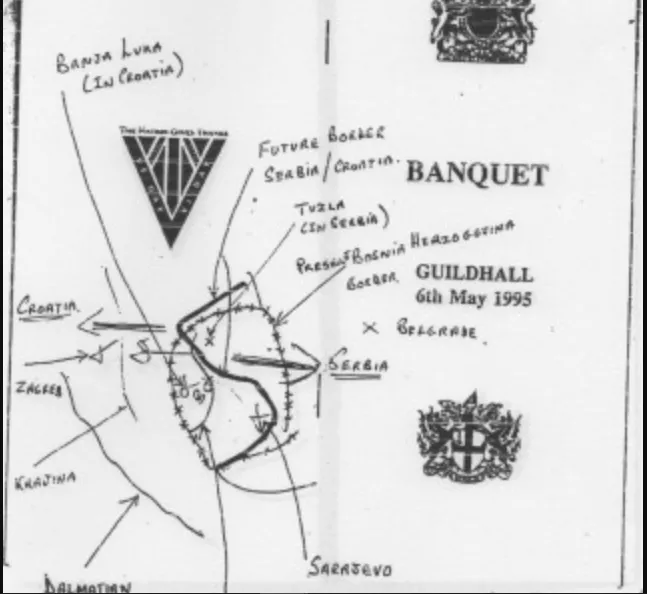
But let's not fool ourselves – if the international community's plan is the division of the state along the border of the rivers Bosna and Neretva, which would separate the Serbian and Croatian worlds, it cannot be implemented institutionally without some fifth-column element within the political body of Bosniaks. That is the bitter truth. At this stage, without traitors with Bosniak names and functions, there is no division. Without those ready to sell the interests of the state for an "Euro-Atlantic future" and a substantial sum, without careerists hungry for embassy attention and positions in structures that will disappear along with the state – this division project cannot be completed. And therefore, it is not surprising that a special caste of political "collaborators" has been nurtured for a long time.
Through that same prism, we should view the hastily made conclusions of the European Court of Human Rights in the case Kovačević v. Bosnia and Herzegovina. Instead of strengthening democratic foundations with its ruling, the court sent a message of fear – not of discrimination, but of the possibility that Bosnia and Herzegovina could become a true civic state. It is clear: the EU does not fear the lack of democracy in BiH, but its full realization. Because democracy in a country with almost two million Muslims, according to the logic that elites no longer hide, means the political dominance of the "non-European" element, regardless of the fact that these people have been indigenous Europeans for centuries. Therefore, the EU's fear does not stem from principles, but from prejudice. Not from law, but from paranoia. And this is proof that Milorad Dodik's narrative has deeply infiltrated the European political imagination – where Bosniaks are increasingly seen not as a constituent nation, but as a Muslim mass to be kept under control and neutralized at some point.
Sarajevo, trapped in fear of attempts and burdened by the question of what the world will say about our every move, neither sees nor hears the alarms being set off over its fate.
And it is time to say it clearly: Bosnia and Herzegovina is not and will never be the subject of anyone's deal.
It is time for the international factors to hear – the OHR is not a mere technical office, but a weapon that already is, and can be, turned against us in a worse form. If it is used to impose solutions that lead to division, disintegration, or discrimination of peoples under the guise of "European norms and reforms," it must be clear: we will not remain silent, nor will we agree. We will not just "act politically." We will defend this country by all means, even against those who today pretend to be protectors while working on its dismantling.
This is not a call to conflict – this is a call to awaken. Because if we continue to look into the murky water as if it were a mirror – we will not recognize what remains of us.
And Dayton is de facto dead, because what is happening behind the scenes has marked the continuation of the war – a war against Bosnia and Herzegovina as a state and against Bosniaks as a people.
I don't know how many in the political body of pro-Bosnian or Bosniak provenance are sufficiently aware and brave, but their message these days must be loud and fierce. Without beating around the bush like the quiet and veiled reaction to the scandalous conclusions of the ECtHR in the Kovačević case, but as direct as possible. So direct that the international community, whoever leads the tailoring of Bosnia and Herzegovina's disappearance, understands that this time, nor now, nor before or in the future, will it go without a fight. Political or armed, depending on their boldness to realize what they are drawing today!
Komentari (0)
Prijavite se za komentiranje
PrijavaJos nema komentara. Budite prvi!
Minuta
Sve →Iz drugih kategorija

High Representative Not Elected: Germans, French and British Sabotaged Americans, New Attempt at End of June

ČOVIĆ WITHOUT MERCY: How Those Who Brought Ademović to Office Created a Political Hell for Him



Sunny Saturday, quite warm



Tragedy in Albanian resort: Two minors drown












