

(Patria) - Bosnia and Herzegovina ranks first in the world in wage growth, according to the latest report by Trading Economics, an organization that deals with economic reports and financial statistics.
This very interesting data refers to October 2025, when wages in our country increased by 16.20 percent compared to the same period last year – when they also grew by 15 percent.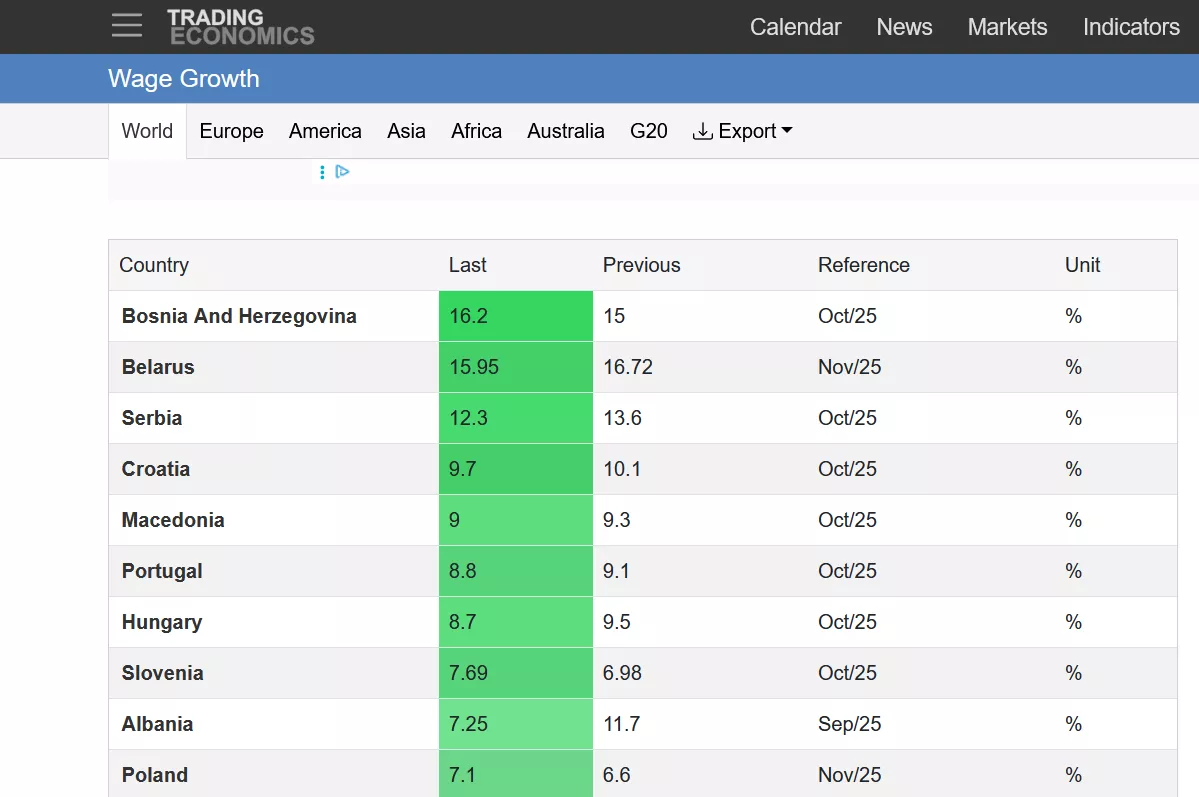
Trading Economics Table
However, Bosnian economic experts bring us back to harsh reality – this data does not reflect the real situation because the standard of living of Bosnian citizens is still very low due to high inflation and rising prices.
Supporting their claims is the data from the Union of Independent Trade Unions of BiH, according to which the trade union consumer basket for November 2025 amounted to as much as 3,355.25 KM.
In an interview with the Patria News Agency (NAP), experts emphasize that even two average (not minimum!) salaries cannot cover the consumer basket, which is a sign of immense poverty.
The average net salary in Bosnia and Herzegovina for October 2025 was 1,605 KM.
Adisa Omerbegović-Arapović, a full professor at the International Burch University (IBU) in Sarajevo, says that the fact that Bosnia and Herzegovina recorded the highest wage growth in the world in 2025 speaks primarily about the nature of the economic measures that produced that growth, and less about the strength of the economy.
- While most countries, facing post-pandemic inflation, tried to curb cost growth and cool demand, our governments implemented an unfounded administrative increase in the minimum wage, followed by adjustments of pay coefficients in the public sector.
This only fueled inflation, as confirmed by the growth in the consumer basket, which in Bosnia and Herzegovina has already exceeded two average salaries for two decades. Such a move statistically pushed BiH to the top of the global wage growth rankings, but in economics, extreme results are rarely a sign of natural success. More often, they are a sign of policies that act contrary to European trends – Omerbegović-Arapović told us.
Nominal wage growth, by itself, the professor adds, does not say much if it is not supported by productivity growth and price stability.
- Given that consumer prices in BiH have wiped out a third of purchasing power in the last ten years, we are among the top countries that have failed to cope with inflation. And this artificial wage growth has somewhat confirmed that, so we will have other problems such as budget sustainability and the burden on the economy, which has to bear all these bad economic policies – states Omerbegović-Arapović.
She notes that the standard of living does not depend on the speed of wage growth, but on their real purchasing power.
- In a country where the consumer basket has long exceeded the sum of two average salaries, the problem is not short-term, but long-term structural weakness. The public sector is too large compared to the real sector, the burden on the economy is too high, and productivity growth is too slow – these are chronic diseases of our economy that no government is addressing properly – emphasizes Omerbegović-Arapović.
She points out that administrative wage increases in such an environment do not solve the root of the problem. On the contrary, it often deepens inflationary pressures, according to our interlocutor.
- When the prices of basic goods and services rise faster than income, nominal wage growth quickly turns into an illusion. Inflation then takes on the role of a corrector, reducing the real value of increased earnings – explains Omerbegović-Arapović.
If current trends continue, she adds, 2026 could bring a slowdown in economic activity. Inflation could remain permanently present, while pressure on employers, especially in export sectors, could result in weaker employment or even job losses.
- Fiscal, short-term growth in tax and contribution revenues could mislead decision-makers. However, without productivity growth and private investment, such revenues are unstable. In the long term, risks to budget balance and the labor market become more pronounced – states Omerbegović-Arapović.
She emphasizes that, economically speaking, Bosnia and Herzegovina cannot be ranked by its true standard of living based on wage levels, but on what those wages can actually buy and how stable incomes are.
- By this criterion, BiH is significantly below the European Union average, but also below some Central and Eastern European countries that had a similar start. The reason is not only the low nominal wage, but the unfavorable ratio between income and cost of living – said Omerbegović-Arapović.
The professor emphasizes that household standards depend on additional sources – the work of more family members, remittances from abroad, or borrowing.
- True living standards also include job security, housing affordability, energy prices, quality of public services, and the ability to plan life long-term. By these indicators, BiH is more reminiscent of low-income economies outside Europe than countries that have managed to converge towards the EU average – points out Omerbegović-Arapović.
In other words, she continues, although wages are nominally low compared to the world, the real problem is that real wages are even lower compared to prices and the risks citizens live with.
- As long as wage growth is not the result of higher productivity, stronger competitiveness, and more stable institutions, Bosnia and Herzegovina will remain at the lower end of the European standard of living scale – regardless of occasional statistical jumps in earnings – concluded Omerbegović-Arapović in an interview with NAP.
Omerbegović-Arapović: BiH is significantly below the EU average
Economic expert Igor Gavran believes that the fact that Bosnia and Herzegovina is statistically among the countries with the highest wage growth in the world does not indicate that the standard of living of Bosnian citizens has increased, or that wages in our country have reached some astronomical level.
On the contrary, he adds, it is more about the fact that wages in Bosnia and Herzegovina were at a very meager level and are still far below the average wages in more developed countries.
- This growth partly represents a gradual catching up to a normal wage level, but unfortunately, it is mostly an adjustment to inflation. Most of this growth is not happening in real terms; it is a nominal increase in wages that loses value over time, so year after year we have nominally higher wages but a actually lower standard of living – says Gavran.
He notes that if wage increases remain at the current level, i.e., if there are no further increases in the minimum wage this year, the wage level in BiH will still be too low and insufficient for most employees to afford a normal and comfortable life.
And if there were a further increase in the minimum, and consequently the average wage in BiH, the effects achieved would depend primarily on how it would be implemented.
- If it is done in a similar way to what has been done so far, without considering inflation, the outcome will again be similar – that value will be rapidly lost. However, if this year were used for a different approach to the market and price movements, if action were taken to reduce them and bring them into realistic frameworks, then a wage increase would no longer be so necessary because the cost of living would decrease, and thus the standard of living would improve. Unfortunately, we see no such indications – adds Gavran.
Regarding the general wage increase this year, our interlocutor continues, it is, at least according to the announcements we currently have, minimal for most citizens, and the increases are more significant only for those working in the public sector, i.e., in administration, primarily in FBiH.
- It is similar with pensions. Increases for most pensioners are minimal, while the "richest" ones, i.e., those receiving maximum pensions, if the announcements in FBiH materialize, will have astronomical increases – emphasizes Gavran.
He cited two key factors why wage increases in BiH must be higher than in the surrounding region and the rest of the world – the much faster growth of prices and a significantly higher and completely unjustified level of inflation, as well as an extremely low starting level.
- We simply must increase wages in the coming period, otherwise the standard of living will remain so low that we can only expect continued emigration and fewer and fewer inhabitants in Bosnia and Herzegovina.
Considering that 2026 is an election year, I expect even less concrete work and reforms, more borrowing and populism, and the most empty promises. And none of the above can have a positive impact on the economy – concludes Gavran in an interview with NAP.
Gavran: I expect even more borrowing and populism
Federal MP and economic expert Admir Čavalić, referring to the data that BiH is first in the world in wage growth in October 2025, says that it is about nominal wage growth and that it was expected to have such indicators.
- However, this does not say much in the context of real growth, and the fact is that the growth was not based on productivity and economic growth, but on simple decrees by the governments of both entities – which placed us alongside countries like Belarus and Serbia.
We all know that these are not exactly the economic tigers of Europe and the world. This isolated indicator speaks more about the decision-making process in economic policies in the country than about the real prosperity of its citizens – says Čavalić.
We asked him to what extent wage growth truly reflects an improvement in the real standard of living of citizens of Bosnia and Herzegovina, considering inflation and the rise in the cost of the consumer basket?
- There is inflation, i.e., an increase in the prices of final products and services, but certainly also a decrease in employment, a decrease in industrial production, and a relatively modest GDP growth estimate.
When all this is put into a broader context, then things become clearer regarding the real standard of living of citizens. Therefore, the citizens' reaction to this indicator is not surprising – Čavalić told us.
His expectations are that 2026 will be a challenging year in terms of the labor market and macroeconomic stability of Bosnia and Herzegovina.
- Apart from geopolitical uncertainty and the still poor situation in Germany, we have our own domestic challenges – from election year, borrowing and consumer budgets, to the fact that the general decline in employment has not stopped (it remains to be seen what January statistics will reveal).
The increase in base rates for craftsmen and some professions is not encouraging. All of this will be passed on to end consumers – added Čavalić.
Čavalić: 2026 will be a challenging year
Muharem Karamujić, a professor at the Faculty of Economics in Sarajevo, says that everything done so far has been completely uninventive.
- We have no normal economic policies. Although they must primarily have a developmental component, what we have had is mainly an increase in taxes, at a time when this should not be happening.
The normal logic is, when you are under pressure – you need help, when you are in good shape – then you can help others.
Our economy is under great pressure from both outside and inside: from our dysfunctional system from within, and from the recessionary environment generated primarily in Germany, and then spreading to the rest of Europe – says Karamujić.
He emphasizes that BiH exporters are struggling, and adds that they are "real wizards".
- Our economy is the only one that creates added value, and everything else is just moving money from one pocket to another. We have now had an increase in the minimum wage, which is an increase in taxes, which can be increased in two ways – by increasing the base or increasing the rate. This time, the base was increased.
Based on that tax increase, they collected 850-900 million KM more in the year. And as a result, we have about 12,000-13,000 people who lost their jobs. The economy has shrunk, jobs have been killed.
This is devastating, we gained nothing from it. The best indicator of economic growth is the growth of economic development, export growth, production growth – not only of goods but also of services. However, this is stagnating and declining in our country – points out Karamujić.
He notes that the FBiH Government, by introducing non-working Sundays, has prevented people from earning from tourism, among other things. Mostly regional tourists come to us.
- They prevented our people here from working, supposedly a non-working Sunday, but it's not non-working, we all know that, it's blatant nonsense. We have had no development measures.
And now we have this famous fiscalization as if we are discovering hot water, which is again an increase in taxes, or rather the tax base. And again, at a time when you are weak, they burden you further. Completely backwards – told us Karamujić.
He emphasizes that we need development policies, something that will help the economy to jump, to employ more people, for the economy to breathe easier.
- This year would have been much better if they hadn't done anything, if they hadn't intervened at all. However, they did, and we have the results we have. We need good economic management, normally, just like any household. You can earn a lot, but if you don't have a good manager, it will all go down the drain.
However, we will obviously not get that from this Government, and we didn't have it before, to be completely honest. We need to demand that quality people are in the right places who can make positive strides. There are many of them, there are many ways to do it, we don't need to reinvent the wheel.
If they continue like this in 2026, they will continue to drown us, purchasing power will fall. Until something completely breaks somewhere. Even two average salaries cannot cover the consumer basket. Average, not minimum. That is a sign of immense poverty.
Approximately 70-75 percent of all employed people earn below the average salary. Even when two people work, they are still poor. The consumer basket is the limit of poverty – added Karamujić in an interview with NAP.
Karamujić: We have no normal economic policies
(D.K.)
Komentari (0)
Prijavite se za komentiranje
PrijavaJos nema komentara. Budite prvi!
Minuta
Sve →Iz drugih kategorija

High Representative Not Elected: Germans, French and British Against Americans, New Attempt at End of June

ČOVIĆ WITHOUT MERCY: How Those Who Brought Ademović to Office Created a Political Hell for Him



Sunny Saturday, quite warm



Tragedy in Albanian resort: Two minors drown












