
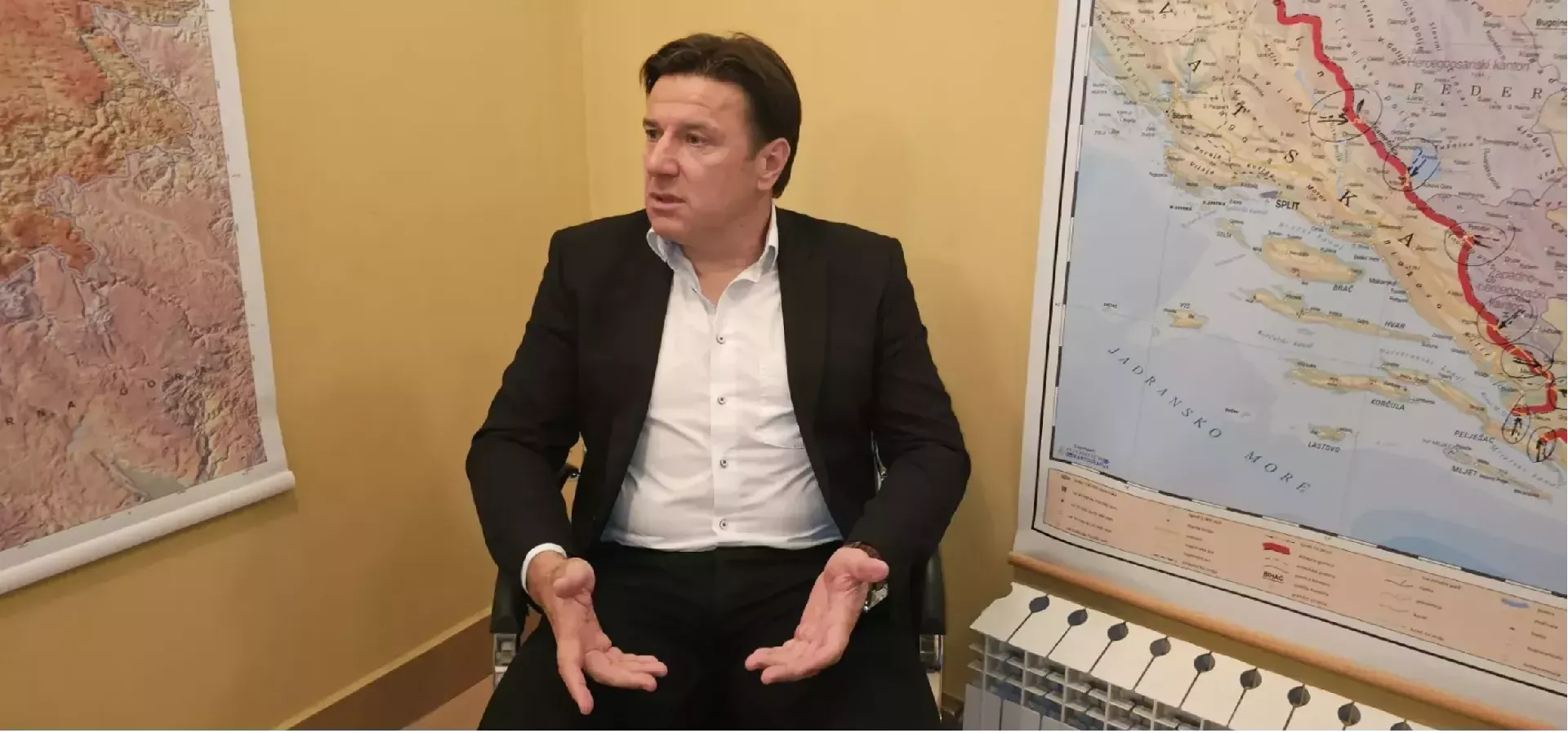
(Patria) - Doctor of Criminology, an expert with many years of experience in security studies and analysis of social threats, Emir Efendić, was a guest today in the first episode of the show "Patria na vezi".
Among other things, we discussed the direct attack by the President of Republika Srpska, Milorad Dodik, on the constitutional order of BiH, while at the same time, personnel from the top of state judiciary and intelligence sector helped to politically and institutionally cover up that case.
Some of the questions our guest addressed included who is protecting the constitutional order of BiH today, what is the role of judicial and security institutions in preserving the system, and how protected are citizens in a system where such cases are covered up?
Efendić says that the speculations about bringing Dodik before the Court of BiH by the Director of the Intelligence Security Agency (OSA) of BiH, Almir Džuvo, are very suspicious from the aspect of jurisdiction and authority.
- If this happened, then it is certain that it was part of a political-judicial agreement with the suspect in order to avoid him being deprived of liberty by police agencies and brought before the court - says Efendić.
He points out that the damaged trust between state institutions can only be restored by acting through institutions according to the Constitution and law. Any other non-institutional action undermines the reputation and trust of the public, as well as within the security agencies themselves.
- This was also the first such case where the intelligence service conducted such activities without police agencies. This is atypical, and I don't think it is in accordance with positive legal regulations on police action - Efendić points out.
In such situations, our interlocutor adds, OSA has always appeared as an assistant, a service to police agencies, but never as an agency that carries out police powers or takes on the role of agencies with police authority.
He believes that the Director of OSA of BiH, Almir Džuvo, will certainly be held accountable and that the parliamentary Committee for the work of OSA of BiH will meet in this regard.
- However, this Committee itself is a reflection of the current government, and it mainly consists of people from politics who participated in carrying out such activities. So, I don't believe that any accountability will come from there, but there will certainly be questions and answers - Efendić points out.
He emphasizes that he does not believe that any political responsibility will arise, given that politics, through its penetration into the security system, tries to stop police processes and investigations when political interests are involved.
He also commented on the fact that the State Investigation and Protection Agency (SIPA) has not had the strength in four months to resolve the security challenge of bringing Dodik before the BiH judiciary.
- First of all, we have legal consequences here, that the order of the Court of BiH was not executed, for which SIPA was exclusively responsible. We also have operational responsibilities, that SIPA did not act in the entire territory of BiH. There is certainly responsibility within SIPA itself - states Efendić.
He assesses that there was a blockade and paralysis of security agencies in BiH, and that this paralysis occurred mainly due to the penetration of personnel from certain political factions within these agencies, through whom they blocked and paralyzed the work of the agencies and prevented the implementation of operational activities to prevent the undermining of the constitutional-legal order.
- By not reforming the police in BiH, and afterwards with the departure of international police forces from BiH, somewhere in the period 2009-2010, certain anti-state and anti-Bosnian policies penetrated the BiH security system, politically took control of it, and in that way blocked and paralyzed the entire security apparatus.
I would freely say that this involves counter-intelligence activities by personnel who have penetrated the security system and who are implementing policies that are anti-Dayton, anti-constitutional, and illegal - Efendić points out.
He believes that, no matter how much we rely on foreigners, as has been the case for the past 30 years, we see that we are not getting solutions from them. And if we do not take concrete measures and steps to solve our own problems, we will certainly not get solutions from outside.
- We must roll up our sleeves and tackle the problems and solve them within the country. If we only rely on international policies, we will not succeed in solving our internal problems. Therefore, I believe that internal policies should take care of solving our security and state issues - emphasized Efendić.
He is optimistic about achieving internal dialogue in Bosnia and Herzegovina.
- We have seen some signals from the opposition in Republika Srpska, which is quite different from the position of Republika Srpska. With such policies, it is possible to reach an agreement to create a better security environment in BiH in the future - concluded Efendić.
Komentari (0)
Prijavite se za komentiranje
PrijavaJos nema komentara. Budite prvi!
Minuta
Sve →Iz drugih kategorija

High Representative Not Elected: Germans, French and British Sabotaged Americans, New Attempt at End of June

ČOVIĆ WITHOUT MERCY: How Those Who Brought Ademović to Office Created a Political Hell for Him



Sunny Saturday, quite warm



Tragedy in Albanian resort: Two minors drown












