
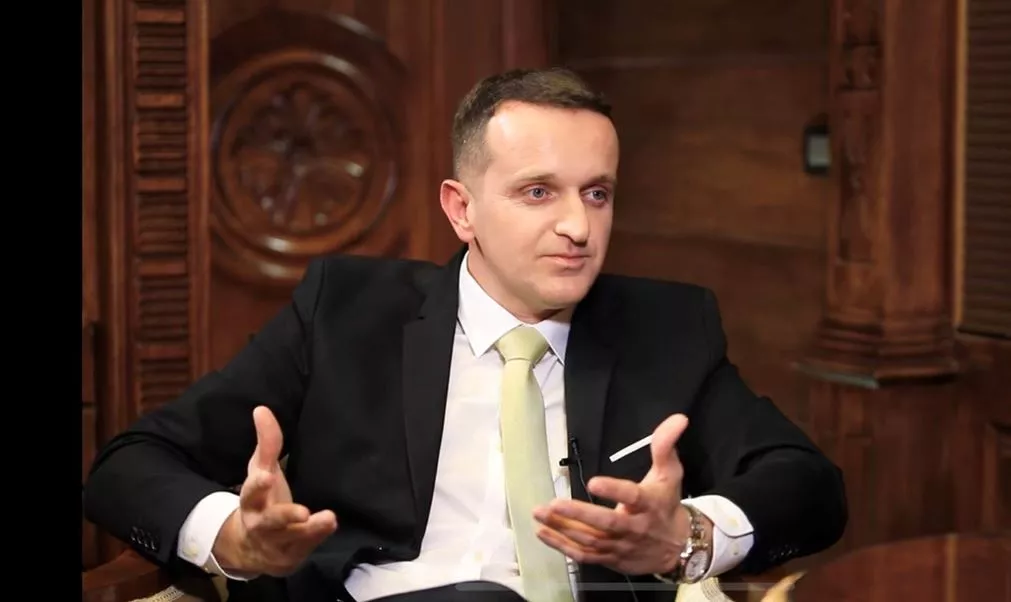
Interview by: Nevena Kovačević/ Patria correspondent from Podgorica
BiH's representative to the UN, Zlatko Lagumdžija, announced the agreed text of the UN Resolution
on the Genocide in Srebrenica two evenings ago, which the UN General Assembly will vote on on May 23rd.
According to Lagumdžija, two amendments, which will be discussed at the session, have also become an integral part of the Resolution.
According to him, the first argument is taken away from false patriots who promote the non-existent guilt of genocidal nations, and the text reads: We reiterate that criminal responsibility under international law for the crime of genocide cannot apply to any ethnic, religious, or other community as a whole.
The second, Lagumdžija adds, points to strengthening unity in diversity, which is not only the motto of the EU but also the nature of our country as a European state based on such traditions, and the text reads: We reiterate our firm commitment to maintain and strengthen unity in diversity in Bosnia and Herzegovina.
The aforementioned two amendments are based on the amendments that the Montenegrin MFA sent to the proposers, with the original formulations being completely changed.
Prime Minister Milojko Spajić said yesterday while appearing on RTCG's daily news that the acceptance of Montenegrin amendments and the use of modified formulations in the preamble of the text represent a great achievement of Montenegrin diplomacy.
Commenting on Spajić's statement, the international secretary of the Social Democrats of Montenegro, Miloš Đuričković, told Patria that the tragicomic diplomatic activity of the Government and the Ministry of Foreign Affairs of Montenegro has finally ended.
“When we told them that they couldn't go out into the world with monstrous amendments and positions, they didn't listen to us. They said we wanted to condemn an entire nation. With an almost identical narrative to Vučić and Dodik, they attacked anyone who thought the Resolution in its original form was more than enough,” he pointed out.
He clarifies that the Government's text of the first and second amendments, modified and cleared of controversial positions, was used for a part of the text in the preamble.
“This represents a measure of compromise between the initiators and sponsors of the Resolution and the Government of Montenegro. We hope they did not tell them, as they told us, that we hate and want to declare the Serbian people genocidal,” he emphasized.
He underlines that for the Ministry of Foreign Affairs of Montenegro and its unfortunate amendments, which are no longer such, this remains a great shame. According to him, the preamble, i.e., the former amendments, did not add any additional value to the Resolution, nor did they contribute to clarifying guilt.
“Also, this change will not bring a single additional vote of support for the Resolution. However, it served a small group of relativizers in Montenegro to present it to the domestic public as confirmation of their personal capabilities and contribution to reconciliation in the region,” Đuričković assessed.
He points out that he agrees with the statement that such behavior regarding the Resolution confirms their personal capabilities.
“The amendments produced nothing. But when we talk about reconciliation, the letter from the Serbian Mission to the UN requesting that the Resolution be rejected best confirms this,” says Đuričković.
Asked whether the increasingly intense pressure from coalition partners and official Belgrade, which we have witnessed through messages conveyed during the Serbian President's visit to Kotor, can influence a change in Spajić's stance on supporting the Resolution, Patria's interlocutor replies that he agrees that there is pressure from Belgrade.
“Unfortunately, I and the Government of Montenegro view that pressure differently. For me, it is inappropriate rhetoric, almost hostile. For the Government and Milojko Spajić, it is positive pressure. I would say motivational pressure to do more for Belgrade and local coalition partners,” he emphasized.
Just like all other crucial value-based topics, he points out, the topic of Srebrenica, for the Government and Spajić, represents nothing more than currency for trade.
“When it comes to the vote in the UN on the Resolution, I am almost certain that there is no support for a positive vote within the parliamentary majority. If we look at the statements of the leaders of the political entities that constitute the Government, we will see that almost the majority denies that genocide happened in Srebrenica, let alone vote for the Resolution,” our interlocutor is categorical.
He claims that the other half of the majority is no better.
“You have the Democrats who are traditionally silent, a couple of Albanian parties who are also silent. Then there is the Europe Now Movement, which changes its stance from day to day and tries in every way to muddy the waters so as not to clearly state its position. Despite Prime Minister Spajić's claims that Montenegro will support the Resolution, if we judge by the experience with Spajić and PES, we will not know the official position of Montenegro with certainty until the day of the vote,” Đuričković assessed.
He believes that it is important for the BiH public to know that the Government of Montenegro, or rather the Prime Minister, does not have a statesmanlike but a trading mentality.
“They do not stand behind official policy, principles, and every topic and relationship is currency for trade when it is necessary for their survival in power,” he explained.
Answering the question of whether the amendments and increasingly frequent protest notes indicate a change in foreign policy, as well as a value shift, Patria's interlocutor assesses that Montenegro has indeed changed its foreign policy.
“It strives to be aligned with Belgrade's foreign policy more than Brussels'. Protest notes, the manner and nature of disproportionate visits by officials to Belgrade and the RS entity confirm that Montenegro has decided to make a shift in its foreign policy. The number of open issues and the deterioration of relations with Kosovo, Croatia, and Bosnia and Herzegovina will continue to grow,” he emphasized.
According to him, after two days of the Montenegrin side refusing to make any changes to the amendments, let alone have them end up as the text of the preamble, the decision to abandon the amendments came just a few hours after the parliamentary majority reached an agreement on the Resolution on Jasenovac.
“This achieved a political agreement with radical Serbian parties in power but also opened the door for manipulation of both Jasenovac and Srebrenica,” Đuričković concludes.
Komentari (0)
Prijavite se za komentiranje
PrijavaJos nema komentara. Budite prvi!
Minuta
Sve →Iz drugih kategorija

High Representative Not Elected: Germans, French and British Against Americans, New Attempt at End of June

ČOVIĆ WITHOUT MERCY: How Those Who Brought Ademović to Office Created a Political Hell for Him



Sunny Saturday, quite warm



Tragedy in Albanian resort: Two minors drown












