
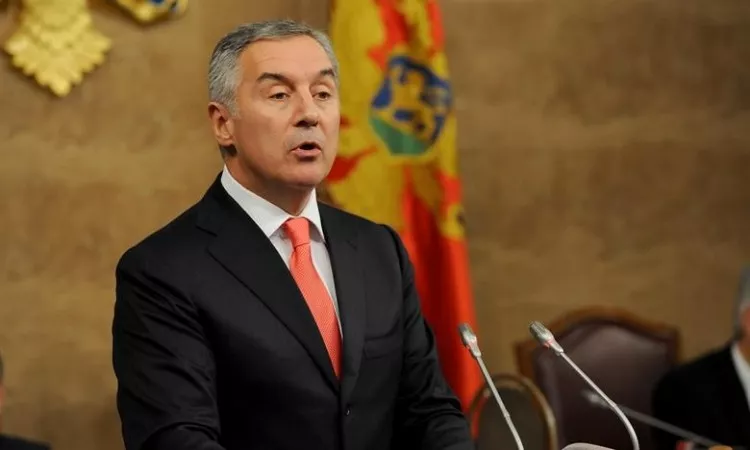
(Patria) - Former President of Montenegro and the Democratic Party of Socialists, Milo Đukanović, said while appearing on Al Jazeera that Europe could find itself on the opposite side of America.
Answering the show host's question about what global implications the first decisions of the newly elected US President Donald Trump could have, he said that the election of the new US president undoubtedly has implications for global politics.
- We must keep in mind that between the two terms of President Trump, global political upheavals have left considerable uncertainty regarding the main direction of world politics today. With Donald Trump's return to the White House, that uncertainty has increased because "the only thing predictable is - the unpredictability of Trump's policies," critics agree on that.
We are definitely witnessing the birth of a new world order. I am convinced that it will not be a world order like today's, which rested on the monopoly of a single world superpower, and that this is a world order that emerged at the end of the Cold War and ultimately led us to the point where today the key geopolitical topic is - when will World War III begin? My most striking impression is that Donald Trump is the first US president who has left so much political space for big capital. It seems to me that the warnings are real that the American value system is in danger, that American big capital threatens to devour American democracy - Đukanović stated.
He added that it is important to treat the Euro-Atlantic partnership carefully and emphasized that the situation in all Western Balkan countries today is worse than it was in 2013.
Asked about the attitude of Western policy towards the Western Balkans, he said that this policy has been pro-Russian in recent years, judging by the consequences.
- That policy blew wind at the back of the Serbian world, and that is the same as the Russian world. That policy was created by the State Department, and Europe only followed, he said.
The primary goals were to separate Serbia from Russia, Đukanović stated, adding that neither is Serbia further from Russia today than it was then, nor has anything been done regarding Kosovo.
Commenting on how strong the forces of the "Serbian world" are in Montenegro and the neighborhood, Đukanović said that Russia felt the space to intervene.
- The Western Balkans is a favorable area for attacks. Nationalists and those who supported them have imposed themselves. This is a challenge for both Montenegro and Bosnia and Herzegovina. The policy of Greater Serbian nationalism today has a majority in Montenegro - Đukanović emphasized.
He said he has a dilemma whether we have broken with the politics of the 1990s.
- I fear that Western policy at one point abandoned the then equal treatment of the six Western Balkan states with the same idea of helping everyone reach a European future, while at the same time, it approached a new policy for the Western Balkans, through Serbia, and I would say "lest the Vlachs catch on" also through Albania. I think the Open Balkan project was an attempt to institutionalize the dominance of Serbia and Albania in the Western Balkans. When I warned that this would lead to a revival of nationalism, the creators of that program assured me that it was under their control. It seems to me that with this kind of Western policy, the path has been paved for the reorganization of the Western Balkans on the principles of ethnocentrism. So, instead of equal treatment of six states, the situation in the Western Balkans is controlled through some of the most important states, political centers, and their partnership with the USA - Đukanović assessed.
He emphasized that interpretations of Montenegro's character as Serbian, and Montenegrins as Serbs, are rooted in Garašanin's "Načertanije" from the 19th century, and that this narrative does not relent.
- That is not curable, obviously - Đukanović said.
The former President of Montenegro underlined in the interview that the litije (religious processions) were a clerico-nationalist counter-revolution in Montenegro, because they aimed to completely revise the character of Montenegro, and added that this revolution aimed to make Montenegro, instead of a civic state, a national one, and specifically, a Serbian state.
Đukanović also said that the forces leading the litije aimed to convert Montenegro from a secular to a theocratic state, even though Montenegro abandoned theocracy back in the time of Prince Danilo Petrović in the mid-19th century, and to turn it from a pro-Western and NATO state into a pro-Russian state.
- And ultimately, to turn Montenegro from an independent and sovereign state into an integral part of the so-called Serbian world. Something akin to the Zeta Banovina during the first Yugoslavia, which is why the President of the Parliament prepared a new logo for the Parliament - Đukanović said.
Asked by the show host whether he feels safe in Montenegro, both as a politician and as a citizen, he said:
- I feel safe in my country and very happy to have been part of a generation that restored statehood to Montenegro. I am concerned after the tragic events in Cetinje. Today, the security system is not able to guarantee citizens basic safety. We had to go through this lesson. Montenegro had a continuity of government for thirty years. It had to get acquainted with the new government. I think it has gotten acquainted, and this cannot be cured by what we are talking about, including the insufficient sense of security among Montenegrin citizens, without changing what gave birth to all this. Of course, I advocate for all of us to individually re-examine ourselves, re-examine our role in creating the kind of environment we have today, and as responsible citizens, approach changes that will ensure the stability of our state and clear European prosperity, but above all, the civic security of every citizen - Đukanović concluded.
Komentari (0)
Prijavite se za komentiranje
PrijavaJos nema komentara. Budite prvi!
Minuta
Sve →Iz drugih kategorija

High Representative Not Elected: Germans, French and British Against Americans, New Attempt at End of June

ČOVIĆ WITHOUT MERCY: How Those Who Brought Ademović to Office Created a Political Hell for Him



Sunny Saturday, quite warm



Tragedy in Albanian resort: Two minors drown












