
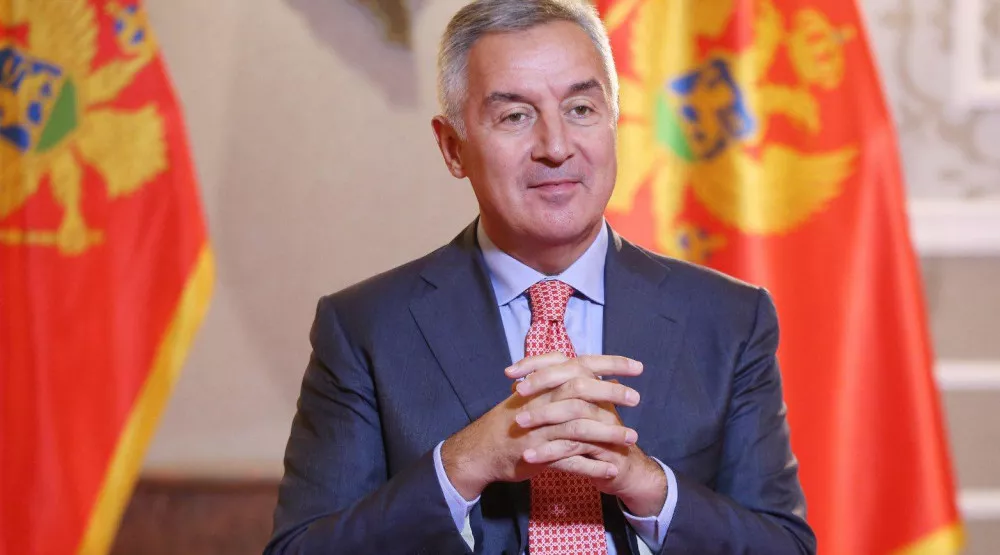
(Patria) - „The Montenegrin experience of citizens' relationship towards the state is truly unique“, says Montenegro's President Milo Đukanović for "Pobjeda".
„It is difficult to find a similar example of a society where almost half of the citizens worked so passionately against the existence of their own state. An upgrade to this specificity is that those who publicly and convincingly argued that independent Montenegro should not exist now want to govern it. Thanks to the will of citizens expressed in the last parliamentary elections, markedly marked by an unprecedented influx of foreign and clerical-political domestic interests, they have received that opportunity.
The entire Western Balkans is still undecided whether our future will be European or nationalist and chauvinist. When it comes to European ambitions, Montenegro was until recently the undisputed leader in the region. Especially after, some fifteen years after the Dayton Agreement, we had the impression not only of a certain but also of a close perspective of EU membership for the countries of the region. Unfortunately, soon came the fatal assessment of „enlargement fatigue“, followed by the economic and overall crisis in Europe, which, together with the refugee crisis and the crisis of Euro-Atlantic relations, seriously weakened the strength of pro-European and reform policies in the Western Balkans.
Who grew stronger?
- Anti-European, retrograde, nationalist politics. Especially after, triggered by a serious disturbance in geopolitical relations, it received a strong boost from „third parties“, countries that continuously try, through their malignant political actions, to thwart European unity and the global competitiveness of the EU, as well as to further bring the European value system into doubt. Such an attitude of international politics towards our region logically revived the old nationalist story that multi-ethnic life in the Balkans is impossible and that, instead, we need a state reconfiguration that would involve the formation of enlarged, nationally and religiously homogeneous states, based on great-state nationalism and chauvinism.
Didn't we try that „model“ in the nineties?
- We did. And it cost us nearly 150,000 victims.
By reviving the idea of a Greater Serbia, now called the „Serbian world“, the aim is to change the character of Montenegro, which, instead of the current multi-ethnic, secular, pro-European country, a NATO member, would become a necessary part of the Greater Serbian triangle Belgrade - Banja Luka - Podgorica. For this purpose, it would be desirable to subject Montenegro to identity engineering and present it as an „old Serbian state“, supposedly formed by the Serbian Orthodox Church. Which is an epochal lie.
Thirty years ago, the international community reacted much more unitedly, decisively, and timely to such retrograde political ideas. Aware that conflicts are a realistic epilogue of the region's lagging behind European civilization, I have repeatedly publicly warned our international partners about this.
The top of the SPC, like the DF, is an instrument for manipulative management by the state leadership of Serbia.
Let us just remember the clever statements of the late patriarch about Montenegrins. The Metropolitan of the SPC in Montenegro, the late Amfilohije, had considerably more integrity. It is no secret that he thought and spoke the worst about the state leadership of Serbia. I would say, not much better about the top of the SPC either. However, he was also an incorrigible Greater Serbian nationalist, unsympathetic to Montenegro as an independent state; a denier of Montenegrin national identity, known also for insults towards minorities; he spoke the worst about Europe and NATO. He came to Montenegro in the nineties with the intention of pacifying it by erasing what is the very substance of Montenegrin identity – libertarianism and anti-fascism.
Such an SPC was the second line of influence of Greater Serbian nationalism on the electoral process in Montenegro. No matter how much they disagreed with each other, their misunderstandings were personal and not ideological: they competed for the glory of who would sacrifice Montenegro on the altar of Greater Serbian nationalism - whether the DF, as the contemporary troops of General Milutinović, or the SPC through „spiritual“ manipulation of the consciousness of Montenegrins, to whom it was necessary to explain through liturgies that the Vojislavljevići, Balšići, and Crnojevići were „Serbian dynasties“, and that Ivan Crnojević built the Cetinje Monastery with money from Serbia, which is why it supposedly is just that it belongs to the SPC.
In the end, official Belgrade interpreted the results of the Montenegrin elections with the logic of a conqueror.
How?
- As an open door for the continuation of its mission of Serbianizing Montenegro and changing the character of the civic state. Since the goals of Greater Serbian nationalism in Montenegro have not yet been achieved, it can be said that the nervousness in the now only headquarters of the DF - in the state leadership of Serbia - is increasing. All the more so since the new Government of Montenegro does not dance to their tune - said Milo Đukanović in an interview for "Pobjeda".
Komentari (0)
Prijavite se za komentiranje
PrijavaJos nema komentara. Budite prvi!
Minuta
Sve →Iz drugih kategorija

High Representative Not Elected: Germans, French and British Sabotaged Americans, New Attempt at End of June

ČOVIĆ WITHOUT MERCY: How Those Who Brought Ademović to Office Created a Political Hell for Him



Sunny Saturday, quite warm



Tragedy in Albanian resort: Two minors drown












