
(Patria) - Who gave Aleksandar Vučić the strength to be arrogant in the region. Was the division of Kosovo planned as a terrorist act?
Has the new government brought Montenegro to its knees and is it engaged in its 'Serbianization'? What danger threatens the Montenegrin nation from the census?
Who is deluded into thinking that Vučić is not behind Milorad Dodik's secessionist policy?
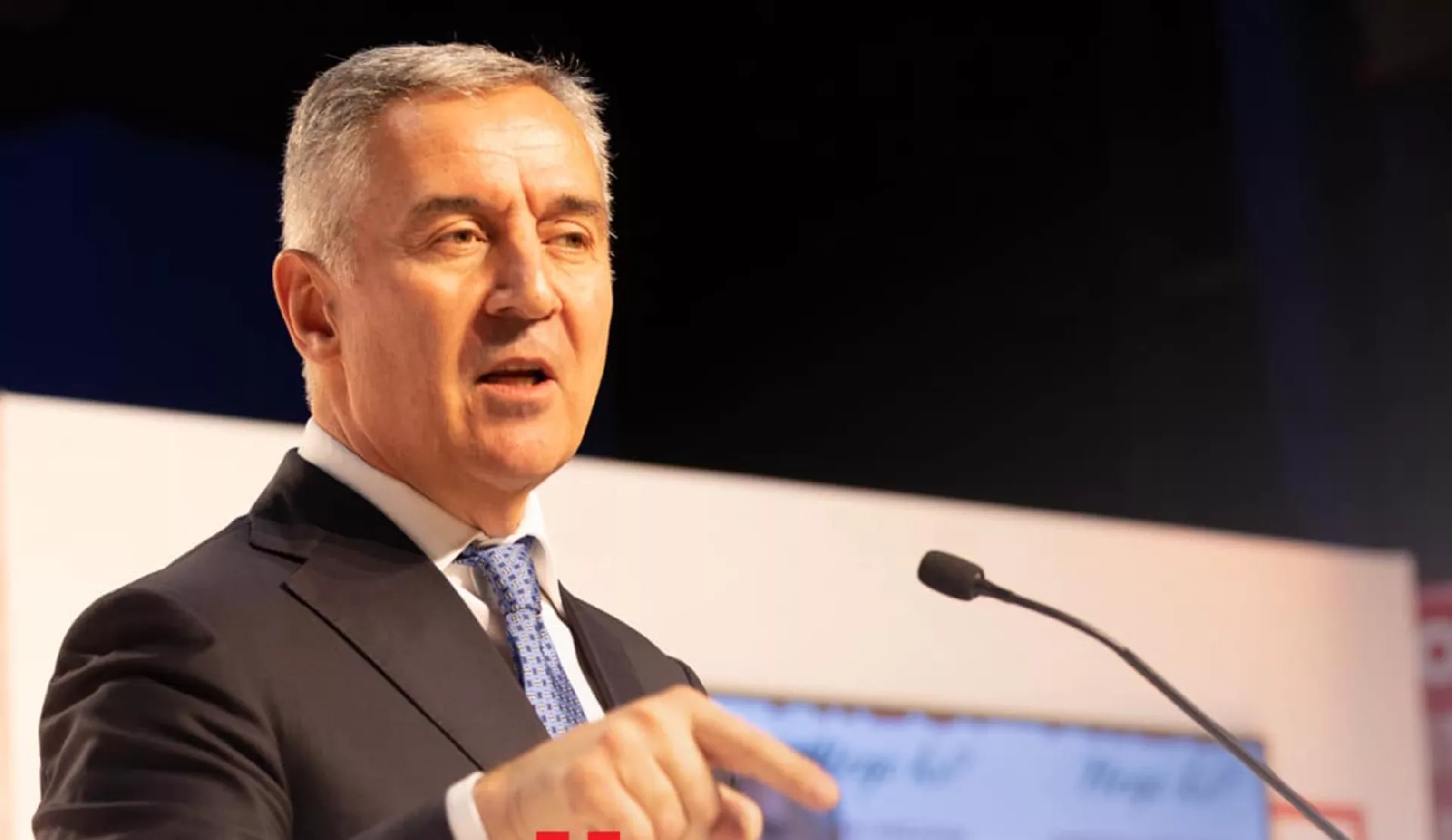
Is he afraid of the dock? These, and other current issues, were addressed in his first interview after withdrawing from politics for Federal Television by the former President of Montenegro, Milo Đukanović.
Đukanović says it is logical that Russia has chosen Greater Serbian nationalists among the Balkan nationalists.
- Putin announced historical revisionism in his new policy. To somehow renew the Cold War. Serbia understands this as an opportunity to revise the results of the recent past in the last 30 years in the Western Balkans.
I believe that geopolitical reasons and their reflections on the policy in the region have led to a significant deterioration of security and political conditions - assessed Đukanović.
Đukanović points out that nationalists have awakened again, and the idea of a 'Serbian world' is nothing more than a renewed idea of the project 'all Serbs in one state'.
- We might have hoped that after the Dayton Agreement, the ideas of Greater Serbian nationalism were buried. They were not. Today, we should all seriously examine why they were not.
Despite individual verdicts in The Hague, Greater Serbian nationalism has not been properly judged. In Serbia, there has been no condemnation of Greater Serbian nationalism - he said.
Putin is trying to demonstrate the strength of the 'Russian bear', and this further fuels the enthusiasm of Greater Serbian nationalists in the region, believes Đukanović.
- Nationalists want border changes, the creation of enlarged states that will be nationally and religiously homogeneous. In this scenario, there is no Bosnia and Herzegovina, no Montenegro, no independent Kosovo, no North Macedonia.
And I believe that this can always end in only one way – it always ends in war, crimes, and genocides, and that is something we will, hopefully, avoid", he stated.
Frozen Conflict
He emphasized that an attempt was made to open 'some frozen conflict in the Western Balkans' in Kosovo.
- Whose policy this is, is clear. It is the policy of Russia. The idea of that terrorist act in Kosovo was to cause unrest, to lead to some limited conflict, the finale of which would be the drawing of a demarcation line between the north and the rest of Kosovo.
Serbia wanted to divide Kosovo with this conflict. That is the main idea. But what we must do is define which policy created the atmosphere in which a terrorist act was ultimately carried out operationally.
I believe that it was the policy of the international community, Western partners, the State Department, the policy of appeasing Serbia, the policy of making concessions to Serbia for its arrogance in its policy in the Western Balkans.
In return, it was expected that Russia would distance itself from Putin, which did not happen. It was expected that Serbia would stop obstructing Kosovo's international recognition. What happened is that Serbia used those concessions.
Instead of conducting its internal policy, Serbia began to pursue a policy of caring for Serbs in the region. In this way, it undermines the sovereignty of its neighbors and worsens the stability of the region - said Đukanović.
What happened in Kosovo is, as he stated, the final expression of a wrong international policy, signed by authorized representatives of the State Department for the Western Balkans.
Vučić is a Serbian Nationalist
He also answered the question of why the international community is lenient towards Aleksandar Vučić.
- Vučić goes as far as he is allowed. He has never hidden his ideological profile. He is a Serbian nationalist. He has not hidden his closeness to Putin either.
All of this would be less dangerous if it had not met with approval, and even encouragement, and justification before the international community by international officials, due to certain calculating motives.
They tried to appease Vučić through various forms, offering him various institutional forms of dominance in the region - he added.
Asked how dangerous Dodik's actions in BiH are and whether he has Vučić's support, he replies:
"We cannot overlook that Vučić is the possible author in achieving these goals. You will never hear it from him. Do not expect him to tell you that he stands behind what Dodik is doing in BiH.
We should not forget that Dodik, even without Vučić, is very close to Moscow. Moscow has its interests there. I believe that any advocacy for secession, endangering the territorial integrity and sovereignty of BiH, is a ticking bomb in the foundations of peace and stability of the Western Balkans".
Montenegro the Biggest Loser
He emphasized that Montenegro, until 2020, was significantly ahead of other Western Balkan countries. Not only because of its membership in NATO but also because of the progress made in the negotiation process with the EU, and because of the trust it gained from important international investors.
- Montenegro is certainly the biggest loser of the processes that occurred after August 30. That's when the so-called liberation of Montenegro happened, as government representatives presented it during these three years.
Thirty years of government is not common in European political culture, so we understood it. This is a time of complete decline, the agony of Montenegro. Not every change has to be a change for the better - stated Đukanović.
He points out that it was completely clear that Russia would not reconcile itself with its failure in Montenegro.
- I would say that Russia pushed pro-Serbian and pro-Russian parties into the background, and put the Serbian Orthodox Church in the foreground. The SOC, by misusing people's religious feelings, mobilized them to defend allegedly endangered holy sites in Montenegro.
Months-long street protests began, which were not religious at all, and this resulted in Montenegro losing its state-political course - said Đukanović, adding:
"Those who are forming the government today have shown absolute confusion so far, it is a slightly repackaged, the same majority from August 30, 2020, so Montenegrins, as evidenced by the election results of June 11, have not drawn a sufficiently clear conclusion in these three years that they made a mistake on August 30, 2020, they are still willing to wallow in the mud of Greater Serbian nationalism. Montenegro is increasingly on its knees day by day".
He also warned that there will be no Montenegrins in the new government of Montenegro.
- Serbia succeeded in Montenegro on August 30, 2020, and you still have two governments, which are anything but governments of Montenegro. There is no elementary care for Montenegro's interests.
The second government delivered the fundamental agreement with the SOC, Montenegrin identity, history... and now it is trying, through the results of a politicized census, to deliver Montenegro's future, with a clear idea to try to increase the statistical representation of the Serbian community.
This should be done by the current government, which is already in a good arrangement with Belgrade. Montenegro should become the first additional part of the 'Serbian world'. It will not be easy with BiH. Dayton BiH is a child of the international community. It will not be easy to conquer the north of Kosovo either - he assessed.
Census
It is very dangerous and irregular for Montenegro to conduct a census, Đukanović notes.
- Ideologues of Greater Serbia want to 'Serbianize' Montenegro. The primary goal is to prove that Montenegro is a Serbian state. Montenegrin national identity is under attack because this paves the way for the destruction of Montenegrin independence.
I trust that a decisive front of resistance to the change in the character of the state of Montenegro will awaken in Montenegro. It has no chance of surviving as a national state. Montenegro is defended only by its civic character - he states.
He says there is no chance he will return to politics.
- I've been in politics long enough, I've given 30 years of my good life to that activity. I don't regret it. Life has taught me not to be exclusive.
However, I believe that the era of my involvement in state policy is over - Đukanović concluded.
Finally, he stated that he has no information that any indictment is being filed against him or any of his close associates for any reason.
- Experience teaches me that whoever talks to you the most about corruption and crime during campaigns is the most likely criminal - concluded Đukanović.
Komentari (0)
Prijavite se za komentiranje
PrijavaJos nema komentara. Budite prvi!
Minuta
Sve →Iz drugih kategorija

High Representative Not Elected: Germans, French and British Against Americans, New Attempt at End of June

ČOVIĆ WITHOUT MERCY: How Those Who Brought Ademović to Office Created a Political Hell for Him



Sunny Saturday, quite warm



Tragedy in Albanian resort: Two minors drown












