
By: A. Čorbo-Zećo
During the trial for the events in Dobrovoljačka Street in Sarajevo, the witness for the Prosecutor's Office of Bosnia and Herzegovina, Dušan Kovačević, answered defense questions via video link from Belgrade, after being directly examined by prosecutor Mladen Vukojičić in October of this year.
Dušan Kovačević was the assistant for logistics to the commander of the Second Military District, headed by Milutin Kukanjac. He previously stated that the command post in Bistrik was blocked at the end of April, and that on May 2, 1992, it was attacked.
Ejup Ganić's lawyer, Lejla Čović, initially asked the witness Kovačević to state who was within the area of responsibility of the Second Military District. The witness replied that the Fourth Corps from Sarajevo, the Fifth from Banja Luka, the Ninth from Knin, the Tenth from Bihać, the Seventeenth from Tuzla, and the Air Force in Sarajevo were under the Second Military District.
He confirmed that this comprised almost 500,000 soldiers.
"Our superior command was the General Staff in Belgrade," Kovačević stated.
Witness Kovačević had previously testified before the Hague Tribunal, for the defense of war criminals Momčilo Perišić and Radovan Karadžić.
Lawyer Čović asked the witness to state what the JNA was doing after learning that on March 1, 1992, by decision of all citizens of BiH, it had become a sovereign and independent state.
The witness claimed that the JNA recognized independent BiH and that they had orders to prevent ethnic conflicts. However, when asked by the lawyer what a paramilitary unit meant to him and the JNA command, Kovačević stated that these were all units not subordinate to the JNA.
But, according to him, the arming of volunteers from the Serb people and the volunteer units that were being formed at the time were not paramilitary units because they were incorporated into the JNA.
The witness also said that Radovan Karadžić had invited Milutin Kukanjac to include the territorial defense units of the Serb people, which had already been formed, into the JNA.
"These units were part of or under the command of the JNA," Kovačević stated.
Speaking specifically about May 2, when Alija Izetbegović was captured at Sarajevo Airport, Kovačević confirmed that Sarajevo Airport was under JNA control at the time.
"The General Staff in Belgrade, in agreement with Kukanjac, made the decision to transfer Alija to Lukavica barracks, because we had information that his safety was endangered. No one was expecting him, his landing was not announced," Kovačević said.
Incidentally, lawyer Senad Pizović asked Kovačević who the president of a sovereign state should announce himself to, but Kovačević did not have a clear answer.
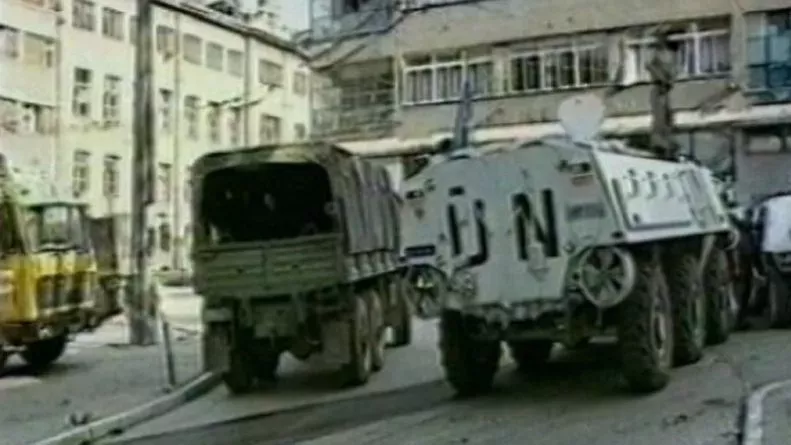
Judge Darko Samardžić also requested clarification, as the witness claimed that Izetbegović's safety was endangered on May 2, but that on May 3 he was a free man and could walk to the Presidency building, so the judge was interested in what happened. Kovačević could not answer specifically, but mentioned UNPROFOR and the territory.
Like many other witnesses, this one also did not know that on May 2, a mass attack was carried out on the city of Sarajevo, nor that the Post Office in the capital of BiH was burning.
Lawyer Edina Rešidović asked Kovačević to state who the JNA was arming by taking weapons from JNA depots, if he claims the JNA was defending all the population.
She also mentioned the taking of weapons from the TO BiH depots in Faletići, and the witness admitted that they armed nearly 69,000 people.
"On April 13, all weapons were taken from Faletići, were you aware of this as a logistician?" Rešidović asked.
Kovačević said that he was blocked at the time and had no involvement.
"There were many people, volunteers who needed to be armed," the witness said.
Judge Samardžić now requested further clarification, because the JNA did not recognize volunteers, but reservists whose failure to report for duty was a criminal offense.
"Members of other ethnic groups did not report," Kovačević stated.
An important question is also who made the decision for the JNA members to withdraw with weapons on May 3, because on April 27, a decision was made for the JNA to withdraw, at which point they became members of a foreign army.
"It was an agreement with Alija to leave with weapons," were Kovačević's words.
The witness stated that he was not present during the part of the negotiations when that decision was made, and said that Kukanjac told him that Alija had conveyed the agreement to his associates, who then passed it on.
Furthermore, the witness today answered lawyer Čović about the first negotiation in the PTT building, where Ejup Ganić, Milan Aksentijević, and UNPROFOR unit commander Lewis MacKenzie were present. He said that Aksentijević came to the Second Military District building and announced that Kukanjac should go to the PTT building, where Alija Izetbegović would also come.
However, the witness denied that there was a rebellion of officers and commanders of the Second Military District, but that Kukanjac did not go.
"Those negotiations failed," Kovačević stated.
After that, Čović asked what happened next and with whom negotiations were held.
"From then on, all agreements reached were made exclusively with Alija Izetbegović," Kovačević added.
Komentari (0)
Prijavite se za komentiranje
PrijavaJos nema komentara. Budite prvi!
Minuta
Sve →Iz drugih kategorija

High Representative Not Elected: Germans, French and British Against Americans, New Attempt at End of June

ČOVIĆ WITHOUT MERCY: How Those Who Brought Ademović to Office Created a Political Hell for Him



Sunny Saturday, quite warm



Tragedy in Albanian resort: Two minors drown












