
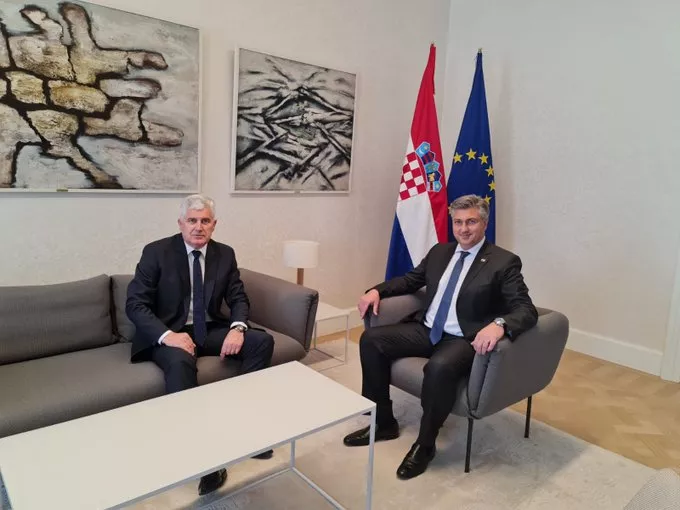
(Patria) - Journalist Adelheid Wölfl, who has been closely following the political crisis in our country in recent months, warned in a new analysis for the Austrian newspaper "Standard" about the possible imminent entry into force of secessionist laws initiated by nationalist leader Milorad Dodik, draws attention to the inability of the Constitutional Court of Bosnia and Herzegovina to suspend them due to "overload" and highlights the connection between HDZ leader Dragan Čović and Russia.
Bosnian spring threatens to heat up on the political scene, as a law stipulating that state property becomes the property of the entity, although contrary to the constitution, could come into force in the Republika Srpska at the beginning of April. The Constitutional Court of Bosnia and Herzegovina has determined that open questions of state ownership - concerning barracks, but also forests - must be resolved by the state parliament. Consequently, the National Assembly of the RS has no right to unilaterally incorporate property.
Specifically, this concerns the Law on Immovable Property adopted by the NSRS on 10 February. Bosniak deputies filed a veto on this law, but it was rejected by the Constitutional Court of the RS. Since the Constitutional Court of Bosnia and Herzegovina is currently completely "overwhelmed", it will likely take months before the court orders that the implementation of the law must be stopped until the constitutionality of the legal act is clarified, writes journalist Adelheid Wölfl in her latest analysis for the Austrian „Standard".
EXPLOITING THE LEGAL GREY ZONE
In the meantime, the authorities in the Republika Srpska could register state property as the property of the RS. This could have far-reaching consequences. It would create a legal grey zone, which is clearly in the interest of the political elites of the RS. This creates conditions in which a return to the previous state would be even more difficult. The Law on Immovable Property is just one of many legal acts initiated by the NSRS, all serving to implement the long-standing secessionist plans of the nationalist SNSD under the leadership of Milorad Dodik.
The laws also include one on a separate RS Medicines Agency, adopted on 20 October and published in the Official Gazette of the RS on 28 December. It will come into force at the end of June. The authorities in the RS apparently wanted to strengthen their negotiating position by then. What is certain is that the Constitutional Court of Bosnia and Herzegovina can only assess the law once it comes into force. Until then, the RS has time to establish a new system. The legal change in public administration necessary for this came into force on 10 February. With the new agency, the RS would leave the joint state medicines agency.
HIGH JUDICIAL AND PROSECUTORIAL COUNCIL
Under the auspices of the SNSD, which has been threatening the destruction of the state of Bosnia and Herzegovina for years, which was also a war aim of the nationalists in the war against BiH from 1992 to 1995, the NSRS adopted measures for the secession of the RS on 10 December. This includes a law on creating a separate High Judicial and Prosecutorial Council of the RS, thereby undermining the state-level HJPC, which has been a thorn in Dodik's side for years.
The draft law on the HJPC of the RS was adopted in its first reading on 10 February in the NSRS, and debate on it is scheduled for the next 60 days. Currently, the law is envisaged to come into force one year after publication in the Official Gazette. However, this condition can also be partially changed, so the law could come into force more quickly.
POLITICAL INFLUENCE ON LEGAL INSTITUTIONS
The scope of legal changes announced by the RS in December covers a wide range of state laws. It is already clear that in the RS, the possibility of a veto on these laws practically does not exist due to the political influence of nationalists in the Constitutional Court of the RS. However, if the laws are not stopped, legal chaos will arise in Bosnia and Herzegovina, eroding state institutions, which will contribute to further political destabilization.
Legal experts expect that Dodik and his SNSD will push through further secession laws. In any case, there are no indications that the nationalists have given up their desire to destroy the state of Bosnia and Herzegovina. Apparently, there is sufficient legal expertise in the RS as well, and work has been underway for some time on ensuring the legal secession of a part of the state and thus undermining the Dayton Peace Agreement.
OVERLOADED CONSTITUTIONAL COURT OF BOSNIA AND HERZEGOVINA
Probably the biggest challenge in this regard currently lies with the Constitutional Court of Bosnia and Herzegovina. For example, the Constitutional Court of Bosnia and Herzegovina has still not made a decision on the law in the RS according to which the state law against denying and glorifying war criminals should not be applied.
This is a law passed by the nationalists of the SNSD so that they could continue to deny war crimes and glorify war criminals with impunity in the RS after High Representative Valentin Inzko imposed a provision banning the denial of genocide on 22 July last year, since an attempt had been made for years to pass such a law in the Parliament of Bosnia and Herzegovina, which was not possible due to the resistance of nationalists.
LAWS DANGEROUS FOR THE STATE
The Constitutional Court of Bosnia and Herzegovina was asked on 24 November to review this legal act in the RS. But the matter has not yet appeared on the court's agenda. This shows that all other secession laws that are dangerous for the state of Bosnia and Herzegovina will not be revised so quickly either.
The nationalists led by Dodik, supported by Serbia and the Kremlin, also have allies within Bosnia and Herzegovina. This is the Croatian nationalist party HDZ led by Dragan Čović. Dodik's and Čović's pro-Russian stance was recently visible at a session of the House of Peoples of Bosnia and Herzegovina. Both nationalist factions opposed the proposal that Bosnia and Herzegovina "fully align its policy, measures and positions with the official positions of the EU on Russia's aggression against Ukraine". They voted against sanctions on Russia and against the positions of the European Union.
CROATIA INTERFERES IN THE AFFAIRS OF THE NEIGHBOURING STATE
Čović receives great support from neighbouring Croatia, as does Dodik from Serbia. The sister party HDZ from Croatia lobbies within EU institutions for changes to the Election Law so that the HDZ can expand its position of power in Bosnia and Herzegovina. Above all, it wants to ensure that in the future only a member of the HDZ can be the Croatian representative in the state Presidency. The constitution currently simply stipulates that someone from the "Croatian people" should occupy one of the three seats. Currently, this is the centre-left politician and non-nationalist Željko Komšić. The three presidents do not represent ethnic groups in Bosnia and Herzegovina; they only have national designations. Ethnic groups, on the other hand, are represented in the House of Peoples.
Recently, Čović threatened that there would be a "territorial reorganization of the country" if the HDZ's wishes were not fulfilled. For weeks, he has had the support of Croatian Prime Minister Andrej Plenković, who even advocates postponing elections in neighbouring Bosnia and Herzegovina in order to change the election law beforehand. Plenković is currently trying to convince other European Union countries of his Bosnia and Herzegovina policy.
NO PARLIAMENTARY MAJORITY
Nevertheless, in recent months, all attempts by the HDZ in Bosnia and Herzegovina to implement its, otherwise old, ethno-political interests have failed because there is no parliamentary majority for them. The electoral alliance formed around the HDZ in the last elections in 2018 won nine percent of the vote.
However, support for Čović now also comes from the Russian ambassador to Bosnia and Herzegovina, Igor Kalabukhov. He supported the concept of Čović and other nationalists that Bosnia and Herzegovina is primarily about three "constituent peoples" (Bosniaks, Serbs and Croats), not about citizens.
RUSSIA SUPPORTS ČOVIĆ
In this context, Kalabukhov criticized the Netherlands. The Netherlands, and above all the highly engaged MEP Tineke Strik, has been leading a campaign in recent months so that all citizens of Bosnia and Herzegovina have their rights. They are discriminated against in passive voting rights because priority is given to ethnically defined Bosniaks, Serbs and Croats. Jews and other minorities are also discriminated against in Bosnia and Herzegovina. The constitution, therefore, should have been changed long ago, but there is almost no support for this in the European Union, concludes the analysis in "Standard", as reported by Slobodna Bosna.
Komentari (0)
Prijavite se za komentiranje
PrijavaJos nema komentara. Budite prvi!
Minuta
Sve →Iz drugih kategorija

High Representative Not Elected: Germans, French and British Sabotaged Americans, New Attempt at End of June

ČOVIĆ WITHOUT MERCY: How Those Who Brought Ademović to Office Created a Political Hell for Him



Sunny Saturday, quite warm



Tragedy in Albanian resort: Two minors drown












