
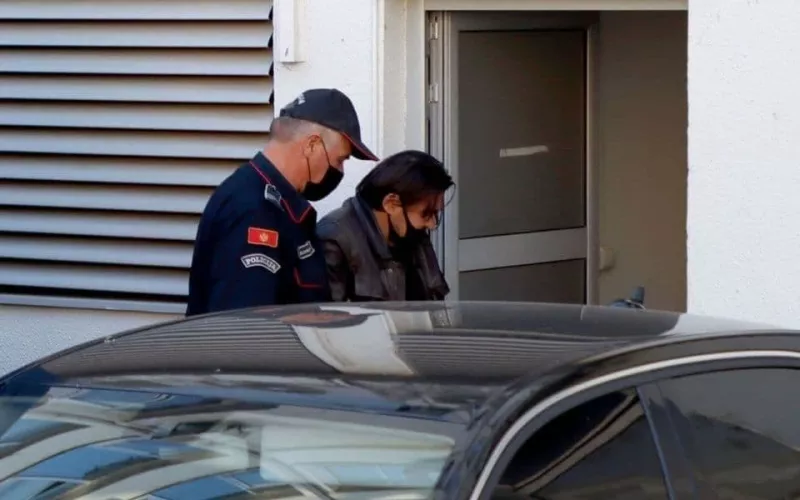
(Patria) - Slobodan Peković, accused of war crimes committed in Bosnia in the 1990s, has been released to defend himself after the Montenegrin High Court failed to deliver a verdict within three years, confirmed Marija Raković, representative of the High Court, for Radio Free Europe.
Namely, according to the law, pre-trial detention is terminated for the accused if a first-instance verdict is not delivered within three years from the date of indictment.
First-Class Scandal
The fact that no verdict was delivered in three years was described as scandalous by Kenana Strujić Harbić, a member of the ruling Bosniak Party.
- Whether it is a lack of will, leniency towards war criminals, some kind of intimate approval, or the inability of prosecutors and judges to prosecute and try war crime cases – the fact that no first-instance verdict has been delivered is a first-class scandal – said Strujić Harbić.
Tea Gorjanc Prelević, director of the Human Rights Action (HRA), states that 30 years after the war and war crimes, the state must more effectively ensure justice for the victims. So far, ten hearings have been held in this case. And there have been ten postponements.
- These postponements – which are legally permissible and justified – have led to hearings not being held for as long as 11 months. This ultimately led to no verdict being delivered in three years – emphasizes the director of HRA, a non-governmental organization monitoring this trial.
The Montenegrin citizen was arrested in Danilovgrad, near Podgorica, in October 2021, on the order of the Special State Prosecutor's Office. An indictment was filed against him in the same month.
The crimes he is accused of were committed in the Foča area in 1992, during the armed conflict between the Army of Republika Srpska and the Army of Bosnia and Herzegovina.
He is accused of having killed Mujo and Emina Šabanović as a member of the Army of Republika Srpska during the attack on the village of Hum in June 1992. Their bodies were burned in the house, which, as further stated, he set on fire after the murders.
He is also charged with raping a woman of Bosniak nationality in Foča in September of the same year.
This is the first trial in Montenegro that includes a charge of sexual violence committed during the war, and the victim of that violence has the status of protected witness A1.
- Since 1996 and the first indictment before the International Criminal Tribunal for the former Yugoslavia (ICTY) for sexual abuse, there have been indications that citizens of Montenegro participated in rapes in Bosnia and Herzegovina, especially in Foča.
More Than 15 Suspects
- Due to a lack of initiative, prosecutorial, and political will to prosecute war crimes in Montenegro, the investigation of wartime sexual violence only began four years ago – stated HRA.
In 2020, The Hague provided the Special Prosecutor's Office with a file concerning the involvement of more than 15 suspected Montenegrin citizens in crimes during the conflict in Bosnia and Herzegovina.
The completion of investigations in these cases is expected in the next two to three years.
Peković denied guilt at the trial, which began in September 2022. He insists that he was not in the village of Hum on the day of the murder, but was at the police station due to a fight in his hometown of Plužine.
Hum is a Bosnian village located halfway between Foča and Plužine, a Montenegrin town near the border with Bosnia and Herzegovina.
Several prosecution and defense witnesses were heard on this matter. Peković also denied committing rape.
Incidentally, a procedure was already conducted before the Court of Bosnia and Herzegovina against Jasko Gazdić for rape A1, who was finally convicted to 17 years in prison for this and other war crimes.
Witness A1 decisively accused Gazdić and Slobodan Peković (who was called Ćurčić at the time) of rape in this proceeding.
At Peković's trial, A1's defense counsel requested that the public be excluded during the testimony, that her face be blurred, and her voice altered.
Peković's defense attorneys requested during the trial that he be released to defend himself, stating that he had suffered two heart attacks and had undergone surgery in prison.
In most cases, hearings were postponed due to the illness of the accused's defense counsel.
Gorjanc Prelević points out that for this reason, the court decided to assign another defense counsel ex officio in addition to the chosen one.
Innovative Approach
- To ensure that he always has a defense and that the trial is not postponed due to the defense counsel's illness, which is an innovative approach – says Gorjanc Prelević.
The court has scheduled several hearings in recent months to bring the trial to a close.
HRA estimates that two to five main hearing sessions need to be held by the end of the trial, depending on whether the court decides to rule on compensation for the rape victim.
The trial was also marked by two important issues, points out Gorjanc Prelević. In addition to being the first in which witness identity protection was ensured, the issue of awarding damages to the victim in a criminal proceeding was also raised.
- Unfortunately, the court has not decided to order an expert examination even two years after this request was made, which is a necessary prerequisite for it to be considered, which may indicate a lack of the court's necessary sensitivity in such cases – states Gorjanc Prelević.
As she explains, a decision on compensation in a criminal proceeding is better for the victim than a civil proceeding, in which her identity would be revealed.
- Ordering an expert examination does not prejudge the guilt, but allows for a timely decision on the request in case of a guilty verdict – says the director of HRA.
Regarding Peković, after being released to defend himself, the court ordered measures of periodic reporting and temporary confiscation of his passport.
Gorjanc Prelević states that the court also had the measure of prohibiting him from leaving his residence with electronic monitoring at its disposal.
- However, considering Peković's objectively poor health and his difficulty moving, we believe it is unlikely that he would attempt to flee in the near future under these circumstances – says Gorjanc Prelević.
Komentari (0)
Prijavite se za komentiranje
PrijavaJos nema komentara. Budite prvi!
Minuta
Sve →Iz drugih kategorija

High Representative Not Elected: Germans, French and British Sabotaged Americans, New Attempt at End of June

ČOVIĆ WITHOUT MERCY: How Those Who Brought Ademović to Office Created a Political Hell for Him



Sunny Saturday, quite warm



Tragedy in Albanian resort: Two minors drown












