
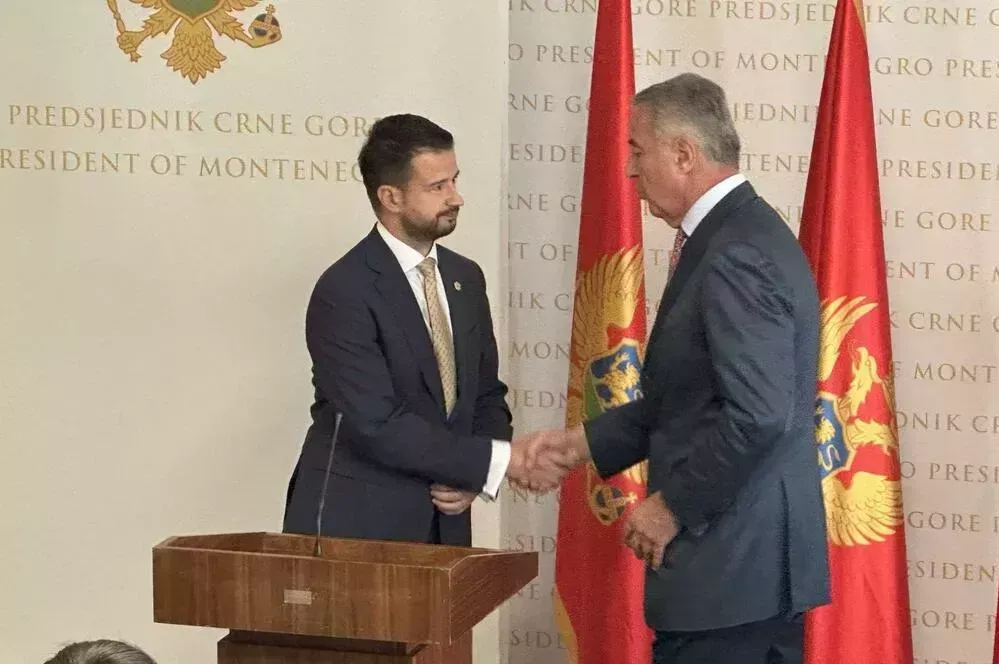
Nevena Kovačević analyzes the outgoing year and events in Montenegro for Patria
The year behind us was turbulent.
Two election cycles at the state level have significantly changed the image of the Montenegrin political scene. The dominant forces within the power structure have been altered, as have the leadership of most opposition parties.
We witnessed harsh accusations, followed shortly by sudden reconciliations, numerous scandals at both state and local levels, and countless populist moves – the key tool in the fight for power.
From a leader in the European integration process, Montenegro has become Europe's "pain in the neck." Gifts in the form of diverse influences from our closest neighbor on internal processes were also unavoidable. After a months-long post-election saga, the process of forming a government was completed on the last day of October with the election of the Government led by Milojko Spajić.
In this text, we will review the most important political events, which we have analyzed individually during the outgoing year.
The fiasco of the idea to form Lekić's Government, the blockade of the European path, and the scheduling of presidential elections
The beginning of the year was marked by the attempt of the old-new parliamentary majority to patch up the holes in their ranks by forming a government led by DEMOS leader Miodrag Lekić, after the amendments to the Law on the President were adopted, the unconstitutionality of which would later be confirmed by the Constitutional Court.
However, Lekić himself soon reluctantly confirmed that the dialogue had failed. The leaders of the Democratic Front accused Dritan Abazović's URA Civic Movement and SNP of sabotaging the entire process for the sake of remaining in power in a technical mandate.
Abazović's Government thus continued its technical mandate, five and a half months after a vote of no confidence. At the same time, shortly after the recording of the presidents of several municipalities reporting to Milica Zavetnica was released, Montenegro found itself at the center of a new regional scandal. Abazović's ministers, Marko Kovač and Aleksandar Damjanović, attended the celebration of the unconstitutional Day of Republika Srpska, applauding Vladimir Putin and Milorad Dodik, celebrating secessionism and war crimes. The justification of a private trip to Banja Luka was futile. The unscrupulous shaming of the country cannot be forgotten, let alone justified.
Warnings from European officials followed, which only the Prime Minister, busy pushing Montenegro into Open Balkan, did not hear. With the election of three judges, the Constitutional Court was unblocked, but the place of the missing seventh judge remained vacant.
The failed negotiations on the government were soon overshadowed by the sudden decision of the Speaker of Parliament Danijela Đurović to call early presidential elections for March 19. Although joint appearances were negotiated, the August 30 majority had four representatives in the first round of elections, and the opposition had two. The seventh candidate was influencer Jovan Radulović.
The pre-election campaign was marked by the dual citizenship scandal of Milojko Spajić, the current prime minister and initial presidential candidate of the Europe Now movement. The speed with which the Ministry of Internal Affairs of Serbia provided the State Election Commission with documentation confirming the allegations about Spajić's dual citizenship indicated a desire for his exclusion from the presidential race as soon as possible, as in the case of Andrija Mandić, who publicly admitted to holding Serbian citizenship, the efficiency was not even close.
Even then, the conflict between the two PES leaders, Spajić and Jakov Milatović, began to emerge, after Milatović, with public criticism of his party colleague, effectively joined the representatives of almost all political entities who accused Spajić of fraud. Spajić constantly entangled himself in attempts to deceive the public, and after the DIK's decision to reject his candidacy, he ceded his place to Milatović, the would-be mayor of Podgorica.
Unexpected outcome of the presidential elections and Milo Đukanović's departure from the helm of DPS
In line with predictions that Milo Đukanović's opponent in the second round would be Andrija Mandić, a presidential debate between them took place shortly before the elections. This electoral process could not pass without a dirty campaign, in which pro-Serbian portals played a dominant role.
The most perfidious move was undoubtedly the release of a recording of a conversation with Draginja Vuksanović Stanković, aimed at discrediting her, during the election silence. On election day, disinformation followed, predominantly aimed at opposition representatives: a secret meeting between Đukanović and Vuksanović Stanković, the beating of Podgorica mayor Ivan Vuković...
A surprising election result – instead of Mandić, Đukanović's opponent in the second round was Milatović. After the results were announced, SDP candidate Draginja Vuksanović Stanković announced her withdrawal from politics due to her poor electoral result, and soon party leader Raško Konjević also resigned from his party positions. The success of the newly formed PES united the August 30 coalition, who called on voters to support Milatović in the second round.
The overthrow of Đukanović became more significant than the elections themselves.
If it hadn't been a vote for anyone but against Đukanović, Milatović would certainly not have become head of state.
The election victory was celebrated with Serbian flags and chauvinistic songs, while messages of the dictator's fall and the final liberation of Montenegro arrived from neighboring countries. On election day, cameras at border crossings were suddenly turned off, which was justified as a technical error and system overload. However, precisely these days it is becoming clear that we were right when we wrote that it was not an oversight, but a cover-up of illegal voter transportation, organized by Aleksandar Vučić's regime. A scenario modeled after the battles for Budva, Podgorica, and Nikšić.
Vučić applied the well-tested practices from the examples of Montenegro and Republika Srpska in the last elections in Serbia, using established functional methods. The thesis about illegal voter transportation to countries in the region was explicitly confirmed a few days ago by high-ranking SNS official Vladimir Đukanović. After the defeat in the presidential elections, Milo Đukanović resigned as president of DPS, and was replaced by Danijel Živković.
Đukanović concluded his presidential term with a visit to Berlin, and Milatović's inauguration was organized in Podgorica instead of Cetinje. The reason for changing the inauguration venue was an incident in which, during a convention in the capital, Milatović was allegedly attacked by a group of citizens, and DPS was accused of preparing the attack.
Montenegro has a president who is the political son of Momir Bulatović, a relativizer of the genocide in Srebrenica, a product of the malignant influences of Greater Serbian nationalists and the anti-state actions of their local servants.
Parliamentary elections and turbulent negotiations for the Government
In mid-March, amidst the presidential campaign, Milo Đukanović issued a decree dissolving the Assembly and immediately called early parliamentary elections for June 11. Political opponents claimed this was an illegal move, and the Minister of Internal Affairs, Filip Adžić, made a brilliant suggestion – not to publish the decree in the official gazette.
The pre-election period was marked by the breakup of the DF, with the Movement for Change leaving the alliance, as well as the reconciliation of Dritan Abazović and Aleksa Bečić, whose parties decided on a coalition arrangement. To this day, these two parties have not escaped the vicious cycle of bitter rivals and uncompromising allies.
The opposition parties' joint appearance was absent this time as well, and the SDP opted for an independent run in the elections, which, along with numerous mistakes, cost them their parliamentary status. The election campaign was dominated by populist promises of salary and pension increases and a seven-hour workday through the Europe Now 2 program, but also the Do Kwon affair, launched by interim Prime Minister Abazović and Minister Adžić, which remains unresolved to this day.
Spajić, who was linked to suspicious dealings of the arrested South Korean cryptocurrency king by publishing the content of an alleged Do Kwon letter, did not handle the situation well this time either, and his rather unconvincing explanations led to a new twist in the entire affair, which caused lasting animosity between the former and current prime ministers and their two parties.
Although PES claimed that Abazović was looking for a prosecutor to arrest Spajić, it all remained at the level of pre-election marketing. Despite a record low turnout, PES predictably won the most votes, followed closely by the coalition gathered around DPS. Spajić immediately ruled out the possibility of cooperation with DPS and URA.
Abazović's interim Government continued to make decisions of questionable legitimacy. The Director of the Police Administration, Zoran Brđanin, was dismissed, and the legality of his dismissal was confirmed twice by the Administrative Court.
The internal party struggle between Milatović and Spajić became increasingly evident with the scheduling of separate sessions of the presidency and the main board. After consultations with party representatives, Milatović formally entrusted Spajić with the mandate to form the Government. This was followed by arduous negotiations, marked by a lack of transparency towards the public. The eternal Prime Minister Abazović wished for the final collapse of the negotiations, triumphantly repeating the remark about the cake that would spoil.
He also made the spectacular claim that international partners were begging them to be part of the Government, even though it was quite clear that by blocking the European path, he had exhausted all his credits with Western and European partners.
The rift between Spajić and Milatović deepened after the announcement that the Government would be formed without the ZBCG coalition and that the position of Speaker of Parliament was intended for Aleksa Bečić. The Front members appealed to Milatović for help, who increasingly criticized the way and principles of conducting negotiations.
Meanwhile, threatening warnings arrived from the neighborhood – Serbian Minister of Defense Miloš Vučević warned that the recognition of Kosovo would backfire on us, predicting a Ukrainian scenario, while Aleksandar Vučić, Ivica Dačić, and even opposition figure Zavetnica, spread false claims that there would be no Serbs in the Government.
Members of Parliament Radinka Ćinćur and Jevrosima Pejović opposed the announced concept of a government with the Democrats and minority parties, which put Spajić in a stalemate. Instead of the predicted support of 44 MPs, a questionable majority of 41 was reached, especially after the Democrats also sided with ZBCG, setting a clear condition – they would not support the Government if its formation depended on Mehmet Zenka, whom they often called a DPS satellite.
Under pressure from Milatović and his faction, and in order to calm the increasingly evident internal party tensions, Spajić relented, aware that his political survival depended on the formation of the Government.
Instead of Aleksa Bečić, the position of Speaker of Parliament was offered to Andrija Mandić. Thus, from daily squabbles over who offered what and who refused, we arrived at a harmonious resolution of a drama full of twists and turns, from love to hate, akin to toxic love affairs.
A coalition agreement was soon signed, which provides for a government reconstruction after a year, with 4 portfolios to be led by ministers from the pro-Russian DF. Almost all minority parties, except for some Albanian parties, were excluded from power. All prerequisites were created for the continuation of the constitutive session of the Assembly, which began back in July.
On the second to last day of October, Andrija Mandić, a Chetnik duke, was elected Speaker of Parliament, and the question of whether such an election was legal, given his dual citizenship, remained hanging in the air.
The political saga ended with the election of Spajić's Government, after an all-night and turbulent parliamentary debate, during which the newly elected prime minister refused to read and explain his exposé, thereby flagrantly violating the Constitution. The Government, essentially controlled by a Chetnik duke, is the most cumbersome in its composition, with the possibility of further increasing the number of ministries after the reconstruction.
Thus, Dritan Abazović's government officially became history, remembered for the longest technical mandate in history, a wasteful approach to public finances and state resources, numerous scandals, but also for its subservient missionary work, through which Abazović significantly contributed to the realization of the crucial interests of official Belgrade.
Scandals of Abazović's Government
We will mention only a few of the scandals that shook Montenegrin and international public opinion shortly before the end of Abazović's rule, all under the guise of fighting crime and corruption.
Let's recall the spectacular operation at the Podgorica hotel, where guests and employees were searched for unknown reasons, and then the action-movie-like scandal – a tunnel was discovered in the depot of the Podgorica High Court, which had been dug for a long time and would likely have remained a secret if a court employee had not complained about a draft.
Let's not forget the state's embarrassment at the UN General Assembly session, with the presence of two large delegations, led by Milatović and Abazović.
The interim prime minister used his visit to New York to announce new, spectacular details, known only to him, about the connections between the media and organized criminal groups, and about paid agents from the European Parliament who write annual reports.
First Government decisions, new parliamentary practices, and the census
The census was prepared by Dritan Abazović's government, dictated by official Belgrade. The initial deadline insisted upon was the beginning of November. Opposition parties launched a boycott campaign during October, stating that Abazović's government did not want to negotiate the participation of the opposition in the census commissions and ensure control mechanisms.
Abazović, consistently implementing the interests of his neighbors, autocratically refused to negotiate with the opposition. Census commissions were formed along family and godparent lines. The months-long aggressive pre-census campaign from the neighborhood went almost unnoticed until Vučić's spiritual father, Porfirije Perić, arrived in Podgorica.
It is unnecessary to remind of the propaganda speech given in the Temple of Christ's Resurrection, with the presence of Serbian far-right opposition figures. In addition to single-identity and single-language messages, Porfirije's visit was marked by meetings with Abazović and Milatović. Census projections followed and came from the highest addresses, both from Serbia and Republika Srpska.
In an attempt to avoid a boycott, the newly elected prime minister proposed postponing the census by a month, and the decision was formalized at the first government session. This was followed by dialogue with the opposition, the civil sector, and councils of minority peoples. Simultaneously with the start of the census dialogue, the European Commission's report arrived, which, in short, stated stagnation in almost all areas. A roadmap for the government, the worst report since the start of negotiations for the opposition, and an almost insignificant document for Abazović's government, in the manner of standard evasion of political responsibility.
After a series of calculating games, the opposition abandoned the boycott, claiming that all demands contained in the agreement they signed with Spajić had been met. The census, after two postponements, began on December 3, despite numerous controversies that accompanied the entire process, daily projections of results announced by Serbian and local propagandists, contradictory information, and earlier claims by the opposition that the census was being rigged by BIA members employed at Monstat.
The process itself was accompanied by numerous scandals that called its legitimacy into question: the termination of contracts with enumerators and instructors due to the use of so-called "washable" pens in several municipalities, a shortage of enumerators, complaints from citizens who were not counted, and on the eve of the census's end, the chairman of the software development commission for data control resigned.
Despite all of the above, and the threats from opposition members to halt the process if the software was not developed by the end of the census, yesterday the opposition hypocritically praised Monstat's work. With the election of Andrija Mandić as Speaker of Parliament, Western warnings about members of the Russian-Serbian agency being unacceptable partners suddenly fell silent.
We also witnessed a practice that is likely a novelty in the history of not only Montenegrin but also European parliamentarism – Mandić held a session in front of an empty plenary hall, without the presence of MPs.
Turbulent parliamentary sessions, full of harsh accusations and verbal threats, which almost led to a physical altercation between Dritan Abazović and Social Democrat MP Nikola Zirojević. Almost at the same time, the president of the state, in Belgrade, comically admired Vučić's knowledge of wine.
Very quickly, we went from Milatović's admiration for Vučić to Mandić's presence at the SNS election victory celebration, shamelessly humiliating the institution he presides over, as well as state integrity.
Prime Minister Spajić, preoccupied with "economic" issues, remained silent about Mandić's disgrace of the country, while Milatović resorted to the well-worn technique of relativization.
Thus, the "no tie" case remained without reactions from the Government and the parliamentary majority, where many would gladly swap places with Mandić. Faruk Resulbegović was elected as the seventh judge of the Constitutional Court, as were three members of the judicial council, while the election of the Supreme State Prosecutor is still pending.
The filling of positions in the judiciary served as a new means of collecting political points and boasting about the effective results of the Government and the new majority in unblocking the European integration process.
The return of the chief negotiator position, abolished by Abazović's government, was also announced. With the dismissal of one of Abazović's key associates, Artan Kurti, major personnel changes in the ANB and the entire security sector were foreshadowed.
Summary of local farces
Podgorica got a new local government in April, after six months of waiting, led by Mayor Olivera Injac, after which a series of illegal appointments began. In Nikšić, the decision to declare the city's patron saint was officially made, and proceedings were initiated against the mayor Marko Kovačević for damaging the state's reputation, specifically for the case of raising his middle finger during the performance of the national anthem at the celebration of the jubilee of the Nikšić daily center.
It is not difficult to conclude the outcome of the proceedings – Kovačević was acquitted. The arrested mayor of Budva, Milo Božović, signed employee salaries from prison. In Andrijevica, citizens have been blocking the work of the local parliament for months, while in Pljevlja, the local government declared the religious holiday of Saint Petka as the new Day of the Municipality. At the end of the year, as a gift to the citizens of Tivat, on the day of the Catholic Christmas celebration, Baja Mali Knindža performed on Pine Square.
This is just a fraction of the local neo-Chetnik exhibitions we have written about, and we will continue to write about them in the future.
Suppression of critical thought and increasingly evident misogyny
Numerous threats to critically oriented media marked this year as well. The latest in a series is a rape threat sent to the editor of M portal, Danica Nikolić, and the same email contains threats against journalists and editors of other media outlets. Abazović's government will also be remembered for constant clashes with the media and representatives of the civil sector, which continue from the opposition benches.
In addition to guilt for critical reporting, the media were also accused of causing an increase in peer violence. Absurd, but true. Misogynistic attacks on female ministers and MPs were almost daily.
The most base, of course, was Vojislav Šešelj's shameful work dedicated to Draginja Vuksanović Stanković.
Constant threats of closing the Faculty of Montenegrin Language and Literature are also a constant, and Serbian propagandists have joined the propaganda against this institution, using pro-government media. A misdemeanor proceeding is underway against historian and professor of the aforementioned faculty, Boban Batrićević, for a column in which he stated, among other things, that the priests of the Serbian Orthodox Church do not preach the word of Christ.
What awaits Montenegro in the coming year
We are ending the year with the adoption of the budget, which the opposition claims is consumptive and fiscally unsustainable, problematizing the January increase in only minimal pensions, and the lack of data on how the Europe Now 2 program will be implemented. They accuse Spajić of deceiving citizens.
On the contrary, Spajić claims that the promises will be fulfilled, and that the funds from the loan of 650 million euros will be used exclusively for the payment of old debts. Ultimately, citizens will bear the consequences of irresponsible economic policy, populist and demagogic promises.
After the previously dismissed Director of the Police Administration was reinstated by a government decision, the parliamentary security committee rejected two of his work reports, and the Minister of Internal Affairs, in line with a pre-designed political game, announced a new proposal for his dismissal.
At the end of the year, new dangerous relativizations arrived – the Minister of Defense Dragan Krapović, speaking about the previously erected memorial plaque in Morinju, problematizing the inscription, stated that what happened in Morinju was not a consequence of Greater Serbian aggression, but of the war in the former Yugoslavia. Such a stance undoubtedly refers to all crimes caused by the malevolent idea of creating a Greater Serbia, and a more detailed analysis of the harmfulness of such relativizing statements will be addressed in individual texts.
Andrija Mandić and the rest of the Front members announce a government reconstruction at the beginning or middle of the year, contrary to the provisions of the coalition agreement, while Spajić claims that no discussions have taken place on this topic.
The promotion of constitutional amendments regarding the change in the status of the Serbian language is also underway, and the team from the former Democratic Front actively advocates for the signing of a dual citizenship agreement with Serbia.
Friction and mistrust within the parliamentary majority are becoming increasingly apparent, which means that another year full of twists, expected and unexpected moves, lies ahead. Mandić and his group will not miss the opportunity to become part of the executive power, so the pressure on Spajić will intensify, and his refusal of an earlier government reconstruction could lead to open conflicts, resulting in a loss of support and a potential initiative for a vote of no confidence.
The imaginary cohesion could soon be formally broken. A final split between Spajić and Milatović is realistically expected, as well as the division of the movement into several camps. Opposition parties announce major reforms. Direct intra-party elections in DPS are to follow, as well as a congress of the Social Democratic Party. However, if the reformed opposition adheres to previous practices – passivity and calculating struggle for power – then there will be nothing left of preserving national interests and the civic concept of the state.
After the census results are published, parties will claim their own merits, but regardless of what they are, the advocacy for constitutional redefinition will not stop. The end of the institutional and political crisis, despite the pretense of unity, is still not in sight.
A government controlled by Russian-Serbian agents, certainly, cannot be a guarantee of a more peaceful and prosperous future, and a final awakening of the opposition parties would be of crucial importance for the path of the country's further strategic development and the protection of its sovereignty.
Komentari (0)
Prijavite se za komentiranje
PrijavaJos nema komentara. Budite prvi!
Minuta
Sve →Iz drugih kategorija

High Representative Not Elected: Germans, French and British Sabotaged Americans, New Attempt at End of June

ČOVIĆ WITHOUT MERCY: How Those Who Brought Ademović to Office Created a Political Hell for Him



Sunny Saturday, quite warm



Tragedy in Albanian resort: Two minors drown












