
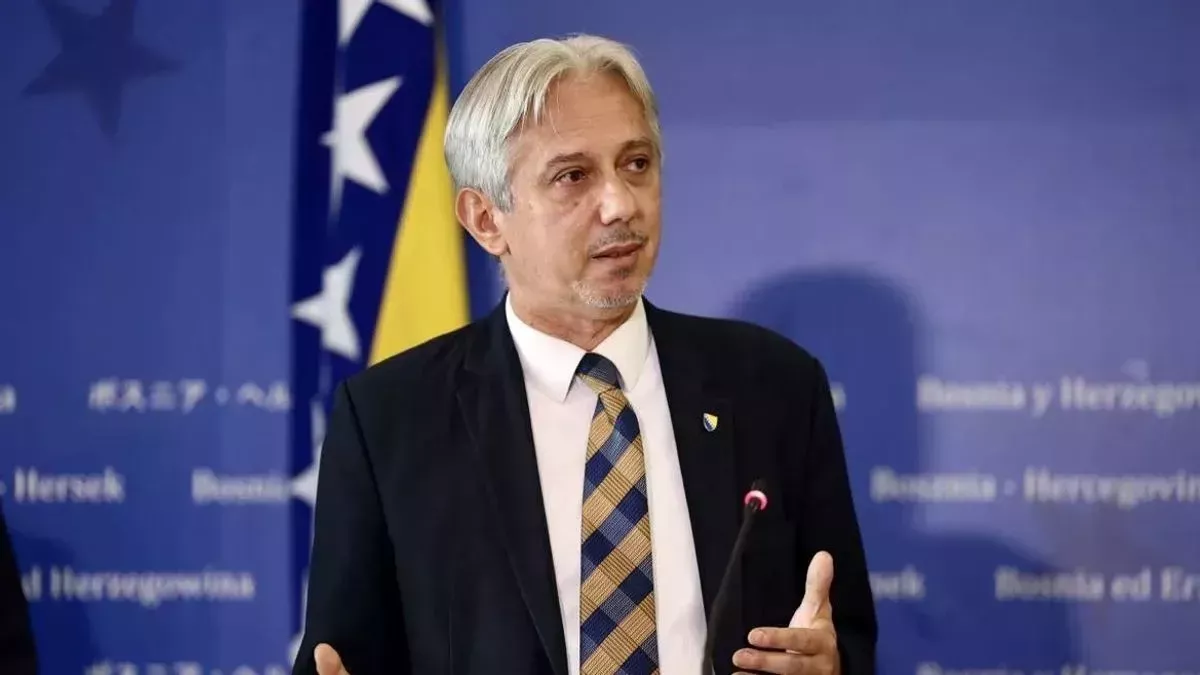
By: Slaven Kovačević/ Hayat.ba
Observing recent statements by various political actors, and occasionally analysts or intellectuals, regarding the unitary form of state organization, which expresses a certain fear or skepticism towards this form of state organization, a relatively simple conclusion emerges: these people do not know what they are talking about.
Of course, politics and its conduct are most often an expression of the perception of political actors about certain phenomena and events, which is occasionally inaccurate and therefore poorly articulated. Therefore, it would be desirable to point out a few elements regarding the unitary form of state organization, especially to those who oppose it.
The first observation among those who oppose the unitary form of state organization relates to their rejection of the democratic principle of "one person - one vote," arguing that this could lead to some ethnically based outvoting, which is essentially incorrect. The "one person - one vote" method is not exclusive to the unitary form of organization, as such a method exists to the same extent in federally organized countries (Germany, Austria, Belgium, Switzerland, and so on). Therefore, the unitary form of state organization has absolutely no connection with the method of election and electoral procedures from which the formation of government arises.
The unitary form of state organization speaks exclusively about how the state is governed, through the existence of a central authority with the highest degree of competence, which, by decision of that central authority, can be transferred to lower levels of government if there is a rational justification for it, in order to make the state more functional.
The second element that regularly appears in the public space relates to statements by political and other social actors that they are not in favor of a unitary form of state organization, and then they continue by saying they are not in favor of a federal organization either. That's where the serious problem lies. Modern political systems theory speaks of three basic forms of state organization: unitary, federal, and confederal organization (outdated theory speaks of simple and complex states).
Knowing this, the logical conclusion is that those who are neither for unitary nor federal organization give their favor and support to confederal organization (state community) in Bosnia and Herzegovina. I believe that there is superficiality among those who express such a stance, that they are neither for unitary nor federal organization, which then puts them in a very delicate position where, by analogy, they fall under the proponents of confederal organization (state community), which I consider very dangerous. From such people, we often hear that they are, as a contrast, proponents of the regionalization of Bosnia and Herzegovina. Well, nothing wrong with that, if we know that all countries that have regions within them are actually unitarily organized countries, regardless of whether they are parliamentary democracies or parliamentary monarchies. For example, Italy or Spain or France, and many others. All these countries have a unitary form of state organization and regions within them.
The third point concerns the inaccuracy that eventual proponents of the unitary form of organization would even include ethnic proportionality in the election and exercise of power, thereby ultimately contaminating the reality concerning the unitary form of organization and fueling opponents of the unitary form of state organization. The unitary form of organization, if we add democracy and its principles to it, can only exist if it is about democratic proportionality, in such a way that each political party has as much political power as it achieves votes and mandates in elections. In such political systems, the parliamentary majority governs the state, and a parliamentary minority can never do so.
The demographic picture of any country has absolutely no connection with the democratic expression of proportionality, which is derived from the number of mandates achieved after elections, and not from the demographic-ethnic picture. Even the recently stated position that ethnic proportionality is prescribed in Article IX of the current Constitution of Bosnia and Herzegovina is completely incorrect, because the Constitution of Bosnia and Herzegovina prescribes democratic proportionality, except for the Presidency and the House of Peoples of Bosnia and Herzegovina, where parity exists as a specific model.
The Constitution of Bosnia and Herzegovina itself does not prescribe any ethnic proportionality in any of its articles. Questions remain open – why do we have 3 Bosniaks, 3 Croats, 3 Serbs, and a few Others in the Council of Ministers if this is not stipulated by the constitution, or why do we have 2 Bosniaks, 2 Croats, and 2 Serbs among domestic judges in the Constitutional Court of Bosnia and Herzegovina, even though this is not stipulated by the constitution. Clearly, someone is pushing an ethnic matrix through political practice at the expense of democracy and its principles, and ultimately at the expense of the quality of those who should perform these honorable functions. Ethnic suitability and quality in performing the entrusted task are two very different things.
The fourth, no less important, point relates to examples from the region, i.e., if we look at the countries formed by the breakup of former Yugoslavia, from west to east: Slovenia, Croatia, Bosnia and Herzegovina, Serbia, Montenegro, Kosovo, and North Macedonia, all of them, except for Bosnia and Herzegovina, have unicameral systems (no upper house of the legislative body – which is represented in Bosnia and Herzegovina by the House of Peoples), all of them elect a president or head of state within a single electoral unit, and all of them are unitarily organized states. So why is Bosnia and Herzegovina being imposed a bicameral system of the legislative body, and moreover, is its federalization, of an ethnic nature, being aggressively proposed? There is no justification or argument for such political expressions or political stances on the basis of which such bad and unsustainable initiatives are formed. Because such initiatives are not focused on rational and functional governance of the state, but repeatedly turn towards ethnic suitability at the expense of quality, this time divided into mono-ethnic federal units.
There are also those who, as a fifth point, speak of consociational democracy as a solution for Bosnia and Herzegovina, which is unsustainable, and even inappropriate. Consociational democracy was not intended for ethnic communities, which is relatively easy to argue. Its first principle is the creation of a Grand Coalition in which political parties or political groups from ideologically distant political orientations participate, but agree to a Grand Coalition for the purpose of forming a government. From this, it is clear that ethnic communities do not participate in the formation of Grand Coalitions, but political parties or political groups do. The second principle of consociational democracy speaks of a mutual veto, in which political parties participate in the same formation of a Grand Coalition and decision-making within it. Again, there are no ethnic communities within consociational democracy, as some here incorrectly portray it. The third principle of consociation is proportional representation within the Grand Coalition, based on democratic potential or electoral results, not on the size of individual ethnic communities.
When Belgium is taken as an example, its upper house, called the Senate, does not only contain Flemings, Walloons, and Germans, as some represent, or let's ask them – where do people of Italian, Spanish, Luxembourgish, Liechtenstein, and then a whole range of African countries origin come from in the composition of the Senate as the upper house, and in significant numbers? Clearly, it is not just about Flemings, Walloons, and Germans, but about democratically elected representatives within the Belgian electoral system. It is even interesting to look at Articles 10 and 11 of the Belgian Constitution, which explicitly speak about the rights and protection of the rights of Belgians, while here only the rights of ethnic communities are protected without protecting the rights of Bosnians and Herzegovinians as citizens of this country, which is a deviant expression of the domestic political system itself.
The conclusion we can draw is that the unitary form of state organization is the most rational for Bosnia and Herzegovina, based on the experiences of neighboring countries, which would have two levels of government: 1. state level and 2. level of local self-government units, with possible regionalization based on the economic and business ties of the regions themselves, without their legislative role.
This would be a step forward, everything else is a step backward. World practice is such that literature indicates that out of 193 UN member states, only about 20 are federally organized countries, or about 10%. Even maintaining the current status quo will increasingly carry tensions and destabilization over time, precisely because of the ethnic matrix or ethnocracy as the dominant form in political and social life. Therefore, the only adequate and rational solution for Bosnia and Herzegovina is its transition to a modern and democratic state, based on democracy, the rule of law, and the protection of individual civil rights, with a unitary form of state organization, because this fulfills a number of European criteria for membership in the European Union and, finally, establishes a functional state of Bosnia and Herzegovina. In contrast stands an ethnically conflictually organized political system, which leads to continuous destabilization and a series of uncertain outcomes.
Komentari (0)
Prijavite se za komentiranje
PrijavaJos nema komentara. Budite prvi!
Minuta
Sve →Iz drugih kategorija

High Representative Not Elected: Germans, French and British Against Americans, New Attempt at End of June

ČOVIĆ WITHOUT MERCY: How Those Who Brought Ademović to Office Created a Political Hell for Him



Sunny Saturday, quite warm



Tragedy in Albanian resort: Two minors drown












