
Interviewer: Delvin Kovač
Instead of finding funds for the reconstruction of buildings destroyed in the war that are owned by the City of Mostar, such as the former Municipal building, the Committee, the "Konak" barracks, and numerous others, the easiest solution has been chosen – to demolish!
This was stated in an interview for the Patria News Agency by Alija Behram, a long-time activist and president of the Association of Citizens Mostarski krug, which strongly protested the city authorities' announcements about demolishing and removing 57 dilapidated and devastated buildings in the city on the Neretva River.
Mostarski krug particularly blames Mayor Mario Kordić and the head of the City Council, Salem Marić, for the omission of the usual steps – a public debate in which a serious circle of architects, civil engineers, spatial planners, and cultural workers of the widest spectrum would have their say on this issue.
The city authorities in Mostar have published a list of 57 dilapidated and devastated buildings that will be demolished/removed. This list also includes buildings whose reconstruction is underway, protected cultural monuments, and even national monuments. How do you comment on this plan of the city administration?
Behram: Activists of Mostarski krug are concerned because the statements from the city administration, signed by Mayor Mario Kordić and the President of the Mostar City Council, along with the accompanying lists of devastated buildings and those designated for demolition, indicated that a whole series of significant buildings, including those of paramount national and cultural importance, were planned for final removal.
Let me remind you, among them is the building of the Dom Armije, damaged during the war, for which the Mostar Unified Veterans Organization had previously initiated activities to reconstruct it into a Memorial Center for preserving the memory of the heroic defense of Mostar and the homeland.
The city authorities were aware of this, so the question remains open as to who needed provocations of this kind. Do I need to emphasize that the project documentation for this building has already been completed, and in the meantime, support for its realization has arrived from the very top of the Federal Government, which the public was informed about.
If the Dom Armije building is planned for demolition, then the city authorities have no idea what they are doing, planning, and what is the paramount, important interest of Mostar's veteran population. And that is by no means a good path.
The list of controversial buildings planned for removal includes national monuments and buildings of special cultural significance. Among them is the popular house of the former mayor of Mostar, Mujaga Komadina, which served as a university library until the war.
Any serious government would have long ago repaired and put such a building on an attractive city promenade into function for use by both the "Džemal Bijedić" University and the University of Mostar.
I remember that after the war, donors from Turkey offered to renovate "Mujaga's House" to the City, but the then city leadership, unfortunately, rejected such a gesture. Mostar residents vividly remember that after the war, local tycoons set their sights on that dilapidated building on the Mostar promenade.
And when they failed to gain control of that property after a long legal battle, they now want to demolish Mujaga Komadina's house in order to gain control of an elite location for new housing construction in some later outcome.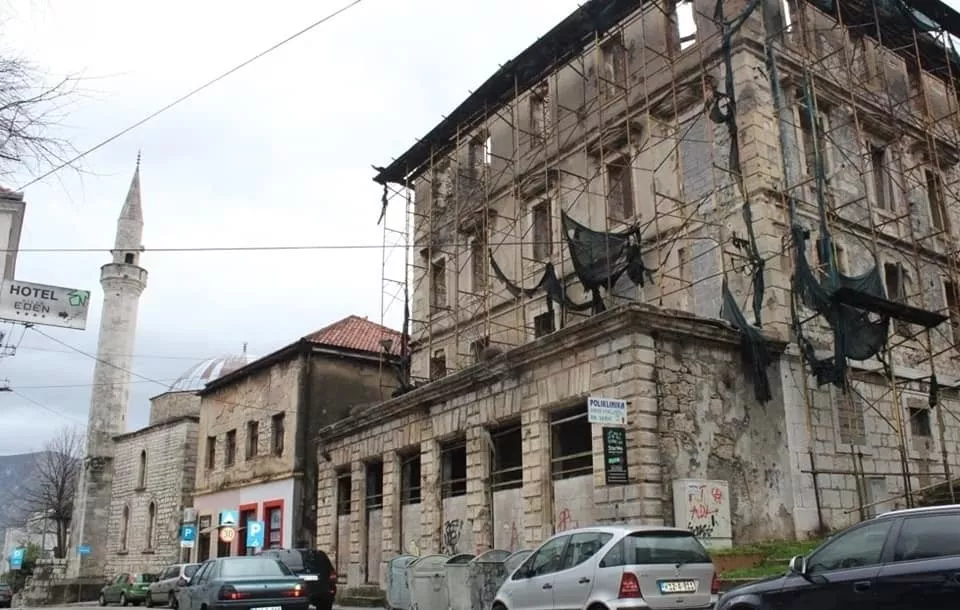
One of the many buildings that still await their reconstruction
Many citizens share this view of mine, but the message to everyone is the same – it will not and cannot pass!
Similarly, serious Mostar residents point out that the planned demolition of the Clock Tower, damaged during the war, would also be an unprecedented act of cultural destruction. City quasi-planners have also included authentic Herzegovinian houses – known as Alajbegović's house (opposite the Court building on Titova Street) – on the demolition list, but this building is also a national monument.
How can such a building even be on the removal list if there is no opinion, let alone consent, from the Commission for National Monuments of Bosnia and Herzegovina regarding it, as well as numerous other buildings?
It is very important that the Commission for National Monuments of Bosnia and Herzegovina has reacted loudly in the meantime, without whose decision or consent, with the mandatory consent of the Federal Ministry of Spatial Planning, no one can touch, let alone demolish national monuments.
Therefore, instead of finding funds for the reconstruction of buildings destroyed in the war that are owned by the City of Mostar, such as the former Municipal building, the Committee, then the "Konak" barracks, and numerous others, the easiest solution has been chosen – to demolish!
That is why, in Mostar, during these few turbulent days, the impression was created that the city authorities want to favor the urban lobby that is hungry for jobs and, of course, profitable business.
Is such a move by the city authorities, led by Mayor Kordić, hasty, underdeveloped, thoughtless, rash? Should the public and experts have been involved beforehand? And what, in your opinion, is the ultimate goal of the city authorities with such a project?
Behram: I remind you, information was released to the public that the City is inviting owners to remove buildings that have been spoiling the city's appearance for years and also pose a threat to the safety of citizens, or the city authorities will remove them, charging the costs of removal to the property.
We have noticed the absence of at least a few (skipped), but important steps. Such a somewhat historic step should have and must have been taken much earlier, because we are talking about dilapidated and devastated buildings that met such a fate during the war.
Therefore, the city authorities have missed a full thirty years without ever seriously and thoroughly confronting this biggest and most important municipal issue in the city.
In previous years, we have had citizens die due to the collapse of certain parts of devastated buildings. Many of these buildings still loom threateningly over passers-by and traffic, especially in the eastern part of the city, which was largely devastated during the bombing raids in the war against Mostar in the nineties.
Golden years were missed when empathy for Mostar was still felt in international circles and when we could have thought that the city, after the brilliant international project "Old Bridge – Monument to Peace," would begin to recover in all its war-torn areas. But, what is, is.
What was irritating and why we reacted so loudly, after all, was the absence of the usual steps. The city administration's announcements about demolishing and removing devastated buildings are happening without the knowledge and participation in the discussion of a serious circle of Mostar architects, civil engineers, spatial planners, and cultural workers of the widest spectrum.
We expected that this would be the right way to exchange information about the order of steps and define the best direction in such a broadly conceived action of removing ruins. And I maintain today, without such a broad, public, and expert discussion in the city, the announced project is doomed to failure from the start.
Many activists of Mostarski krug also believe that a seriously prepared press conference was missing, at which the media could have inquired in more detail about the content of this important city action so that they could inform the citizens promptly and comprehensively.
Thus, the impression is created that the mayor and the president of the City Council have mixed up the order of steps and caused more questions, even anger, with their announcement than approval, which should be the most important thing in this whole matter.
Behram: The easiest solution has been chosen – to demolish
Most of these buildings are on state land, and the Mostar authorities seem to want to register that land and then profit from it by selling it...
Behram: Looking at how new residential areas have sprung up in attractive locations after the war, especially on the western outskirts of the city, it is difficult to avoid the impression that in most cases, the city authorities have favored investors by agreeing to new megalomaniacal projects and new building designs, thus erasing the dear images of Mostar from our memory.
In this way, Mostar is slowly but surely losing its traditional, recognizable, dear local postcard. The city land with the former buildings of the so-called Mostar Old Hospital, where a hotel complex (Mepas) was built, has been "sold" almost for nothing.
Similarly, the building with the land of the dilapidated "Neretva" hotel, on the banks of the Neretva River on the eastern side of the city, was sold to an investor for peanuts.
I remember writing about this as a journalist, even about how the new owner intended to (re)sell the location to a new buyer for four to five times the amount. It is another question why this hotel complex was never fully built, even though fifteen years have passed since the purchase.
This particularly irritates and causes rebellion among indigenous Mostar residents, those who have lived there for a long time, remember, and love their city. However, their places are being taken by people who came here much later and do not know or live with such "Mostar emotions." And that is sad.
On the sites of the former popular Mostar hotels "Mostar" and "Ruža," instead of harmonious, urbanistically acceptable buildings that blended quietly and softly into the Mostar environment, today stand hotel-catering behemoths, without any charm or attractiveness.
Therefore, I maintain that the authorities favor such construction, without citizen participation and most often bypassing expert public discussions on each individual building. Who benefits the most from this would not be difficult to figure out.
Among the buildings planned for demolition is the Glass Bank building, which is supposed to house all federal institutions, and for which there is a reconstruction project. Do you also get the impression that the city authorities in Mostar are doing everything on their own initiative, disregarding the opinions and stances of other levels of government?
Behram: The status of the so-called Glass Bank building in the city center, which is designated as devastated and planned for demolition, has caused a lot of controversy. Mostar residents know well that the Federal Government once paid about 7 million KM to house the capacities of five federal ministries in that very building.
As far as I know, this included a reconstruction project, and it was determined that the building's statics were not compromised. I remember that city and federal authorities enthusiastically advocated, praised, and announced the imminent realization of this project at joint press conferences.
On the Croatian side, such an approach was "celebrated" as a kind of democratic victory because, as interpreted, "the breath of the Federation would be more strongly felt and experienced in Mostar."
Then, a few years ago, everything quieted down, then died out, without Mostar residents ever being presented with information about what happened and why such a widely conceived, welcome project was so easily abandoned, leaving only a threatening, bare concrete skeleton in the very heart of Mostar today.
This was unforgivable. Now many in the city are asking: who is crazy here? Who was given so much money and the decision was never realized, only to now talk about demolishing the building. This is, at the very least, scandalous, not to say rude towards the citizens of Mostar.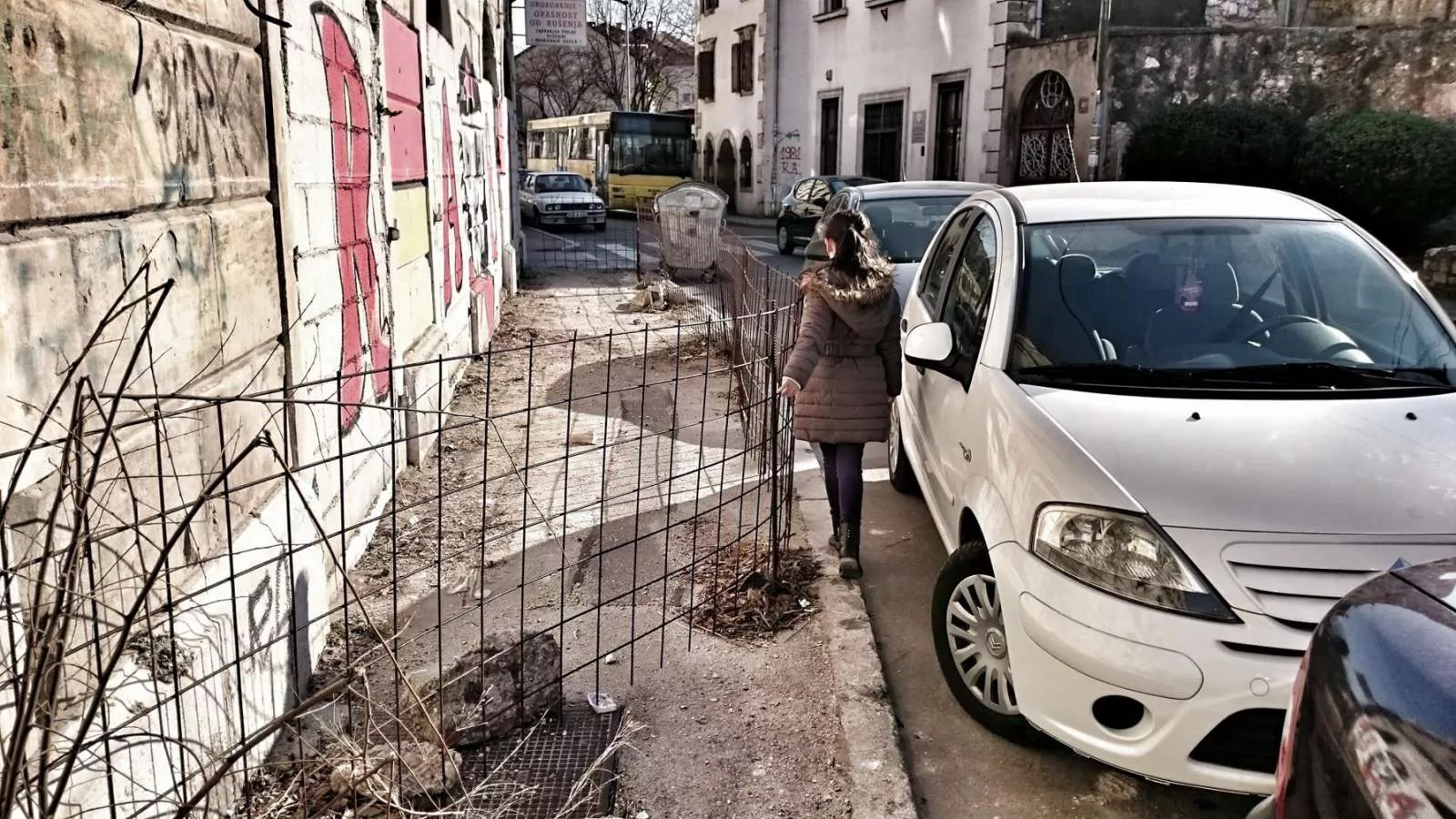
Movement through the streets of Mostar is difficult for citizens
What, in your opinion, is the solution for the many neglected, dilapidated, and devastated buildings that are definitely harming the city's image and also pose a danger to all residents of Mostar?
Behram: Activists and friends of Mostarski krug reacted immediately and called on the city authorities of Mostar to stop the announced activities in the way they were bureaucratically coldly, but certainly, hastily announced.
We insist and demand that a series of public debates be scheduled with detailed information presented about each individual building planned for removal, but certainly with the broad participation of directly interested citizens and the expert public of Mostar.
Fortunately, as far as we can see, our loud cry from responsible, concerned, and interested citizens has had an impact. Very quickly, a "clarification letter" arrived from the city administration containing precisely the order of steps that the non-governmental organization Mostarski krug insisted on.
Mayor Kordić and President of the City Council Salem Marić announce work on an elaboration at the city's expense "on the condition of each individual building." This primarily refers to a clear understanding of the load-bearing capacity and structural safety of each individual building, which will be signed by authorized expert institutions.
We now, of course, want an approach to be found for interested citizens, but also for the general public to be presented with the details of the announced elaboration. A special approach is also announced in the process of removing ruins "due to the safety of passers-by, traffic, and the safety of neighboring buildings."
It is good that the city authorities will provide a simplified and cooperative invitation to the owners of dilapidated buildings in order to clearly assess and define the approach and plan for removal or possible renovation, if it turns out to be possible.
Only after fulfilling such an approach can we talk about announcing a public call for the selection of companies that will work on removing the ruins, a decision on which was made by the Mostar City Council. In all of this, it is good that the public in the city has awakened and become interested, and Mostarski krug has also announced public debates on this topic.
Komentari (0)
Prijavite se za komentiranje
PrijavaJos nema komentara. Budite prvi!
Minuta
Sve →Iz drugih kategorija

High Representative Not Elected: Germans, French and British Against Americans, New Attempt at End of June

ČOVIĆ WITHOUT MERCY: How Those Who Brought Ademović to Office Created a Political Hell for Him



Sunny Saturday, quite warm



Tragedy in Albanian resort: Two minors drown












