
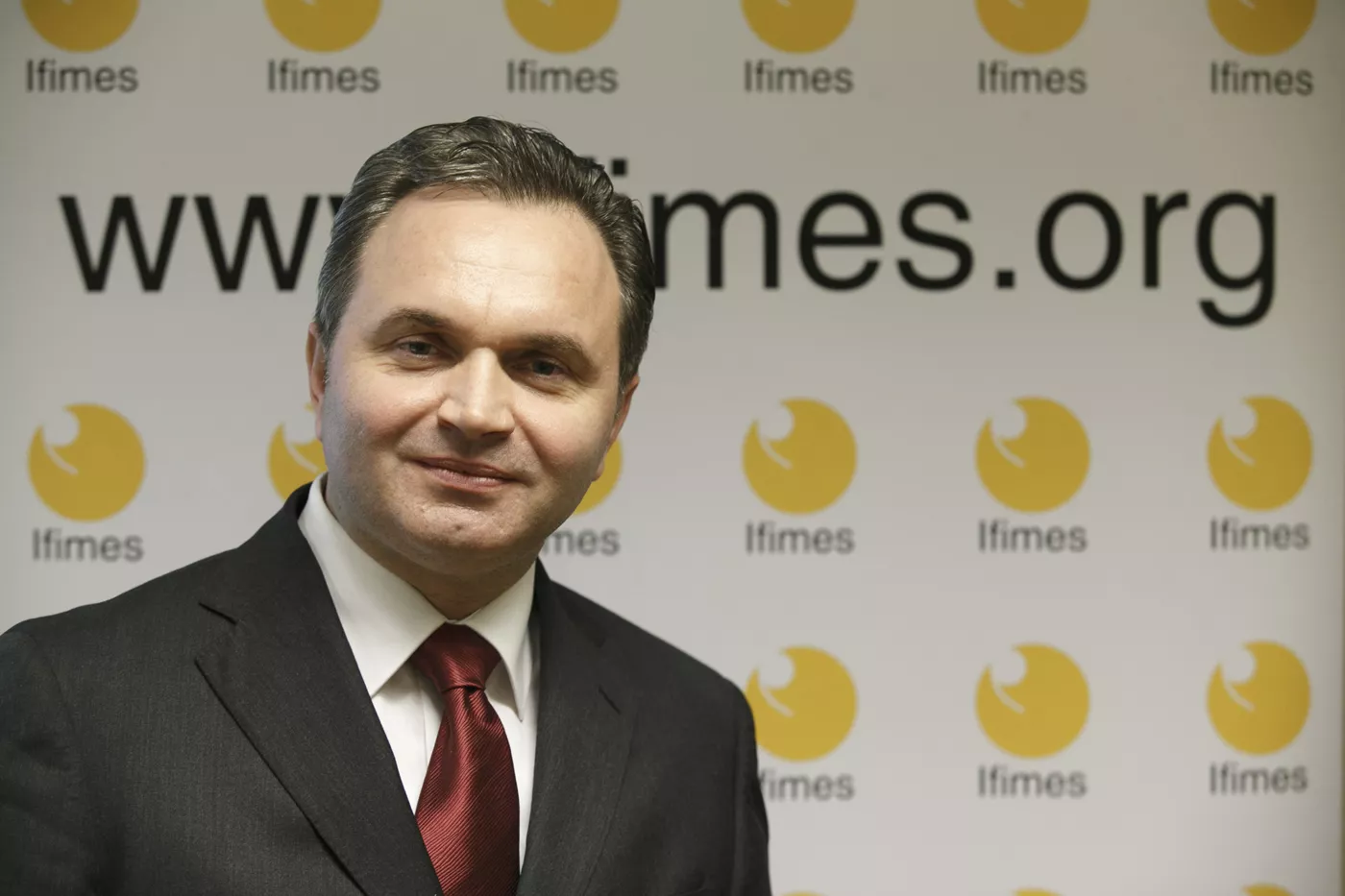
The coup d'état that was underway at the beginning of the demonstrations has failed, and it was launched two months earlier than planned because of the elections in Serbia, claims in an exclusive interview for the Bosnian news agency Patria (NAP) Zijad Bećirović director of the International Institute for Middle Eastern and Balkan Studies (IFIMES) from Ljubljana.
According to him, all events in BiH in recent days were carefully planned with the intention of installing a new leader of the Bosniaks, and enabling Belgrade and Zagreb to complete the partition of BiH. For these radical claims that Bećirović makes, he says he has evidence, including information that among the demonstrators in Sarajevo, the fiercest were those who came via Vraca from Lukavica!
NAP: How do you comment on the development of the situation in BiH since February 7, when some state institutions were set on fire? Some saw elements of a coup d'état and terrorism in this, while others see an awakening of the people.
Bećirović: At first glance, it seems spontaneous and like an awakening of the people. However, those who know the situation in Bosnia and Herzegovina and the actors on the political scene clearly understand that nothing happens spontaneously in BiH, but rather these are processes that are directed and monitored in all social segments. These are well-planned activities, which were supposed to be implemented two months later, but it was subsequently decided that due to the elections in Serbia, which will be held on March 16, 2014, activities regarding the attempted coup d'état would be accelerated. Why? The election campaign in Serbia and the activities of Aleksandar Vučić (SNS) would create an environment for the fight against crime and corruption, which would be used by Fahrudin Radončić (SBBBiH) in areas predominantly inhabited by Bosniaks.
NAP: But still, many believe that the dissatisfaction is justified and that people have reasons for the protests...
Bećirović: It is indisputable that people in BiH have been living poorly for decades and that the results of the authorities at all levels are mostly catastrophic. Such a situation, according to the scenario, would lead to mass protests that would topple cantonal governments in predominantly Bosniak areas, which is what happened.
The overthrow of the Federal Government and the Bosniak member of the BiH Presidency, Bakir Izetbegović, did not succeed. On one side, we would have the overthrow of the government through mass protests, and on the other side, Radončić would, through his own or media under his control, discredit and/or eliminate any politician from competing Bosniak parties, and if early or regular elections were held on October 5 this year, it would only formalize his leadership among the Bosniaks.
This would open up space for him to impose himself as the undisputed leader of the Bosniaks in the coming period. The price of Radončić coming to the head of the Bosniak people would be his public or tacit blessing for the creation of a Croatian entity and the possibility of secession of the Republika Srpska. There is no coup d'état without external support. Since it is known from before that Radončić is part of the Greater Serbian project and that his SBBBiH was conceptually created in Belgrade, it is necessary to investigate the role of Aleksandar Vučić in all these events, who is a "child" of the Greater Serbian project, given his mortgage from the past, as well as a series of his secret meetings with Radončić recently. When the police forces in Sarajevo stopped the arrival of paid protesters (professionals) at the inter-entity line in Lukavica, it turned out that these protests did not have the same fervor and strength as when the front rows of the protests were paid individuals from Serbia, Montenegro, and some even from the Netherlands. Tuesday (February 11) was the key day when this project was defeated. Of course, certain circles across the Atlantic are not innocent in these events, nor is the EU itself.
It is indicative that the protests were not in front of the Council of Ministers of BiH, whose minister of security is Radončić. Coup d'états, if they do not succeed on the first day, are considered failed coup d'états. Radončić made a mistake because he tried to lead the coup d'état through the media; in fact, he exposed himself through his numerous and unnecessary public media appearances.
NAP: These are serious accusations; do you expect the investigation to prove what you are saying?
Bećirović: If Bosnia and Herzegovina were a state governed by the rule of law, in this case, one would expect action from the BiH Prosecutor's Office and the chief prosecutor Goran Salihović, who apparently prefers to socialize with leaders of political parties, even those involved in the coup d'état, instead of doing his job.
A thorough investigation is needed, which would show who all participated in this project, which has failed and from which many are already distancing themselves. Judicial prosecution of the bearers and participants of the coup d'état would confirm that BiH is a state governed by the rule of law; we will see what the chief prosecutor of BiH will do, because this is a thoroughly prepared coup d'état.
NAP: How do you comment on the fact that certain representatives of the international community are supporting the organized plenums in BiH cities?
Bećirović: The international community in BiH is disabled, just as the EU's policy towards BiH and the Western Balkans in general is such. A good part of the international community has played a negative role in events in BiH in recent years. Some international representatives also had corrupt motives for such actions.
The implementation of the "Sejdić-Finci" ruling most illustratively shows that EU high representatives were not dealing with the ruling but tried to impose a solution to the so-called Croatian question in BiH. If there is a Croatian question in BiH, there is also a Bosniak and Serbian question, but none of them talk about the question of citizens/nationals of BiH. Officials from the West like attractive events where they can take pictures, give a statement, without paying attention to the background of such events. Thus, they (un)consciously supported the coup d'état project.
NAP: Foreign media assess that this is the biggest crisis after Dayton; is that really the case?
Bećirović: Perhaps a more precise definition would be that it is a constant stable crisis in BiH. When the cameras of leading world media see mass protests and violence, quite certainly, according to their logic, they portray it as a big or the biggest crisis. The crisis in BiH is systemic.
Komentari (0)
Prijavite se za komentiranje
PrijavaJos nema komentara. Budite prvi!
Minuta
Sve →Iz drugih kategorija

High Representative Not Elected: Germans, French and British Sabotaged Americans, New Attempt at End of June

ČOVIĆ WITHOUT MERCY: How Those Who Brought Ademović to Office Created a Political Hell for Him



Sunny Saturday, quite warm



Tragedy in Albanian resort: Two minors drown












