
Written by: Rasim Belko
Continuity, not an exception, has become a fact that public opinion and political thought in Sarajevo, lacking mature strategies and genuine will to implement them, increasingly react like fans—frenetically, thoughtlessly, and shortsightedly.
This reflex lays bare the essential problem: the absence of one's own political paradigm. When it is absent, one passionately cheers for someone else's, even if it comes from an entity whose political structures and ideologies have been challenging the very existence of the state of Bosnia and Herzegovina for decades.
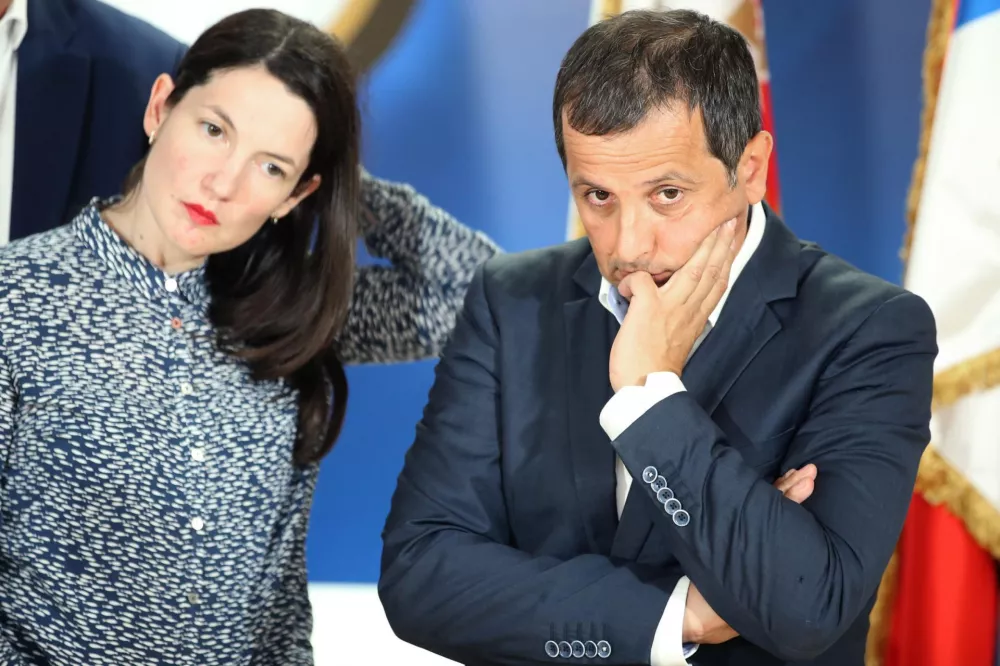
The paradox is obvious. In Sarajevo, almost without exception, the opposition to Milorad Dodik in the RS has become a media darling. It is difficult to find a daily media headline that does not carry statements by Nebojša Vukanović, Jelena Trivić, and Igor Crnatak, or someone else, often with a tone of admiration, as if their political rhetoric brings salvation for the state. Yet, in reality, these are politicians whose programs and ideological premises stem from the same source as Dodik's.
Why, then, are these actors so attractive to Sarajevo media? Perhaps because it is easier to deal with the conflict within the RS than with one's own lack of political capacity. It is easier to analyze Vukanović's tears than to face the fact that Sarajevo has had no articulated state-building vision, neither media nor political, for years.
The current moment best illustrates this. Dodik, under pressure from the international community or his own interest, is again trying to act "cooperatively." This turnaround, whatever its motivation, opens at least minimal space for easing political tension and stabilizing institutions. Yet, the first to jump in to thwart it are the opposition figures in the RS. Because anything that might even hint at benefiting Bosnia and Herzegovina does not suit them. They do not blame Dodik for nationalism and secessionism, but for not implementing them consistently.
And here lies the key absurdity of the Sarajevo media scene. Those who advocate for the integrity of Bosnia and Herzegovina daily give space to those who deny its integrity, simply because they are not in power in Banja Luka at that moment.
Such media logic is not only wrong—it is self-destructive. Instead of strengthening awareness of the state, the media turn into megaphones for the political dwarfs of the Greater Serbian idea, whose total voter base barely fills the modest rolling stock of the RS Railways.
Even more disheartening is that these same media rarely find space to cover the trials of those who defended and are most responsible for the survival of BiH, nor to promote ideas that would make the country more functional and prosperous. Instead of state-building thought, we get infotainment based on trivialities.
Instead of a political compass—clicks and algorithms.
If it is true that media reflect society, then this image is also a symptom of a deeper disorder. Sarajevo, it seems, finds inspiration more easily in someone else's conflict than in its own responsibility. And as long as that is the case, neither Dodik nor his opponents in the RS are the real problem. The problem is that the Bosnian public has stopped distinguishing what is politically important from what is merely media-loud.
And that is why Vukanović's tears over the referendum and undermining the state are in the focus of Sarajevo's lost media scene.
Komentari (0)
Prijavite se za komentiranje
PrijavaJos nema komentara. Budite prvi!
Minuta
Sve →Iz drugih kategorija

High Representative Not Elected: Germans, French and British Against Americans, New Attempt at End of June

ČOVIĆ WITHOUT MERCY: How Those Who Brought Ademović to Office Created a Political Hell for Him



Sunny Saturday, quite warm



Tragedy in Albanian resort: Two minors drown












