
By: Dean Džebić
While complete confusion reigned in Prime Minister Golda Meir's cabinet in 1973, one of the aides to the IDF Chief of Staff stated: "They caught us with our pants down." The then Chief of Staff, Sarajevo-born David "Dado" Elazar, was not taken seriously in the preparations for the Arab coalition attack. Both Aman (military intelligence) and Shabak (internal security service) fell asleep, while at least Mossad, through Ashraf Marwan and the code word "chemicals," knew that war was inevitable.
However, such a failure of the formidable intelligence apparatus was possible in that fateful year of 1973, which was the last chance to destroy the state of Israel. Yesterday, however, it was not only Israel's intelligence community that failed; the political and social system failed as well. As early as the 1990s, polemologist and military strategist Martin van Creveld established the thesis that any delay in destroying Hamas and the former Fatah, but above all Hamas, only strengthens these terrorist factions. The longer the final confrontation with Hamas is postponed, the stronger, more resilient, and more capable it will become, striking faster and harder. Hamas struck yesterday, hard and fast, and with brazen audacity, catching Israel not with its pants down, but without any pants at all.
An unprecedentedly small number of IDF soldiers were guarding the security fence, and rocket attacks, combined with coordinated drone strikes that showered the embrasures and forward firing points with hand-held defensive bombs, completely annihilated the guard crew. After breaching the fence and creating a gap, a large number of Hamas fighters were inserted across southern Israel in an unprecedented assault using motorized paragliders. Thus, an extremely asymmetrical model, even for Hamas, which has honed the craft of asymmetric warfare, which, nota bene, is not asymmetric due to the disparity of opponents, but due to the disparity of conventional and unconventional methods, i.e., attack models.
In this total attack from land, sea, and air, accompanied by unprecedented rocket fire, the Israeli side, in boxing terms, entered a series of blows from which it was difficult to stay on its feet. Of course, the ace that Israel has played very successfully since 1967 is its air force, the IAF, which has no equal in the region or beyond. However, a striking element remains that some IDF generals were killed in their sleep or captured, something we have not witnessed in the last fifty years.
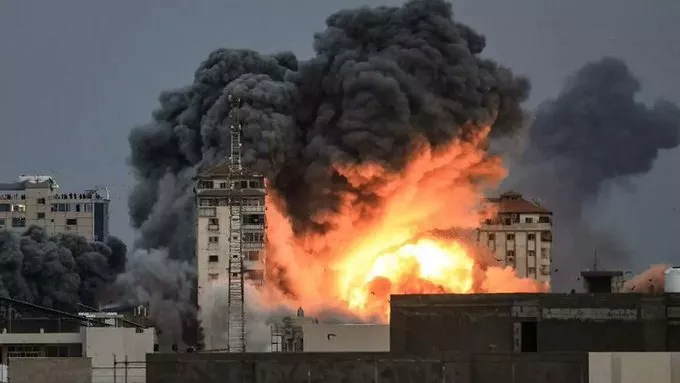
Of course, the worst segment of any Arab-Israeli war is collateral casualties and the use of weapons whose very goal is to cause as much collateral damage and casualties as possible. Through saturation, i.e., simultaneous attack from a large number of directions or firing points, the linearly deployed and carefully hidden batteries of 114mm Rajum multiple rocket launchers, each with 12 tubes, sowed death in all Israeli cities. There is also the significant question of the number of Iron Domes, i.e., the Iron Dome system, whose effectiveness was reduced yesterday due to a whole range of factors.
Namely, the Iron Dome is a computerized system in which the computer calculates the trajectories of fired artillery rockets and shells, assessing and providing the operator with the probability of a hit. If the system assesses that a rocket or shell is heading for the sea or the desert, it does not engage it. Usually, during mass attacks with MRLs that Hamas receives from Iran via Hezbollah, but also produces itself, over 30 percent of fired rockets end up in the sea or desert, and therefore the 85 percent accuracy norm of the Iron Dome can be met. However, yesterday, Hamas artillerymen were significantly more accurate because all targets were inside Israel, and the general impression is that significant preparations yielded results.
On the other hand, the IDF has the fastest mobilization system in the world, given that by evening, about 30 mixed brigades, along with 10 professional brigades and four reserve divisions, had been mobilized. Israel's defense system relies on a large recruitment pool of the population, including active and passive reserves and professional forces, and given that men serve a mandatory five-year military service and women three years, this recruitment pool is essentially the entire population.
During the afternoon, the IDF managed to localize the further advance of Hamas, but Hamas certainly has a major trump card up its sleeve: kidnapped civilians and IDF soldiers. Along with the inevitable IAF air show over Gaza, the clearing of Hamas strongholds lies ahead, while despite the approval of options, a ground invasion is still uncertain. Gaza is not Lebanon, and the situation in the IDF is not like in 2006; in fact, Israel is far from what it appears to be. The country is politically divided, as the return of Benjamin Netanyahu to the position of prime minister was not liked by many. The existing government is very shaky, given that Netanyahu, as a necessary evil, formed the government with the extreme right, which could politically disavow him if he does not respond radically enough to this attack.
On the other hand, the IDF is extremely ill-disposed towards the new government, which has significantly limited it through constitutional and reform programs, especially the reform of legislation. In such a divided country, with an opposition led by Yair Lapid and a whole range of internal challenges, Hamas tried to play its most expensive card with its brazenly fierce attack, which it undoubtedly neither planned nor carried out independently. Ultimately, this is not a war of the Palestinians, but a proxy war of Iran with Israel, which asymmetrically delivers blows given that Israel remains conventionally unreachable. In this and such an architecture of complex and fluid alliances characteristic of the regional security complex of the Middle East, Gaza will not disappear this time either, given that the uncontrolled chaos of the Middle East still has its controllers.
What is certain is that not everyone has thrown their cards into the game, given that Hezbollah is eager to enter this conflict, but without the blessing of Tehran, it cannot, given that Tehran also remembers how the Arab coalition fared in 1973 when it threw everything at Tel Aviv across the Golan and Sinai without reservation.
Deja vu over Palestine, again and again until further notice.
Komentari (0)
Prijavite se za komentiranje
PrijavaJos nema komentara. Budite prvi!
Minuta
Sve →Iz drugih kategorija

High Representative Not Elected: Germans, French and British Against Americans, New Attempt at End of June

ČOVIĆ WITHOUT MERCY: How Those Who Brought Ademović to Office Created a Political Hell for Him



Sunny Saturday, quite warm



Tragedy in Albanian resort: Two minors drown












