
By Armin Sijamić
Yesterday, Bosnia and Herzegovina was once again on the agenda of the United Nations General Assembly. This time, a resolution on the International Day of Reflection and Commemoration of the Genocide in Srebrenica in 1995 was adopted with 84 votes in favor, 19 against, 68 abstentions, and 22 did not vote.
Thanks to official Belgrade, the vote on the resolution calling for justice and reconciliation, remembrance and respect for the victims of genocide did not pass without tremors. Threats of conflict came from Belgrade and through its regional outposts. A good part of the public in the region also fell into collective euphoria, presenting yesterday's UN vote as a "vote on the Resolution on the Genocide in Srebrenica," and ultimately, after the vote, spreading the lie that most of the world does not recognize the genocide in Srebrenica.
This deception, which even some well-intentioned people fell for, is part of the propaganda war waged from the moment it became clear that the resolution would be voted on. Belgrade then presented the waiting for the session to be scheduled as a postponement of the vote, although it was something else – the UN Secretariat did not provide any other voting date except the one on which the vote took place.
Thus, propaganda from Belgrade tried to present yesterday's vote as a vote on whether genocide occurred in Srebrenica. But things are completely different. The United Nations and almost all member states have no doubts about whether there was genocide in Srebrenica, as, among others, the courts of that world organization have ruled. Because of these rulings, yesterday's vote was possible.
For, Against, Abstentions
The second issue the public dealt with was the outcome of the vote. Many were surprised by the number of abstentions or those who did not vote. Although this is not overly important for the final outcome of the vote, one should realistically assess today's world. Numerous wars and crises have divided the world, so it is not surprising that many countries do not support the West, which stood behind the resolution. Nineteen countries did not vote for various reasons, some because they lost their voting rights due to non-payment of membership fees.
Nevertheless, nationalist circles from Belgrade are celebrating such a result as a victory for the defenders of the achievements of convicted war criminals Radovan Karadžić and Ratko Mladić. The absurd "explanation" that Serbia won with a result of 84 for, 68 abstentions, and 19 against could be answered by the fact that 84 voted for, and 68 had no problem with the resolution being adopted.
After all, among those who abstained, there were many who said that genocide occurred in Srebrenica. What's more, among those who voted against were countries that sent their delegations to Potočari for the anniversaries of the genocide. A good portion of the abstentions had procedural objections. Some objected that the people of Gaza or Congo deserve a similar resolution, and that Western countries remain silent about it.
Essentially, disagreement with Western policy was hidden, the genocide in Srebrenica was not denied, the verdicts of international courts were not denied, nor was there a desire to harm Bosnia and Herzegovina, to whose sovereignty and territorial integrity everyone expressed support.
An exception, along with Serbia, was Russia, whose representative tried to question everything that came to his mind. But even that should not be surprising, considering that in the last two years, at the insistence of the West, the UN General Assembly has adopted several resolutions on Russian aggression against Ukraine, which Moscow calls a "special military operation," while accusing the West of waging war against Russia. Russia, according to many, was at the forefront of lobbying against yesterday's resolution.
In addition, some countries did not vote for the resolution out of fear that they themselves would be the subject of other resolutions, as they are involved in conflicts and wars in their own or neighboring countries. This could be the case with Israel, which did not vote.
The largest number of those who did not vote for the resolution did so in protest against the West and the United States, as many see Bosnia and Herzegovina as part of a world governed by the West. Thus, in almost every UN vote, Cuba, Grenada, Russia, North Korea, Belarus, Syria, China... will be against the West. In this vote, the list expanded to include those where Russia's and China's influence is growing, including Hungary, Mali, Serbia...
Also, there are probably states whose vote was somehow bought, which often happens in various UN votes. This primarily applies to small and poor countries.
A Divided World
For Bosnia and Herzegovina, besides the fact that the resolution was adopted, the most important thing is the support of most European Union and NATO countries, all former Yugoslav countries except Serbia, then Switzerland, Albania, Moldova, and Ukraine, the most powerful countries of the Islamic world (Indonesia, Turkey, Pakistan, Iran, Egypt, Saudi Arabia, Qatar, Malaysia...), the votes of the two most influential African countries (South Africa and Egypt) and those associated with Russia, such as Niger, Chad, or Senegal. Most African countries abstained, and only Eritrea, Comoros, Mali, Eswatini, and Congo voted against, with Congo's representative objecting to Rwanda, a sponsor of the resolution, being held responsible for crimes in his country.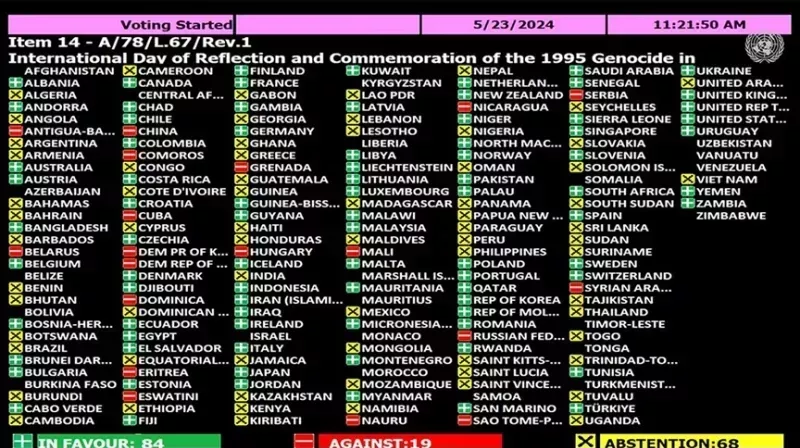 Results of the UN General Assembly vote
Former USSR member states in the Caucasus (Azerbaijan, Armenia, and Georgia) did not vote or abstained, as did Kazakhstan, Uzbekistan, Turkmenistan, Kyrgyzstan, and Tajikistan. In Asia, China voted against, India abstained, and Japan, South Korea, Singapore, and even Myanmar, which has strong ties with Beijing and is under Western sanctions, voted in favor. Thus, only Syria and China voted against.
In the Pacific and Oceania, Australia and New Zealand supported the resolution, while Nauru and Sao Tome and Principe voted against. Other countries voted in favor, abstained, or did not vote.
Russia and Serbia had their greatest success south of the US border. Antigua and Barbuda, Cuba, Dominica, Grenada, and Nicaragua voted against. Of the five most powerful Latin American countries (Brazil, Argentina, Mexico, Colombia, and Chile), the latter two were in favor of the resolution, while the others abstained. El Salvador, Guyana, Costa Rica, Ecuador, and Uruguay voted in favor. Other countries did not vote or abstained.
In yesterday's statements, the representatives of Mexico and Brazil did not dispute the genocide or the verdicts of international courts. They explained their positions by the lack of consensus in the Balkans, fear of conflict, procedural objections to the resolution sponsors, and other issues insisted upon by Russia and Serbia. The impression remains that more Latin American countries could have voted in favor if BiH had paid more attention to the part of the world that often rejects the pressure of great powers.
The Truth About the Aggression Against Bosnia and Herzegovina
Ultimately, yesterday's voting outcome is a defeat for Serbia, which failed to convince enough countries to vote against it. Russia and China also suffered a defeat, failing to convince even all BRICS members, the Shanghai Cooperation Organization, or the Collective Security Treaty Organization. Belgrade's loss of prestige will likely be charged in various ways. Let's recall when Russia thwarted a similar resolution proposed by the United Kingdom to the UN Security Council, Russian media wrote about the "price" Moscow paid, as official London would know how to return it.
With yesterday's vote, the UN General Assembly declared July 11th the International Day of Reflection and Commemoration of the Genocide in Srebrenica in 1995. Volker Türk, UN High Commissioner for Human Rights, welcomed the resolution as a "further recognition" for the victims and survivors and their pursuit of justice, truth, and guarantees of non-repetition. "The resolution is all the more important given the persistent revisionism, denial of the genocide in Srebrenica, and hate speech by high-level political leaders in Bosnia and Herzegovina, as well as in neighboring countries," he stated in a press release.
By adopting the resolution, BiH has gained an opportunity to inform the international public about the details of the aggression against our country and to expose the lies that Belgrade insists on, even at the cost of conflict. One of the main weapons used against Bosnia and Herzegovina for centuries is summarized in the words of George Orwell – "Who controls the past controls the future. Who controls the present controls the past." Belgrade lost that tool yesterday, at least when it comes to the genocide in Srebrenica.
Komentari (0)
Prijavite se za komentiranje
PrijavaJos nema komentara. Budite prvi!
Minuta
Sve →Iz drugih kategorija

High Representative Not Elected: Germans, French and British Against Americans, New Attempt at End of June

ČOVIĆ WITHOUT MERCY: How Those Who Brought Ademović to Office Created a Political Hell for Him



Sunny Saturday, quite warm



Tragedy in Albanian resort: Two minors drown












