
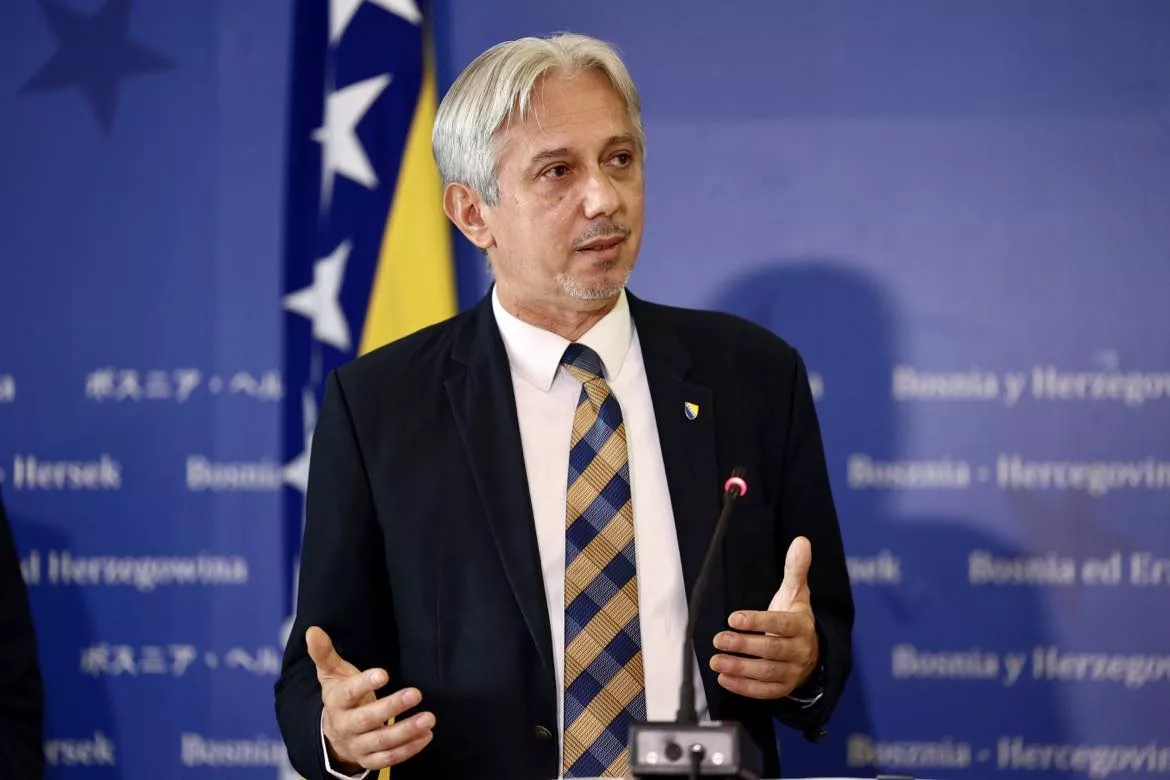
By: Prof. Dr. Hazim Bašić
Recently, a hearing was held before the European Court of Human Rights in Strasbourg before the Grand Chamber of this court in the case of Dr. Slaven Kovačević vs. Bosnia and Herzegovina. As is known, applicant Kovačević complained about the discriminatory provisions of the Constitution of Bosnia and Herzegovina, which prevent him from exercising his active right to vote, which the ECtHR easily established in its ruling from August last year.
In addition to Kovačević, the team fighting to uphold last year's ruling included Azra Zornić, who proved constitutional discrimination of her passive right to vote before the same court 10 years ago, as well as Joseph Marko, former judge of the Constitutional Court of BiH.
Bosnian David vs. Goliath
As many as 13 individuals, divided into three teams, were engaged in the task of overturning the ruling, presenting their views against the applicant's three-member group. The first, representing the state of Bosnia and Herzegovina and led by Monika Mijić, one of the agents of Bosnia and Herzegovina before this court, whose legality is questionable, as well as state and entity justice ministers.
This team is largely close to HDZ BiH. Next on the opposing side were representatives of the Republic of Croatia, whose payment of 100,000 EUR to the court, at a delicate moment, as alleged assistance to the court's work, has already been questioned in both moral and legal terms. Finally, as a 'third party' (and not as a friend of the court, as claimed by the OHR), the British lawyer Timothy Otty with two advisors also appeared.
He was engaged, exceeding the scope of his mandate, for reasons known to him, by the High Representative in BiH, with a suspicious appointment procedure (without the consent of the PIC Steering Board) and finally, at an unknown price and with suspicious financing. With such a setup in the courtroom, Slaven Kovačević's team entered into an unequal struggle comparable to David vs. Goliath.
The process lasted almost five hours, during which the three united teams received significantly more time for their presentations.
Human Rights Fighters and Their Arguments
The three teams advocating for the preservation of the discriminatory BiH Constitution were synchronized. However, their presentations used everything but strict legal argumentation. Arguments of a political, even daily political nature were presented, untruths were stated, as well as various, often nonsensical speculations.
Lawyer Timothy Otty, who, incidentally, as a member of the Venice Commission, is in a conflict of interest, spoke contrary to the opinion of the Commission of which he is a member, which long ago stated that ethnic representation is not a European democratic standard. Among other things, his argumentation can be reduced to the fact that, because Russia attacked Ukraine, the fight for human rights in Bosnia and Herzegovina should be stopped, which is infantile and unfounded.
In addition, Otty also uses Schmidt's well-known stance on the 'fragile and unstable political situation in BiH, which the confirmation of the ruling could worsen...' Neither Schmidt nor Otty answer the crucial question: who will cause new instabilities?
Will it be those who threaten secession and 'unrest in the south', or those who advocate for civil rights?
The agent of the Republic of Croatia first stated an untruth that her country is a guarantor of the Dayton Peace Agreement, and then made an arbitrary qualification that the S. Kovačević case is actually about 'achieving a certain political agenda'. Isn't her appearance in this court precisely the realization of the political agenda that Croatia is pursuing towards Bosnia and Herzegovina? This agent found herself in an unenviable position: how to prove that Slaven Kovačević (a Croat according to her assessment) is not actually endangered in the constitutional-legal system of BiH, while at the same time the spin from her country for years has been that Croats in BiH are endangered.
She also engaged in spinning visions of Bosnia and Herzegovina's development, imputing three different visions to various ethnic groups. This certainly does not fall under legal argumentation; it is more of an interference in the internal affairs of our country.
Bosnia and Herzegovina vs. Citizen Slaven Kovačević
The agent of Bosnia and Herzegovina, M. Mijić, was illegally appointed to this position because she is in the status of acting official for the seventh time, while the valid law allows only two repetitions of this status. She retained her status thanks to the support of a part of the politically short-sighted ruling coalition colloquially called the 'Trojka'.
It should also be noted that the appointment to such positions, according to the BiH Constitution, is made by the Presidency of BiH, so Mijić is actually an agent of the BiH Council of Ministers. The argumentation of the 'representative' of our country was based on undermining the credibility of applicant Kovačević.
She dealt with questioning his ethnic affiliation, which is one of the identities that falls within the scope of privacy (it can even be changed according to political needs) and which is completely irrelevant in the context of this case. She even stated that Kovačević is 'only slightly discriminated against' because he has influence on the election of as many as two members of the BiH Presidency, while citizens of Republika Srpska do not have such influence as voters in elections.
The Bosnian agent was very brave and equally audacious when, before the court that has 'human rights' in its name, she stated that there are so few citizens in BiH whom the BiH Constitution offensively labels as 'others' that they don't actually need human rights.
An argument (confession) of the type 'we are all discriminated against' (perhaps suggesting that it should remain that way) was also heard, as well as the insinuation that Slaven is doing all this for fame!
The Overthrow of the Little Chamber's Judgment Began from the Day It Was Rendered
By submitting her report to the UN Security Council in November last year, the High Representative had already problematized this ruling. He has, therefore, been instrumentalized for the overthrow of this ruling for more than a year.
The argumentation that the High Representative presented then was repeated before the Grand Chamber of the Court by his personal lawyer, Timothy Otty, for a high fee.
With its attitude and engagement towards the ruling in the S. Kovačević case, HDZ BiH has taken primacy from SNSD in pursuing anti-Western policy and abandoning European values. The long-standing advocacy of this political party for the introduction of new electoral units (virtual electoral unit, one-day electoral unit, floating cantons, ...) indicates that their vital interest is the overthrow of the ruling in the Kovačević case. Contrary to this, last year's ruling of the Little Chamber proposes as a solution for the abolition of discrimination that BiH be a single electoral unit for the election of members of the Presidency and the House of Peoples of BiH.
The Ruling in the Case Kovačević vs. Bosnia and Herzegovina is Paradigmatic
The decision of the Grand Chamber of the ECtHR in the S. Kovačević case will be historic, whatever it may be. If it is overthrown, the path of Bosnia and Herzegovina to the EU will be forever closed. At the same time, as Kovačević correctly noted, it opens the way for the introduction of this practice (ethnic representation) in other countries: Montenegro, Kosovo, Croatia, Macedonia, Serbia, ... By abandoning its initial stance, the ECtHR would abandon fundamental European values and, in the process, confirm ethnic cleansing as a legitimate act.
If the ruling of the Little Chamber is confirmed, this ruling would become a key argument in which direction the constitutional changes that BiH expects in the process of its integration into the EU should go. It is certain that the fight for constitutional changes in this regard will be multi-decadal. The value of all ECtHR rulings, and especially the ruling in the S. Kovačević case, for the future democratic development of our country is immeasurable.
Their final implementation would at least partially remedy the results of the double aggression against Bosnia and Herzegovina. The international community must finally acknowledge the fact that the citizens of Bosnia and Herzegovina are not asking for anything that does not belong to them and that has not been judicially proven as their right. The fight for the execution of these rulings is a fight for civilizational values.
Komentari (0)
Prijavite se za komentiranje
PrijavaJos nema komentara. Budite prvi!
Minuta
Sve →Iz drugih kategorija

High Representative Not Elected: Germans, French and British Against Americans, New Attempt at End of June

ČOVIĆ WITHOUT MERCY: How Those Who Brought Ademović to Office Created a Political Hell for Him



Sunny Saturday, quite warm



Tragedy in Albanian resort: Two minors drown












