
By Armin Sijamić
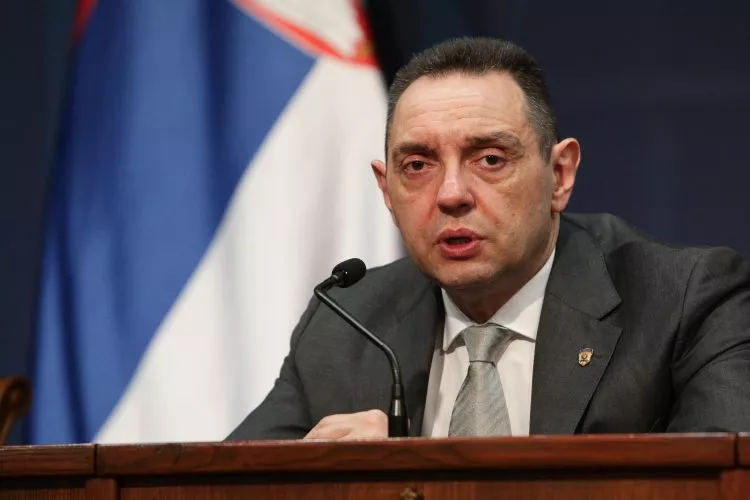
A little over ten days ago, the United States Department of the Treasury imposed sanctions on the director of the Serbian intelligence service, Aleksandar Vulin. The sanctions come at a time when regional crises, directly or indirectly linked to official Belgrade, are escalating and threatening to dismantle everything Washington has built in this part of the world over the past decades.
The imposition of sanctions on Vulin, as the head of the intelligence service (BIA) and previously minister of police and minister of defense, is not an ordinary decision. Such treatment of an important figure within a country that the West is trying to win over shows how far things have gone.
Vulin is not just another technocrat or one of countless short-lived politicians. Vulin is, above all, a man close to Serbian President Aleksandar Vučić. Vulin's party, the Movement of Socialists, is not a significant factor in Serbian political life. The support it enjoys among the people is negligible, and few could name more than two of its members. If you visit the party's website, you will find no names of people in its governing bodies, and its Facebook page has not had a post in over four years. Yet, a cadre from this party holds positions directly related to Serbia's security. Therefore, Vulin owes his status on the political scene to Vučić, with whose party he runs in elections on a joint list.
The justification states that Vulin is being sanctioned for his involvement in illegal arms trafficking, drug trafficking, undermining effective and democratic governance in the Western Balkans, corruption, and aiding Russian activities. To reiterate, Vulin has been the director of the intelligence service, former minister of police, and minister of the army for the past six years. Previously, he served as minister of social affairs and director of the Office for Kosovo, starting in 2012.
Vučić's Response
Washington's decision to sanction Vulin is bad news for Vučić. In his characteristic manner, he commented on the decision, asking the United States to provide him with evidence so that Serbia could prosecute Vulin, stating that Vulin was guilty because he refused to impose sanctions on Russia. If anyone in Washington were inclined to such a stance, the Serbian president would be asked which institution to provide the evidence to, if not one directly connected to Vulin and Vučić.
The American ambassador in Belgrade, Christopher Hill, stated that the sanctions on Vulin are not sanctions on Serbia and that his country wants cooperation with Belgrade. However, regardless of Ambassador Hill's goodwill, this decision is a verdict on a policy, as it is difficult to believe that one person could be involved in arms and drug trafficking, undermining institutions, crime, and serving Russian interests without being noticed, while holding important positions. Otherwise, the American services fabricated the accusations against Vulin. If the American claims are true, then it is clear that Vulin was not alone and that his positions served to facilitate the "business."
Many have called for Vulin's resignation and dismissal in Serbia. Whether this will happen is unclear for now, but it should be kept in mind that Vulin's removal could be presented as Serbia's distancing from Russia and its move closer to the West. If Belgrade had desired good and equal relations with the countries in the region, Vulin would not have been given the opportunity to lead the country's security apparatus.
Regional Implications
The political fate of Vulin is less important for Bosnia and Herzegovina and other Balkan countries. What is important is whether the reckoning with Vulin also means a reckoning with the policy he represents. Vulin is an advocate of the "Serbian world," which Serbian nationalists have interpreted as a consolation prize for the militarily and politically defeated "Greater Serbia" of the 1990s. Although the "Serbian world" is a deception even to Serbian nationalists, as no one prevents Serbs from being Serbs and cherishing their traditions, this concept has unsettled the region and deepened crises.
The reconciliation in the region, advocated by politicians from all countries, including Serbia, and supported by the West, has been fading in recent years. The resurgence of aggressive nationalism is a result of the West, particularly Washington and the European Union, and Germany under Angela Merkel, giving in to Vučić, believing he had "changed." This approach helped establish a consensus in the region that a few leaders would maintain peace. If we go back to the time when Boris Tadić governed Serbia, the issue was not how to prevent war, but how to accelerate the path towards Euro-Atlantic integration.
After more than a decade of ruling Serbia, Vučić's policy has revived old fears in the region, transforming him into a supposed peacemaker whom Serbian politicians consult. Vučić's conciliatory rhetoric has not been matched by actions. All the kind words he has spoken have been nullified in practice by the actions of those who see him as the protector of Serbian national interests. All those who reject the region's Euro-Atlantic path, who do not want peace and dig into the wounds of other nations, who do not recognize the verdicts of international courts that citizens of Serbia must accept according to domestic law, those who threaten to dismantle states, those who seek conflicts, and many others, have not been reprimanded, let alone punished, by Vučić's Serbia. Some have been rewarded, and many have been helped.
The Real Damage
Many have warned about this, but the West has remained blind, deaf, and mute. Due to the internal differences among Western countries, the Balkans have become a worse place than it was fifteen years ago. Those who would quantitatively measure this assessment should start with the number of people who have left this part of the world since then. Those who would qualitatively assess it should ask themselves if the judiciary is more effective now or fifteen or twenty years ago. In the economy, how many large domestic production companies have emerged, and how many have disappeared or been sold to foreigners?
In response to these questions, we have received "alternative solutions." Open Balkan has emerged, agreements between peoples led by almighty leaders, Western sanctions that do not hit their targets, protests based on religious and ethnic grounds, constitutional crises resolved by "de-escalation," calls for more international troops in BiH and Kosovo, and even ideas about sending troops to NATO member Montenegro. Great-power projects have been revived and are becoming increasingly acceptable to those tired of the situation in this part of the world.
In all this noise, contact with reality is lost. And that reality is devastating for many in this part of the world, including for great-power projects. For example, the noise is meant to hide the fact that the Greater Serbian project is weaker today than thirty years ago. There is less money, fewer people, and fewer influential friends supporting it. Official Belgrade wants to hide this, which is particularly evident since the beginning of the Russian aggression against Ukraine. Vučić refused to comment on it, and then called early elections, hoping the war would end quickly. Then, Belgrade's great-power project manifested as a series of crises in the region because it had to be expressed when it could not be hidden and wait for a better opportunity. Thus, the West was told that if Belgrade's interests are not considered, then escalations of crises are possible, and some peoples and states have been turned into hostages dependent on those who cause crises and the West's willingness to appease them. American sanctions on Vulin have exposed this weakness of Belgrade. Washington has finally told Belgrade that the European path means following Brussels.
Finally, let's consider the recent celebration of Dragoljub Draža Mihailović, an associate of Nazis and fascists, while the same actors commemorate the crimes in Jasenovac. Chetnik units captured Serbian refugees and handed them over to the Ustaše, leading many of those people to end up in Jasenovac. Connecting partisans, victims of Jasenovac, and Chetniks into a single policy speaks of the desperation of that policy. That desperation grows when they include Russia, which is "denazifying" Ukraine, in that narrative. It is not difficult to imagine what Russia would do to proven collaborators of Nazis and fascists if it had the opportunity. After World War II, the Chetniks did not flee to Russia but to the West. The fact that official Moscow has not distanced itself from them since the breakup of Yugoslavia speaks to Russia's influence in this part of the world, as it cannot find others to serve its interests.
American sanctions on Vulin also show how far Moscow is from the region, and how close the West is. Therefore, the responsibility for the situation in this part of the world lies with the West, which has been given more opportunities over the years to finally break the great-power projects. Proponents of great-power policies should not have interlocutors in the West under these circumstances. Otherwise, in a decade, someone will accurately state that the current situation is better than what they found then.
Komentari (0)
Prijavite se za komentiranje
PrijavaJos nema komentara. Budite prvi!
Minuta
Sve →Iz drugih kategorija

High Representative Not Elected: Germans, French and British Sabotaged Americans, New Attempt at End of June

ČOVIĆ WITHOUT MERCY: How Those Who Brought Ademović to Office Created a Political Hell for Him



Sunny Saturday, quite warm



Tragedy in Albanian resort: Two minors drown












